
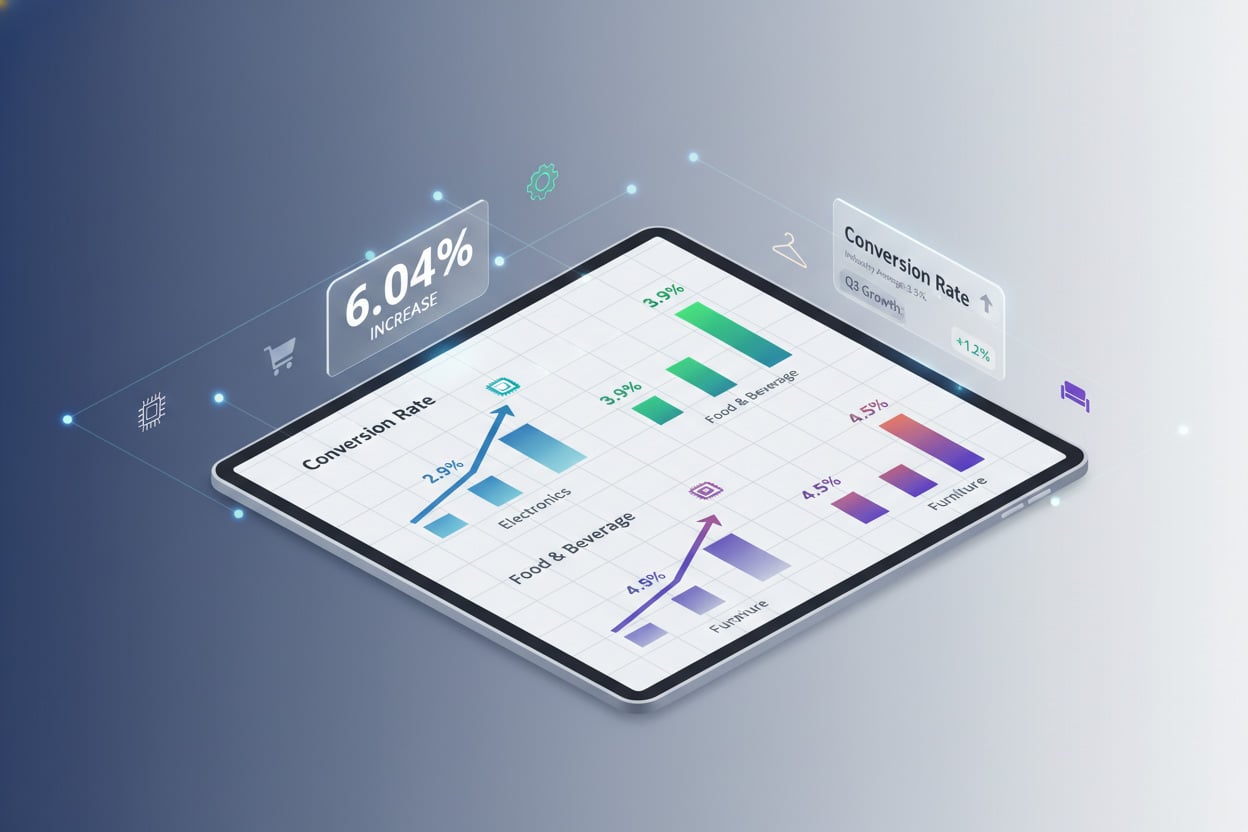

Over the past year, our research team at Atwix compiled conversion rate data across 14 major eCommerce industries, analyzing over 100 million data points from businesses ranging from B2C retail to complex B2B distribution. This report aggregates findings from Dynamic Yield, IRP Commerce, Ruler Analytics, and proprietary client data to deliver accurate benchmarks for the average eCommerce conversion rate by industry.
Understanding the average eCommerce conversion rate by industry is crucial for benchmarking performance and identifying opportunities for optimization. While overall eCommerce conversion rates globally range from 2% to 4%, significant variations exist, with food and beverage leading at 6.04% and B2B manufacturing at 1.8%. These disparities stem from differences in purchase complexity, average order value, customer type, and sales cycle length.
Industry Conversion Rate Benchmarks
Table 1: Average eCommerce Conversion Rate by Industry
| Industry | Overall Rate | Desktop | Mobile | Key Factors |
|---|---|---|---|---|
| Food & Beverage | 6.0% | 6.8% | 5.4% | High frequency, subscriptions |
| Health & Beauty | 4.55% | 5.2% | 3.9% | Repeat purchases, personalization |
| B2B eCommerce | 3.9% | 4.6% | 3.2% | Account management, custom pricing |
| Fashion & Apparel | 3.01% | 3.7% | 2.8% | Visual appeal, seasonal promotions |
| Overall Average | 2.9% | 3.2% | 2.8% | Baseline across sectors |
| Electronics | 2.3% | 2.9% | 1.8% | High consideration, price comparison |
| B2B Manufacturing | 1.8% | 2.1% | 1.5% | Complex approvals, custom specs |
| Home & Furniture | 1.24% | 1.6% | 0.9% | High-ticket, delivery concerns |
Key Findings: Desktop conversion rates outperform mobile by 14-40% despite mobile generating 70-75% of traffic. B2B sectors show lower conversion rates but significantly higher average order values (5-10x B2C). November-December shows 18-25% higher rates due to holiday promotions.
Factors Driving Industry Differences
The average eCommerce conversion rate by industry varies due to fundamental differences in customer behavior and business models:
B2B vs. B2C Dynamics: B2B transactions involve 6-10 decision-makers, approval workflows, extended sales cycles (weeks to months), and custom pricing negotiations. B2C features single decision-makers and simplified checkouts. Despite lower conversion rates, B2B companies that implement account hierarchies and approval workflows see a 43% increase in conversions within six months.
Purchase Complexity: Low-complexity products (such as food and beauty) enable quick decisions and frequent repurchases. High-complexity products (such as electronics and manufacturing equipment) require extensive research, specification comparisons, and often physical inspection.
Customer Type: Consumer buyers seek convenience and emotional connection. Business buyers prioritize total cost of ownership and ROI documentation. Ruler Analytics shows that B2B services achieve a 3.4% paid search conversion rate, compared to 0.9% for B2C.
Industry-Specific Optimization Strategies
Manufacturing & Distribution Tactics
Current Challenge: B2B manufacturing achieves an average conversion rate of only 1.8% due to complex catalogs and multi-stakeholder approvals.
Optimization Strategies:
- AI-Powered Search: Filter by technical specifications. Atwix client Reinders achieved 230% sales growth after deploying intelligent search
- Custom Pricing Display: Show pre-negotiated pricing upon login, eliminating quote requests for routine reorders
- Bulk Order Workflows: Enable CSV upload of part numbers for procurement managers
- Approval Automation: Configure workflows with budget thresholds for automatic routing
Retail & Consumer Goods Optimization
Mobile-First Priorities (Fashion at 3.01% overall, 2.8% mobile):
- Shoppable Instagram feeds and AR try-on experiences
- One-click checkout via Shop Pay, Apple Pay, or Google Pay
- Progressive Web Apps delivering app-like performance
- AI product recommendations are increasing cross-sell by 23-35%
Beauty & Health Drivers: Subscription models (7.28% conversion for back-in-stock emails), personalized quizzes (5 questions maximum), and AI virtual try-ons.
Technical Implementation by Platform
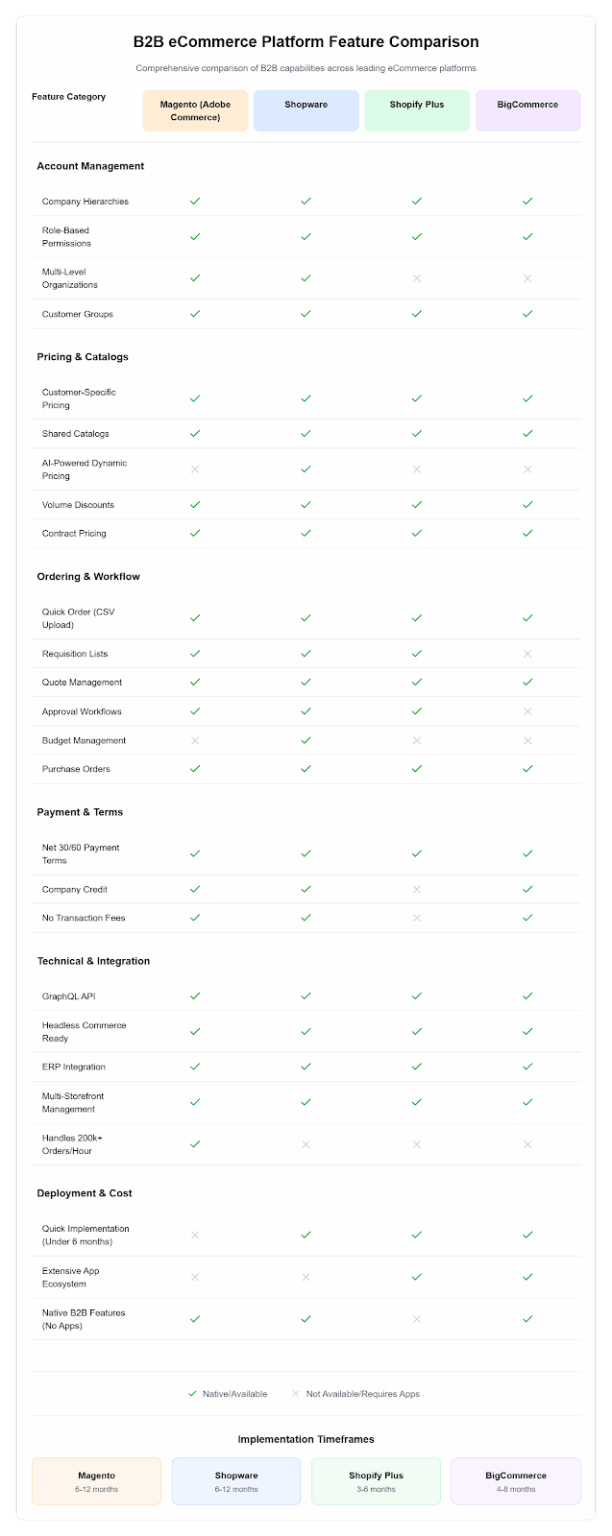
Table 2: B2B Platform Comparison
| Platform | Best For | Key B2B Advantages | Implementation Time |
|---|---|---|---|
| Magento (Adobe Commerce) | Large enterprise | Company hierarchies, 200K+ orders/hour | 6-12 months |
| Shopify Plus | Rapid deployment | 8,000+ app ecosystem, quick launch | 3-6 months |
| Shopware | European mid-market | Built-in AI pricing, GDPR compliance | 6-12 months |
| BigCommerce | Multi-storefront | No transaction fees, native B2B | 4-8 months |
Magento B2B Features: Company hierarchies with role-based permissions, shared customer-specific catalogs, bulk quick order via CSV, requisition lists for one-click reordering, and quote negotiation workflows.
Shopware B2B: AI-powered dynamic pricing, modular components (activate only needed features), team-based budget management with automatic approval routing.
Shopify Plus B2B: Company-specific payment terms (Net 30/60), unlimited customer price lists, bulk order forms, and native multi-currency support.
BigCommerce B2B: Zero transaction fees (vs. Shopify’s 0.5-2%), native customer groups with specific pricing, multi-storefront management, and headless-ready architecture.
Timeline Expectation for Results
Quick Wins (0-3 Months): Mobile checkout optimization, site speed improvements, trust signals. Expected impact: 8-15% increase.
Medium-Term (3-6 Months): Personalization engines, customer-specific pricing for B2B, enhanced site search. Expected impact: 25-43% increase.
Long-Term (6-12 Months): Platform migration, AI-powered automation, omnichannel ERP integration. Expected impact: 100-400% increase.
Atwix’s client, Coastal Business Supplies, experienced dramatic conversion improvements within 8 months of their Magento rebuild.
The average eCommerce conversion rate by industry provides essential benchmarking, but optimization must account for your business model, customer type, and platform capabilities. B2B companies should focus on reducing multi-stakeholder friction, implementing customer-specific pricing, and optimizing repeat purchase patterns. Companies implementing platform-appropriate B2B features alongside mobile-first design consistently achieve rates 2 – 3x above industry averages.
How We Benchmark: Methodology Transparency
It’s important to acknowledge that conversion rate measurement varies significantly across organizations. Different analytics tools (Google Analytics, Adobe Analytics, platform-native analytics), attribution models (last-click, multi-touch, data-driven), and calculation methodologies produce different results.
Common Benchmarking Variations:
- Session-based vs. visitor-based calculations: Session-based typically shows higher rates
- Tool accuracy: Google Analytics 4 vs. GA Universal vs. platform analytics often report different conversion counts
- Conversion definition: Some count completed purchases only; others include quote requests, form fills, or phone calls
- Traffic inclusion: Whether to include bot traffic, internal traffic, or return visits affects baselines
Our Methodology for This Report: We’ve aggregated data from third-party benchmarking studies (Dynamic Yield’s 200M+ monthly user dataset, IRP Commerce industry reports, Ruler Analytics cross-industry analysis) that use session-based conversion calculations with completed purchase transactions as the conversion event. This approach provides the most conservative, apples-to-apples comparison across industries. Your individual results may vary based on your analytics configuration, but these benchmarks provide directional guidance for performance assessment.
Requesting a Conversion Rate Audit
Atwix specializes in B2B eCommerce optimization across Adobe Commerce, Shopware, BigCommerce, and Shopify Plus. Our 300+ certified professionals have delivered an average 230% revenue growth for manufacturing and distribution clients through systematic conversion optimization strategies tailored to the average eCommerce conversion rate by industry benchmarks.
Whether you’re performing below the average benchmarks for your sector or looking to achieve rates 2-3x above your industry baseline, our team can identify platform-specific opportunities and B2B workflow improvements that drive measurable results.
Reach out to Atwix here to request a conversion rate audit or learn more about our B2B optimization services.