

Choosing between a pre-built B2B eCommerce platform and custom B2B eCommerce solutions represents one of the most critical technology decisions your organization will make. For CTOs and VPs evaluating their options, the stakes are high: the wrong choice can result in millions of dollars in lost revenue, operational inefficiencies, and a total cost of ownership that spirals beyond initial projections.
This guide provides a comprehensive analysis of leading B2B eCommerce platforms, including Adobe Commerce, Shopify Plus, Shopware, and BigCommerce, and compares them to custom-built solutions. More importantly, it provides a decision framework to determine which approach aligns with your specific business requirements, from ERP integration capabilities to industry-specific needs in manufacturing, distribution, and wholesale sectors.
What you’ll discover:
- Platform comparison matrix with pricing, features, and integration capabilities
- Custom vs platform decision framework based on business complexity
- Industry-specific recommendations for manufacturing, distribution, and wholesale
- Real-world results from PowerPak and Byrne Electrical implementations
- ERP, CRM, and WMS integration requirements and capabilities
- Total cost of ownership analysis, including hidden costs
Understanding the B2B eCommerce Platform Landscape
The B2B eCommerce market has matured significantly, with platforms now offering sophisticated features once only available through custom development. However, the gap between off-the-shelf capabilities and complex business requirements remains substantial for many organizations.
Modern B2B buyers expect B2C-like experiences: intuitive interfaces, real-time inventory visibility, personalized pricing, and seamless ordering processes. Yet B2B transactions involve complexities that consumer platforms never encounter, such as multi-tier approval workflows, customer-specific catalogs, complex pricing matrices, and deep integration with enterprise resource planning systems.
The fundamental question isn’t whether platforms have improved, but whether they’ve improved enough to handle your specific operational complexity.
Platform Comparison Matrix: Top Custom B2B eCommerce Solutions
Before diving into decision frameworks, let’s examine the leading platforms and custom B2B eCommerce solutions side by side. This comparison focuses on factors most critical to CTOs and VPs: total cost of ownership, scalability, integration capabilities, and implementation timelines.
| Adobe Commerce | Shopify Plus | Shopware | BigCommerce | Custom Solution | |
|---|---|---|---|---|---|
| Starting Price | $22,000 – $125,000/year | $2,300 – $40,000/month | $600 – $6,500/month | $975 – $custom/month | $150,000 – $500,000 |
| Implementation Time | 4-8 months | 2-4 months | 3-6 months | 2-5 months | 6-18 months |
| Best For | Enterprise with complex catalogs | Rapid deployment, growth-stage | European markets, modular needs | Multi-channel selling | Unique workflows, competitive advantage |
| ERP Integration | Native connectors + custom | App ecosystem + APIs | API-first architecture | Built-in + marketplace apps | Full tailored |
| Scalability Rating | Excellent (handles millions of SKUs) | Very Good (transaction-based pricing at scale) | Very Good | Good (annual GMV limits apply) | Excellent (purpose-built) |
| Key Limitation | High development costs | Limited customization depth | Smaller developer community | Customization constraints | Long development cycles |
Here is a detailed description of each of these platforms. To jump straight to the decision matrix, click here.
Adobe Commerce (Magento): The Enterprise Standard
Adobe Commerce dominates the enterprise B2B space with sophisticated capabilities: customer-specific catalogs, negotiated pricing, quote management, and approval workflows. The platform’s native B2B module, proven scalability (supporting millions of SKUs), and extensive customization options make it ideal for complex requirements. However, expect significant investment: $22,000-$125,000 annually in licensing, $75,000-$300,000 in implementation, and 15-20% of implementation cost for annual maintenance.
Adobe Commerce offers robust APIs and pre-built connectors for major ERP systems, including SAP, Oracle NetSuite, Microsoft Dynamics, and Epicor.
Shopify Plus: Speed to Market Leader
Shopify Plus excels at rapid deployment (typically 60-90 days) with intuitive interfaces and automatic updates. Pricing starts at $2,300 monthly but increases to 0.25% of GMV at high volumes. Transaction fees (ranging from 0.15% to 0.25% on third-party gateways) and app costs (ranging from $500 to $3,000 monthly) add up. Implementation typically costs between $30,000 and $150,000.
The API-first architecture supports integrations, though ERP connections typically require middleware solutions. Best for standard B2B patterns with rapid time-to-market requirements.
Shopware: The Modular Contender
Shopware’s composable architecture and strong European market presence offer flexibility at competitive pricing: $600 (Rise), $2,400 (Evolve), or $6,500 monthly (Beyond). Implementation costs range from $50,000 to $200,000. The platform’s REST API provides a solid foundation for integration, although a smaller developer ecosystem may increase costs or timelines for specialized work.
BigCommerce: The Multi-Channel Specialist
BigCommerce positions itself for omnichannel selling with no transaction fees and flexible pricing ($975-$5,000+ monthly). Implementation costs range from $40,000 to $180,000. The platform offers strong marketplace integrations but requires third-party middleware for complex ERP scenarios. Best for businesses prioritizing multi-channel capabilities with moderate B2B complexity.
The Custom vs Platform Decision Framework
The choice between platform and custom development isn’t binary; it exists on a spectrum. Most organizations achieve success with a hybrid approach, leveraging platform foundations while customizing key differentiators.
Platform Only vs. Hybrid vs. Custom Only: Complete Comparison
| Pros | Cons | |
|---|---|---|
| Platform Only | • Fastest time to market • Lower upfront investment • Proven, tested functionality • Automatic updates & security patches • Large support community • Predictable costs | • Limited customization depth • Potential feature constraints • Ongoing licensing costs • May require workarounds • Platform limitations on scaling • Vendor dependency |
| Hybrid Approach | • Balance of speed and customization • Leverage proven core features • Customize competitive differentiators • Easier upgrades than full custom • Flexibility where it matters most • Moderate timeline | • More complex than a pure platform • Requires careful planning • Custom code maintenance needed • Potential upgrade complications • Higher costs than platform-only • Needs an experienced partner |
| Custom Only | • Unlimited customization • Perfect fit for unique workflows • Competitive advantage through tech • No platform licensing fees • Complete control over features • Optimized integrations | • Highest upfront costs • Longest development time • Ongoing maintenance burden • You own all technical debt • No proven functionality • Requires a large dev team |
When Platforms Are Sufficient
Pre-built platforms work exceptionally well when your business aligns with these criteria:
Standard B2B Workflows: If your sales process mirrors common B2B patterns, including customer accounts, basic pricing tiers, approval workflows, and quote requests, platforms can deliver these capabilities without custom development.
Time-Sensitive Market Entry: When competitive pressure demands rapid deployment, platforms offer pre-tested functionality that drastically reduces time to market. PowerPak, a leading supplier of safety equipment, needed to address same-day delivery challenges quickly. Atwix optimized their existing Magento platform rather than rebuilding, achieving a 230% eCommerce growth in just three months while reducing cost per order by 6%.
Limited IT Resources: Organizations without dedicated development teams benefit from platforms’ managed infrastructure, automatic updates, and ecosystem support.
Predictable Scalability Needs: If your growth trajectory follows predictable patterns and doesn’t require fundamentally new capabilities, platforms scale effectively within their architectural constraints.
When Custom Development Makes Sense
Custom B2B eCommerce solutions become the right choice when business requirements diverge significantly from platform capabilities:
Proprietary Business Logic: Complex configuration rules, custom pricing algorithms, or unique fulfillment workflows often exceed platform capabilities.
Competitive Differentiation Through Technology: When eCommerce itself provides a competitive advantage through unique experiences or proprietary tools, custom development protects that differentiation.
Extreme Integration Requirements: Deep integration with legacy ERP systems, custom WMS, or proprietary platforms may incur excessive middleware costs.
Complex Multi-Entity Operations: Organizations with multiple legal entities, each with distinct catalogs and workflows, may exceed platform capabilities.
The Hybrid Approach
Byrne Electrical exemplifies this approach. Facing aging technology limitations, they selected Adobe Commerce with Atwix as implementation partner, balancing out-of-the-box capabilities with targeted customization. The result: a complete B2B portal with ERP integration deployed in eight weeks.
George Fabis, Director of IT at Byrne, explains: “We wanted to empower our B2B customers by making the order process simpler. We also wanted to empower our extremely knowledgeable salespeople and help them be order makers, not just order takers.”
Industry-Specific Recommendations
Different B2B sectors face distinct challenges that influence platform selection. Let’s examine recommendations for the three primary B2B segments.
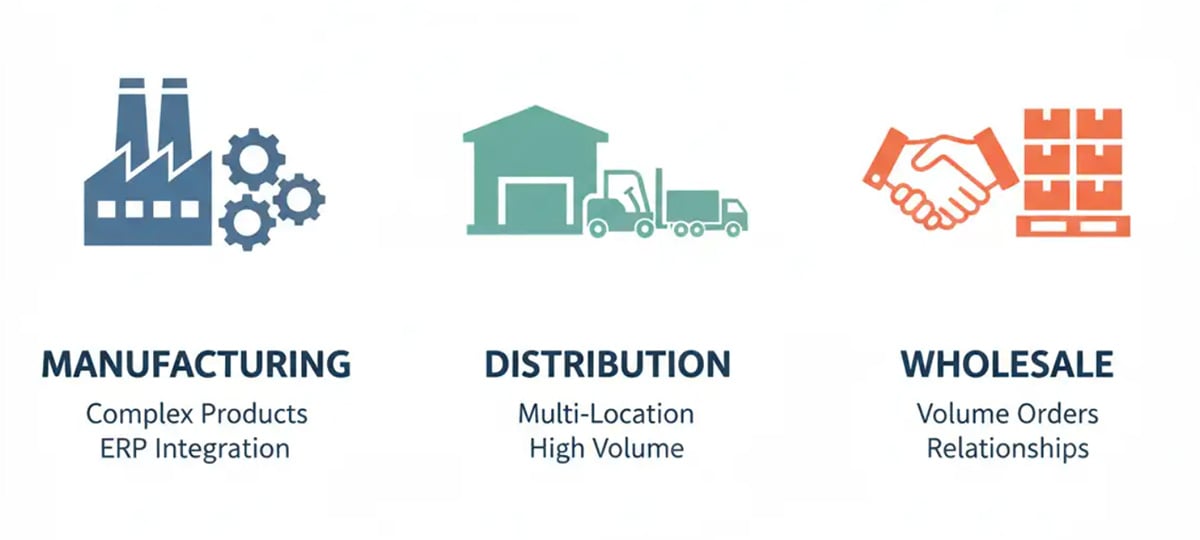
Manufacturing: Complex Products and Deep ERP Integration
Primary Challenges: Products with thousands of configurable options, real-time inventory across multiple facilities, complex pricing, and deep ERP/MRP integration.
Recommendations: Adobe Commerce leads for manufacturers with complex products and established IT teams. Custom B2B eCommerce solutions become necessary when product configuration exceeds the platform’s capabilities or when a competitive advantage depends on proprietary tools. Hybrid approaches work well, as they implement Adobe Commerce for core functionality while custom-developing specific modules, such as product configurators or CAD integration.
Distribution: Inventory Complexity and Customer Segmentation
Primary Challenges: Multi-location inventory, deep customer hierarchies, customer-specific pricing, multiple fulfillment options, and high-volume repeat orders.
Recommendations: Shopify Plus works well for straightforward catalogs and standard hierarchies. Adobe Commerce better serves the needs of businesses with extreme inventory complexity. BigCommerce offers a middle ground for multi-channel distributors.
PowerPak demonstrates distribution-specific requirements. Their same-day delivery commitment required the immediate transmission of orders to warehouse systems. Their optimized Magento platform was tightly integrated with warehouse operations, enabling 230% growth and a 89% increase in customer retention.
Wholesale: Volume Transactions and Relationship Management
Primary Challenges: High-volume transactions with approval chains, customer-specific catalogs, negotiated pricing, split billing, and sales rep management.
Recommendations: Adobe Commerce excels with sophisticated account management and quote workflows. Shopify Plus serves wholesalers transitioning to digital. Custom development may be necessary for deeply embedded sales processes or proprietary workflows.
Integration Capabilities: The Critical Connection
For B2B organizations, eCommerce is just one component in a complex ecosystem. Integration capabilities often determine success more than platform features.
ERP Integration
ERP integration synchronizes products, inventory, pricing, customers, and orders across the entire system. Adobe Commerce offers pre-built connectors for major systems (SAP, Oracle, Microsoft Dynamics) and robust APIs for legacy systems. Shopify Plus often requires middleware platforms (Celigo, Jitterbit) for complex scenarios. Custom solutions enable direct database integration without the need for middleware overhead.
CRM and WMS Integration
B2B organizations rely on CRM systems for managing customer relationships and WMS for order fulfillment. Key requirements include bidirectional data synchronization, sales rep tracking, and real-time inventory visibility. Both Adobe Commerce and Shopify Plus offer integration options with major platforms, though complexity varies.
Total Cost of Ownership Analysis
Published pricing rarely reflects true costs. The total cost includes licensing, implementation, integration, customization, maintenance, and any hidden fees.
Year One Cost Comparison
| Cost Category | Adobe Commerce | Shopify Plus | Shopware | BigCommerce | Custom Solution |
|---|---|---|---|---|---|
| Platform Licensing | $22,000 – $125,000 | $27,600 – $30,000 | $7,200 – $78,000 | $11,700 – $custom | $0 |
| Implementation | $75,000 – $300,000 | $30,000 – $150,000 | $50,000 – $200,000 | $40,000 – $180,000 | $150,000 – $500,000 |
| ERP Integration | $25,000 – $100,000 | $30,000 – $120,000 | $35,000 – $125,000 | $30,000 – $100,000 | Included in build |
| Customization | $15,000 – $75,000 | $10,000 – $50,000 | $20,000 – $80,000 | $15,000 – $60,000 | Included in build |
| Training | $5,000 – $15,000 | $2,000 – $8,000 | $4,000 – $12,000 | $3,000 – $10,000 | $10,000 – $25,000 |
| First Year Total | $142,000 – $615,000 | $99,600 – $358,000 | $116,200 – $495,000 | $99,700 – $350,000 | $160,000 – $525,000 |
Ongoing Annual Costs (Years 2-5)
| Cost Category | Adobe Commerce | Shopify Plus | Shopware | BigCommerce | Custom Solution |
|---|---|---|---|---|---|
| Platform Fees | $22,000 – $125,000 | $27,600 – $48,000+ | $7,200 – $78,000 | $11,700 – $60,000 | $15,000 – $40,000 (hosting) |
| Maintenance | $20,000 – $50,000 | $0 (included) | $15,000 – $40,000 | $0 – $15,000 | $40,000 – $100,000 |
| Updates/ Upgrades | $10,000 – $40,000 | $0 (automatic) | $8,000 – $30,000 | $5,000 – $20,000 | $25,000 – $75,000 |
| Apps/ Extensions | $2,400 – $12,000 | $6,000 – $36,000 | $3,600 – $18,000 | $3,600 – $18,000 | $0 |
| Annual Total | $54,400 – $227,000 | $33,600 – $84,000 | $33,800 – $166,000 | $20,300 – $113,000 | $80,000 – $215,000 |
Five-Year Total Cost of Ownership
For a mid-market B2B company ($20 million online revenue):
- Adobe Commerce: $360,000-$1,523,000
- Shopify Plus: $234,000-$694,000
- Shopware: $251,000-$1,159,000
- BigCommerce: $181,000-$802,000
- Custom Solution: $480,000-$1,385,000
Hidden Costs to Consider
Transaction Fees: Shopify Plus charges 0.15-0.25% on third-party gateways, which amounts to $15,000-$25,000 annually at a $10M revenue level.
Upgrade Costs: Adobe Commerce and Shopware require periodic upgrades ($20,000-$75,000 every 18-24 months).
Middleware: Shopify Plus and BigCommerce often require integration middleware ($1,500-$5,000 monthly).
Agency Dependency: Budget $5,000-$15,000 monthly for retained development across all platforms.
Real-World Results: Case Study Insights
PowerPak: 230% Growth Through Platform Optimization

PowerPak faced a critical challenge: their outdated Magento platform couldn’t support the same-day delivery requirements essential to their business. Construction sites rely on the timely delivery of safety equipment; when supplies run out, work comes to a halt.
Rather than rebuilding, Atwix optimized PowerPak’s existing platform: migrating to the current Adobe Commerce, implementing advanced filters and quick-order functionality, and optimizing performance. Timeline: three months.
Results: 230% eCommerce growth, 89% customer retention, 6% cost per order reduction.
Key Lesson: Platform optimization often delivers a better ROI than a complete rebuild when the core architecture remains sound.
Byrne Electrical: Eight-Week B2B Portal Launch

Byrne Electrical needed to modernize its B2B selling capabilities, which included complex product catalogs, customer-specific pricing, and ERP integration, all within tight timelines.
Atwix implemented Adobe Commerce, focusing on the rapid deployment of core functionality: company accounts, quote management, pricing matrices, and ERP integration. Timeline: eight weeks.
Results: Complete B2B portal replacing manual processes, simplified customer ordering, and sales team transformation.
Key Lesson: Phased deployment prioritizing core functionality accelerates time to value while enabling continuous improvement.
Making Your Decision: A Practical Framework
Decision Matrix
Answer these questions to determine your optimal path:
How complex is your product catalog?
- Standard products → Platform sufficient
- Highly configurable → Adobe Commerce or custom
- Proprietary configuration → Custom development
How critical is time to market?
- Need 3-4 months → Shopify Plus or BigCommerce
- Can allow 4-8 months → Adobe Commerce
- Flexible timeline → Custom development option
What’s your integration complexity?
- Light integration → Any platform
- Standard ERP → Adobe Commerce or Shopify Plus
- Legacy systems → Adobe Commerce or custom
What’s your technical team capacity?
- Limited developers → Shopify Plus or BigCommerce
- Small team → Adobe Commerce with agency
- Dedicated team → Adobe Commerce or custom
What’s your first-year budget?
- Under $150K → Shopify Plus or BigCommerce
- $150K-$400K → Adobe Commerce or Shopify Plus
- Over $400K → Custom development option
Recommendation Summary
Choose Shopify Plus for rapid deployment, standard B2B patterns, limited technical resources, and lower TCO.
Choose Adobe Commerce for complex catalogs, deep ERP integration, moderate customization, and enterprise scalability.
Choose BigCommerce for multi-channel selling, moderate budgets, standard integration, and omnichannel priorities.
Choose Shopware for European markets, modular adoption, API-first strategy, and flexible scaling.
Choose Custom Development when requirements fundamentally differ from platforms, eCommerce provides a competitive advantage, or integration exceeds platform capabilities.
How Atwix Approaches Custom B2B eCommerce Solutions
As a certified Adobe Gold Solution Partner and top Magento contributor, Atwix provides objective guidance across multiple platforms: Adobe Commerce, Shopify Plus, Shopware, BigCommerce, and custom development. Their expertise spans ERP integration (SAP, Oracle, Microsoft Dynamics, legacy systems), industry-specific knowledge (manufacturing, distribution, wholesale), and strategic advisory on platform selection, TCO modeling, and phased rollout strategies.

Conclusion
The decision between custom and platform solutions in B2B eCommerce is about identifying the right fit for your specific requirements, resources, and strategic priorities. Modern platforms have matured significantly, offering sophisticated B2B functionality that once required custom development. The PowerPak case illustrates how thoughtful platform optimization drives significant growth.
Custom B2B eCommerce solutions remain the right choice when requirements diverge significantly from platform capabilities. However, higher costs and longer timelines require careful justification. Most successful implementations blend platform foundations with strategic customization—the Byrne Electrical case shows how this hybrid approach delivers rapid time to value while preserving flexibility.
Prioritize these critical factors: integration requirements, time-to-market, total cost of ownership, internal capabilities, and strategic importance. The right partner brings expertise across solutions, providing objective guidance rather than advocating for a single approach.
Ready to determine the right B2B eCommerce approach for your organization? Request a platform assessment from Atwix’s team of certified experts.