
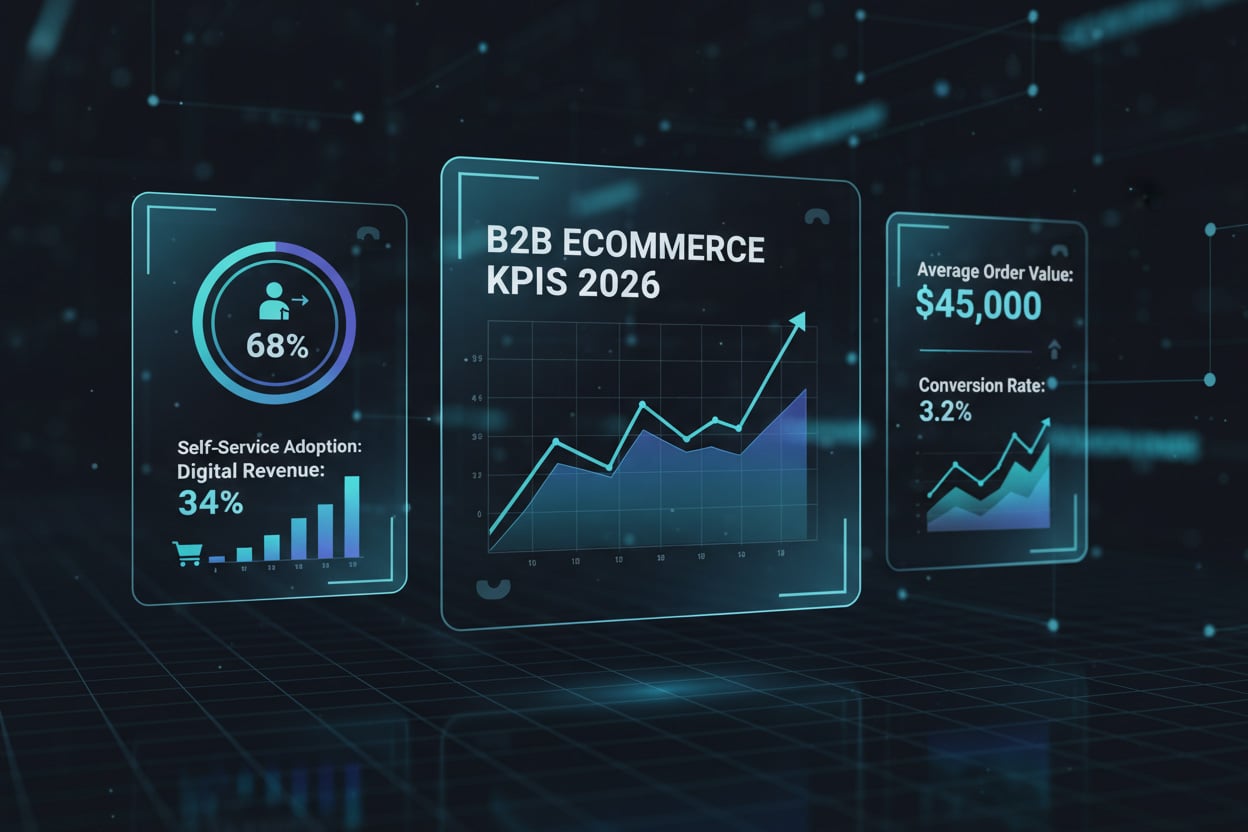

The B2B eCommerce landscape has transformed dramatically, with online sales now representing 34% of total B2B revenue and growing at a 14.5% annual rate (McKinsey & Company, 2024). As digital channels become the primary buying experience, tracking the right B2B eCommerce KPIs is essential for sustainable growth and competitive advantage.
Unlike B2C metrics focused on impulse purchases, B2B eCommerce KPIs must account for complex buying cycles, multiple stakeholders, contract pricing, and long-term relationships. With 61% of B2B buyers preferring an overall rep-free buying experience through digital channels (Gartner, 2025), businesses need clear frameworks for measuring success and identifying opportunities for improvement.
Quick Reference: Top 5 B2B eCommerce KPIs for 2026
| KPI | What It Measures | Target Benchmark | Priority Level |
|---|---|---|---|
| Digital Revenue Mix | % of revenue from self-service channels | 20-35% (scaling businesses) | High |
| Conversion Rate | Visitors who complete purchases | 2-4% (B2B average) | High |
| Self-Service Adoption | % of customers using online platform | 60%+ monthly active users | High |
| Average Order Value | Typical transaction size | $500-$100,000+ (industry-specific) | Medium |
| LTV:CAC Ratio | Customer value vs. acquisition cost | 3:1 minimum | Medium |
Sources: McKinsey & Company (2024), Gartner (2022), Coveo (2024)
Essential B2B ecommerce KPIs for 2026
1. Digital Revenue Mix (DRM)
Digital Revenue Mix measures the percentage of total revenue generated through self-service digital channels, including your eCommerce site, customer portals, and punchout catalogs.
Formula: Digital Channel Revenue ÷ Total Revenue × 100
2026 Benchmarks:
- Emerging: 10-20%
- Scaling: 20-35%
- Advanced: 35%+ (McKinsey & Company, 2024)
With 71% of suppliers now offering eCommerce (McKinsey & Company, 2024), higher digital revenue correlates with operational efficiency and improved customer satisfaction. Companies with strong digital channels handle more orders with fewer resources while providing 24/7 access.
Improvement Strategies: Expand self-service capabilities with contract pricing visibility, implement approval workflows, and align sales compensation with digital-closed revenue.
2. Conversion Rate
Conversion rate tracks how effectively your platform turns visitors into paying customers, accounting for B2B’s multiple sessions and approval processes.
Formula: (Total Orders ÷ Total Sessions) × 100
2026 Benchmarks:
- B2B average: 1.8-3.0% (Coveo, 2024)
- Industrial/manufacturing: 2.5-4.0%
- Distribution: 3.0-5.0%
Critical Sub-Metrics:
- Add-to-Cart Rate: 6-8%, with the Americas leading at 8% (Tidio, 2023)
- Checkout Completion: Target 70%+ (Experro, 2026)
Optimization Tactics: Implement guest checkout, clearly display contract pricing, add quick-order functionality, and provide real-time inventory visibility.
3. Self-Service Adoption Rate
This metric measures what percentage of customers who are actively using your online platform rather than relying on sales rep assistance.
Formula: (Active Online Accounts ÷ Total Active Accounts) × 100
2026 Benchmarks:
- Target: 60%+ monthly
- Best-in-class: 75%+
- Industry preference: 83% prefer self-service (Gartner, 2022)
Adoption Drivers: User-friendly mobile interface, with 50.8% of sales starting on smartphones, real-time pricing, quick reorder functionality, and comprehensive account management.
4. Average Order Value (AOV)
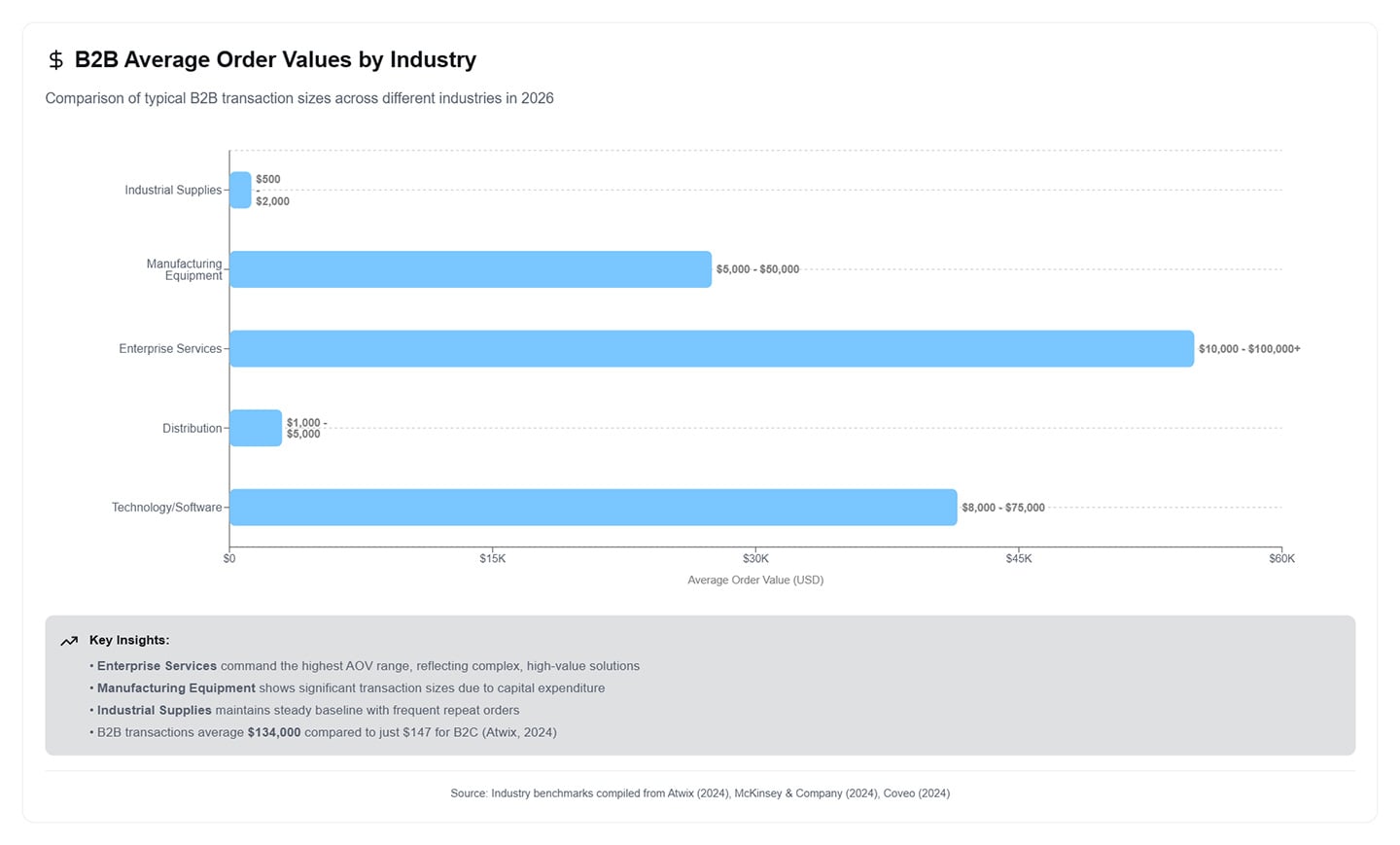
AOV measures the typical transaction size, with B2B transactions substantially larger than B2C. Research shows B2B deals averaging $134,000 compared to just $147 for B2C (Atwix, 2024).
Formula: Total Revenue ÷ Number of Orders
2026 Benchmarks:
- Industrial supplies: $500-2,000
- Manufacturing equipment: $5,000-50,000
- Enterprise services: $10,000-100,000+
AOV Improvement: Implement intelligent cross-sell recommendations, create volume-based pricing tiers, build product bundles, and offer free shipping thresholds.
5. Customer Lifetime Value to Acquisition Cost (LTV:CAC)
This ratio measures long-term customer profitability against acquisition costs.
Formula: Customer Lifetime Value ÷ Customer Acquisition Cost
2026 Benchmarks:
- Target ratio: 3:1 or higher
- Payback period: 12 months or less (McKinsey & Company, 2024)
Improvement Strategies: Focus on high-potential segments, create post-purchase onboarding, implement replenishment programs, and develop account expansion strategies.
Advanced Metrics to Monitor
Quote-to-Order Conversion
This metric tracks how effectively digital quotes convert to orders, which is critical given that 38-41% of purchases involve multiple stakeholders (Atwix, 2025).
Benchmarks:
- Industrial/manufacturing: 30-50%
- Distribution: 40-60%
- Software/SaaS: 45-65% (McKinsey & Company, 2024)
Optimization: Provide real-time inventory promises, maintain contract pricing integrity, and set quote turnaround SLAs under 2 hours.
Reorder Rate
Reorder rate measures repeat purchase frequency, indicating satisfaction and platform usability.
Benchmarks: Target 40%+, with top performers achieving 60%+ (Experro, 2026)
PowerPak achieved an 89% retention rate after optimizing its B2B platform with Atwix, demonstrating how platform improvements directly impact loyalty (Atwix, 2024).
Your B2B eCommerce KPI Tracking Framework
| KPI Category | Metric | 2026 Benchmark | Measurement Frequency | Data Source |
|---|---|---|---|---|
| Adoption | Digital Revenue Mix | 20-35% (scaling)35+ (advanced) | Monthly | ERP + Analytics |
| Adoption | Self-Service Adoption Rate | 60%+ monthly active75%+ (best-in-class) | Monthly | Platform Analytics |
| Conversion | Overall Conversion Rate | 2-4% (B2B average)2.5-4% (industrial)3-5% (distribution) | Weekly | Web Analytics |
| Conversion | Quote-to-Order Rate | 30-50% (industrial40-60% (distribution)45-65% (SaaS) | Weekly | CPQ System |
| Transaction Value | Average Order Value (AOV) | $500-2K (supplies)$5K-50K (equipment)$10K-100K+ (enterprise) | Monthly | ERP + Analytics |
| Customer Value | LTV:CAC Ratio | 3:1 minimumPayback ≤12 months | Quarterly | CRM + Marketing |
| Retention | Reorder Rate | 40%+ (target)60%+ (top performers) | Monthly | ERP + Platform |
Implementation Roadmap by Quarter
Quarter 1: Foundation & Instrumentation
- Focus KPIs: Digital Revenue Mix, Overall Conversion Rate, Average Order Value
- Standardize event tracking across all digital touchpoints
- Integrate web analytics with ERP and CPQ systems
- Create an executive dashboard linking KPIs to revenue
- Establish a 12-24 month baseline for trend analysis
Quarter 2: Adoption & Enablement
- Focus KPIs: Self-Service Adoption Rate, Add-to-Cart Rate, Checkout Completion Rate
- Launch account controls and contract-aware pricing
- Implement a digital-first approach with three strategic accounts
- Establish sales leadership commitment to the digital channel credit
- Optimize mobile experience (50.8% of transactions start on mobile)
Quarter 3: Conversion & Optimization
- Focus KPIs: Quote-to-Order Rate, Conversion Rate optimization
- Deploy guided selling and recommendation engines
- Configure replenishment programs for top SKUs
- Streamline approval workflows for multi-stakeholder purchases
- A/B test checkout process improvements
Quarter 4: Value & Economics
- Focus KPIs: LTV:CAC Ratio, Reorder Rate, AOV optimization
- Refine LTV:CAC targeting with sub-6-month payback cohorts
- Implement cross-sell and upsell strategies
- Create volume-based pricing tiers
- Expand to the marketplace or punchout, where margins support it
KPI Governance & Accountability Structure
Successful B2B eCommerce KPI programs require clear ownership and accountability:
| Governance Element | Description | Frequency |
|---|---|---|
| Metric Ownership | Assign one owner per metric (not a committee) | – |
| Performance Reviews | Weekly operating cadence with red/amber/green status | Weekly |
| Compensation Alignment | Link bonuses to DRM, conversion, and LTV:CAC improvements | Quarterly |
| Data Quality Investment | Fund initiatives for product data, pricing, and industry accuracy | Ongoing |
| Response Playbooks | Pre-approved action plans when metrics fall below targets | As needed |
Red/Amber/Green Threshold Examples
| KPI | 🟢 Green (Target) | 🟡 Amber (Warning) | 🔴 Red (Action Required) |
|---|---|---|---|
| Conversion Rate | ≥3% | 2-2.9% | <2% |
| Self-Service Adoption | ≥60% | 45-59% | <45% |
| LTV:CAC Ratio | ≥3:1 | 2:1-2.9:1 | <2.1 |
| Reorder Rate | ≥40% | 30-39% | <30% |
| Quote-to-Order Rate | ≥40% | 30-39% | <30% |
Implementation Essentials
Quarter 1: Standardize tracking, integrate analytics with ERP/CPQ, create dashboards, and establish 12-24 month baselines.
Quarter 2-3: Launch account controls, implement guided selling, and optimize the mobile experience.
Quarter 4: Refine unit economics and expand channels where margins support growth.
Governance: Assign one owner per metric, establish weekly reviews with red/amber/green thresholds, link compensation to improvements, and fund data quality initiatives.
Validating Results with Case Studies
Real-world results demonstrate the power of optimizing B2B eCommerce KPIs. After implementing an optimized Adobe Commerce B2B solution, PowerPak achieved:
- 230% eCommerce growth in 12 months
- 89% customer retention rate
- 6% reduction in cost-per-order (Atwix, 2024)
These metrics confirm that organizations that implement comprehensive B2B eCommerce KPI tracking and optimization consistently outperform competitors. Research confirms B2B buyers consume 13 pieces of content during their purchase journey (PathFactory, 2023), underscoring the importance of comprehensive digital experiences.
How Atwix Drives KPI Improvements
At Atwix, we deliver measurable improvements in client B2B eCommerce KPIs through platform expertise and data-driven strategy. Our B2B eCommerce development services focus on conversion-focused features, including quick order functionality, contract pricing visibility, mobile optimization, and intelligent search.
Our ERP integration services ensure real-time synchronization of inventory, pricing, order history, and product specifications – critical for data quality and customer trust.
Start Optimizing Your B2B eCommerce KPIs Today
The B2B eCommerce KPIs you track in 2026 determine your competitive position in an increasingly digital marketplace. With 61% of B2B buyers preferring an overall rep-free buying experience through digital channels (Gartner, 2025), measurement excellence is essential for growth.
Implement these core metrics: Digital Revenue Mix for adoption, Conversion Rate for experience optimization, Average Order Value for transaction economics, Self-Service Adoption for efficiency, and LTV:CAC for profitable growth.
Successful programs require comprehensive measurement, clear accountability, and continuous optimization. Companies excelling at all three consistently outperform competitors in growth and profitability.
Ready to transform your B2B eCommerce performance? Contact Atwix today to implement a comprehensive KPI tracking and improvement program tailored to your business goals.