


Most B2B platforms waste buyer time. The B2B eCommerce best practices that actually move revenue aren’t about more features — they’re about removing friction from the flows buyers use most. 67% of the B2B buyer journey happens digitally before any sales conversation, yet most platforms still force everyone through the same rigid checkout, hide pricing behind login walls, and make reordering harder than it should be.
Here are the 10 flows that drive revenue, the ones that kill deals, and what to prioritize based on real 2026 buyer behavior.
Key Takeaways
- B2B BNPL will process nearly $500B in transactions by 2026. – embed flexible payment options or lose deals
- AI-powered product discovery is replacing keyword search – conversational queries now matter more than exact SKU matches
- Self-service reordering drives 3-5x more repeat purchases than manual processes
- Average B2B buying groups include 6-10 decision-makers – approval workflows must accommodate multiple stakeholders
- 84% of B2B buyers demand omnichannel experiences across websites, marketplaces, and sales reps
- Punchout integration is now table stakes for enterprise contracts
- Businesses excelling at personalization see up to 40% higher revenue
- Mobile-first flows matter – 33% of B2B purchases happen on mobile devices
1. Embedded Flexible Payments (BNPL & Net Terms)
Traditional B2B payment friction kills conversions.
Buyers want terms. They want to preserve cash flow. They want options beyond “pay now with a credit card.”
IDC predicts B2B BNPL will reach nearly $500B in transactions by 2026, driven by embedded credit underwriting that happens directly in checkout .
What works:
Instant credit approval at checkout. Real-time underwriting that takes minutes, not days. Multiple payment options – ACH, cards, BNPL, net 30/60/90 terms – all in the same flow.
Critical elements:
- Embedded credit checks during checkout with instant approvals
- Net terms (30/60/90 days) for approved buyers
- Multi-invoice settlement within a single order
- Transparent terms and fees presented upfront
- Automated collections handled by the payment provider
Some businesses report up to 60% lift in average order value when offering BNPL.
Two.
Common mistake: Redirecting buyers to external financing applications. Keep everything embedded in your checkout or you will lose them.
Implementation priority: High. 90% of business buyers check payment options before purchasing, and nearly 75% won’t buy if you don’t offer their preferred method
2. AI-Powered Product Discovery
Keyword search is dying in B2B.
Buyers are no longer searching for “forklift parts.” They’re asking contextual questions about load capacity, contract terms, and alternatives.
Traditional catalog search cannot handle complex technical requirements or conversational queries. By 2026, over 55% of B2B searches are expected to include voice or conversational inputs .
What works:
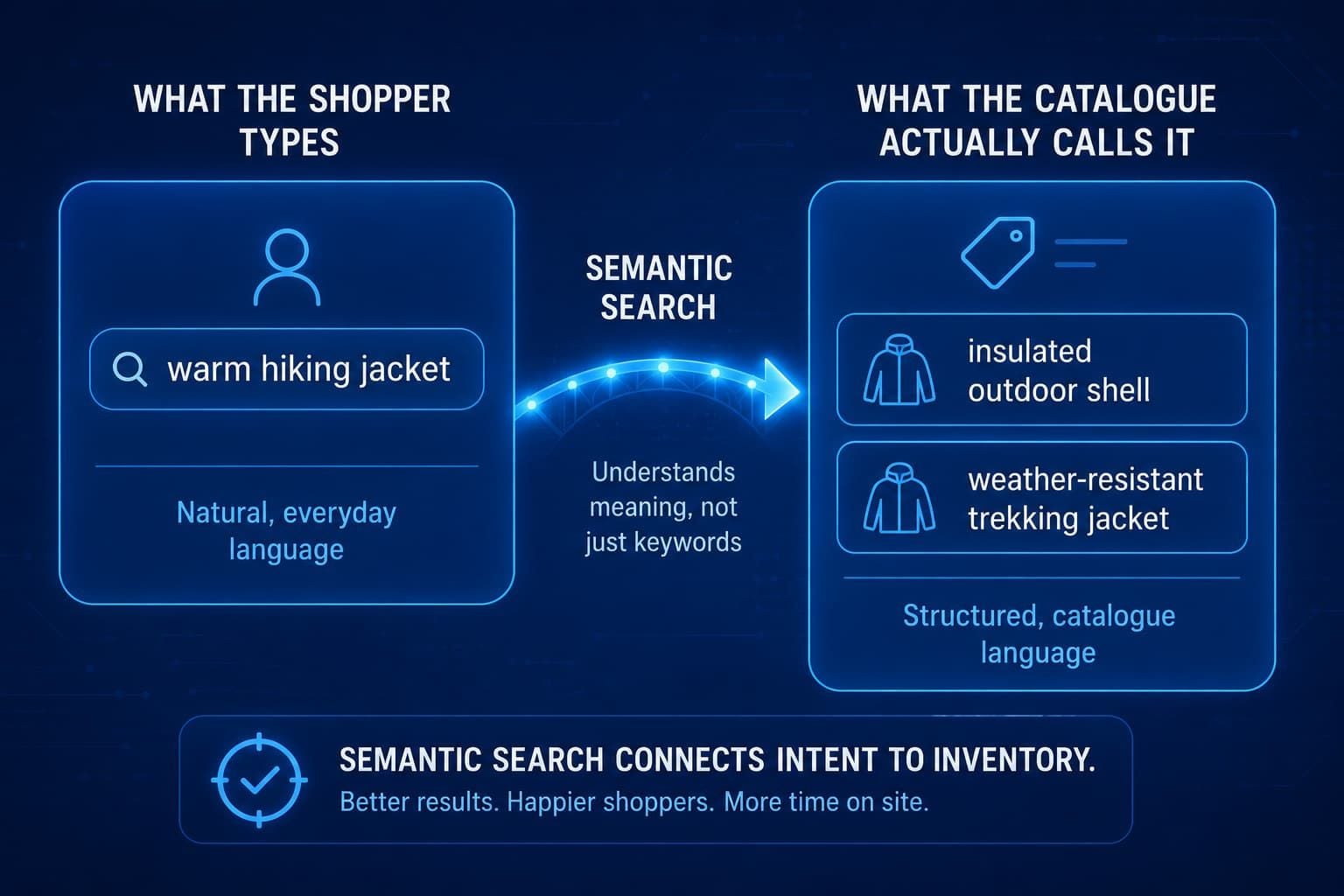
Natural language processing that understands technical specifications. AI agents that navigate inventory based on use cases, not just SKU numbers. Semantic search that returns relevant products even when buyers use different terminology.
Critical elements:
- Detailed product attributes beyond basic descriptions (compatibility, specifications, use cases)
- Structured technical data that AI can parse
- Related product recommendations based on actual purchase patterns
- Contextual filtering by customer type, industry, or previous orders
Implementation priority: High for distributors and manufacturers with complex catalogs. Buyers expect conversational search, not keyword matching.
3. One-Click Reordering & Smart Lists
Repeat orders should take seconds.
B2B buyers order the same items regularly. Making them search, add to cart, and checkout every time wastes their time and costs you conversions.
What works:
One-click reorder from complete order history. Saved lists buyers can edit and share across their organization. Subscription options for consumables with flexible scheduling and quantity adjustments.
Critical elements:
- Full order history with clear item details, pricing, and dates
- “Reorder All” and “Reorder Selected Items” functionality
- Alerts for discontinued items with substitute recommendations
- Quick lists accessible from any page
- Bulk editing capabilities for saved lists
Implementation priority: Essential. This is table stakes for any B2B operation with repeat buyers.
4. Multi-Stakeholder Approval Workflows
B2B buying groups include 6-10 decision-makers on average .
Enterprise buyers need internal approval before purchase. Forcing them outside your platform to get sign-off creates abandonment.
What works:
Configurable approval chains based on order value, department, or product category. Automated routing with notifications. Mobile approval for managers who are not at desks.
Critical elements:
- Threshold-based triggers (orders over $X require approval)
- Role-based routing (department heads, finance, procurement)
- Mobile approval capability
- Override options for urgent orders
- Complete audit trails for compliance
Common mistake: Making workflows too rigid. Buyers need exceptions for urgent orders or they will route around your system entirely.
Implementation priority: Essential for enterprise sales. 77% of B2B buyers say their last purchase was very complex or difficult, involving many steps and stakeholders .
5. Account Hierarchies with Inherited Permissions
Large organizations have complex buying structures.
Parent accounts, subsidiaries, regional offices, departments, cost centers. If your platform treats them all the same, you lose.
What works:
Clear parent-child relationships with inherited pricing and permissions. Central visibility for admins with controlled autonomy for sub-accounts.
Critical elements:
- Consolidated billing with individual cost allocation
- Shared contract pricing across entities
- Role-specific permissions (viewer, buyer, approver, admin)
- Reporting that rolls up by hierarchy level
- Custom catalogs per entity when needed
Implementation priority: Critical for multi-location enterprises and franchise operations.
6. Omnichannel Consistency
84% of B2B buyers want suppliers to offer several different sales channels – eCommerce, marketplaces, telesales, physical stores.
B2B buyers using 3+ channels spend 30% more per transaction than single-channel buyers .
What works:
Unified pricing, inventory, and order history across all touchpoints. Buyers start on mobile, continue on desktop, finish with a sales rep – all without losing context.
Critical elements:
- Single source of truth for pricing and inventory
- Cross-channel order tracking
- Consistent customer data across all systems
- Sales reps can see and act on digital activity
- Self-service and sales-assist coexist without conflict
Implementation priority: High. One-third of B2B buyers prefer each mode – in-person, with a rep, and self-serve. What’s changed is how fluidly they expect to move across those modes .
7. Punchout & Procurement Integration
Enterprise buyers use procurement systems.
SAP Ariba, Coupa, Oracle, Jaggaer. If you are not integrated, you are not in consideration for major contracts.
What works:
Native punchout integration that lets buyers shop your catalog inside their procurement platform. Orders flow automatically back to their system with proper coding.
Critical elements:
- OCI, cXML, or other standard protocol support
- Real-time inventory and pricing sync
- Purchase order number capture
- Accurate tax and shipping calculation before submission
- Support for multiple buyer organizations
Implementation priority: Non-negotiable for enterprise sales. Medium priority if targeting mid-market.
8. Personalized Catalogs & Dynamic Pricing
Generic catalogs confuse buyers and slow decisions.
Contract-specific items. Negotiated pricing. Regional availability. Custom configurations. Show buyers only what is relevant to them.
Businesses that excel at personalization see up to 40% higher revenue .
What works:
Dynamic catalog filtering based on customer attributes. Account-specific pricing that displays automatically. Product recommendations based on purchase history and industry.
Critical elements:
- Customer group segmentation with catalog rules
- Contract pricing that overrides standard rates
- Hide/show products based on region, account tier, or agreements
- Recently ordered and frequently bought sections
- Industry-specific product collections
Common mistake: Over-personalizing without clean data. Fix your product information and customer segmentation first.
Implementation priority: Medium-high for businesses with diverse product lines or contract-based pricing.
9. Split Cart & Multiple Delivery
Large organizations order for multiple locations simultaneously.
Forcing separate orders for each delivery address triples buyer effort and increases errors.
What works:
Single cart that splits automatically by delivery location. One checkout with multiple shipping addresses and dates.
Critical elements:
- Address book with unlimited locations
- Line-item level delivery date selection
- Clear split order confirmation showing what ships where
- Consolidated invoicing with location-specific packing slips
- Freight calculation per destination
Implementation priority: High for distributors and manufacturers serving multi-location buyers.
10. Bulk Order Entry Tools
Buyers placing 50+ line items do not want to click “add to cart” repeatedly.
They have spreadsheets, ERP exports, and purchasing lists. Meet them where they are.
What works:
CSV upload with product matching and error validation. Quick order forms with SKU and quantity fields. Copy-paste from Excel that parses correctly.
Critical elements:
- Smart SKU matching that handles variations
- Clear error messages for invalid items or quantities
- Preview before adding to cart
- Template downloads for correct formatting
- Save and resume for incomplete orders
Implementation priority: Essential for wholesale, distribution, and manufacturing suppliers.
What Not to Waste Time On
Over-complicated wishlists. B2B buyers want fast reordering, not wish management.
Excessive personalization without foundation. Fix your data first. Bad recommendations irritate more than they convert.
Rigid approval processes. If buyers cannot handle exceptions, they will abandon your platform for email and phone orders.
Mobile apps when mobile web works. Focus on responsive design first. Apps add maintenance complexity without proportional value for most B2B scenarios.
Generic AI chatbots. AI-powered chatbots handle up to 80% of routine inquiries , but only when properly trained on your catalog and workflows. Generic bots frustrate users.
Implementation Strategy for 2026
Start with flows that match your actual buyer behavior.
90% of B2B buyers start their purchasing journey with online research . Your platform must serve buyers at every stage.
Priority framework:
- Fix immediate conversion killers (payment options, mobile checkout, reordering friction)
- Enable larger deals (approval workflows, account hierarchies, punchout)
- Improve efficiency for power users (bulk ordering, advanced search, custom catalogs)
45% of buyers say they’re dissatisfied with current B2B eCommerce experiences, and 65% would pay more to vendors who deliver excellent digital journeys .
Test each flow with real buyers before full rollout. Five customer interviews reveal more than fifty internal assumptions.
Metrics that matter:
- Time from quote to order
- Self-service adoption rate
- Average order frequency for repeat buyers
- Mobile conversion rate
- Payment method mix
- Approval workflow completion time
Most B2B platforms fail because they build for an imaginary buyer.
Gartner expects 30% of B2B sales to happen in digital sales rooms by 2026 . The winners will be platforms that reduce friction at every step.
Build for the buyer who actually shows up. Contact us.