


Artificial intelligence already feels like magic – you ask a question, and an answer appears. But behind the scenes, large language models do not actually understand your world, your data, or your tools unless we teach them how to connect. Model Context Protocol, or MCP, is an emerging way to give LLMs a shared, structured language for interacting with systems, knowledge, and actions. Instead of hardcoding endless integrations, MCP lets AI reason about context in a consistent and reusable way. Think of it as moving from improvisation to a common grammar for intelligent machines.
The Context Problem
Most likely, you already know ChatGPT and use it day to day for all kinds of general questions. But the moment you ask something like “Who is our most profitable customer?” or “Which product is selling the worst?” you will usually get a nicely written guess at best. That is the default behavior, because the model does not have your actual business numbers. If you give it fresh context from your business, though, it can do real reasoning, spot patterns, and even propose next steps that are grounded in reality. The real question is not “can an LLM answer this?” but “how do we feed it the right data when that data lives in multiple places and changes every hour?”
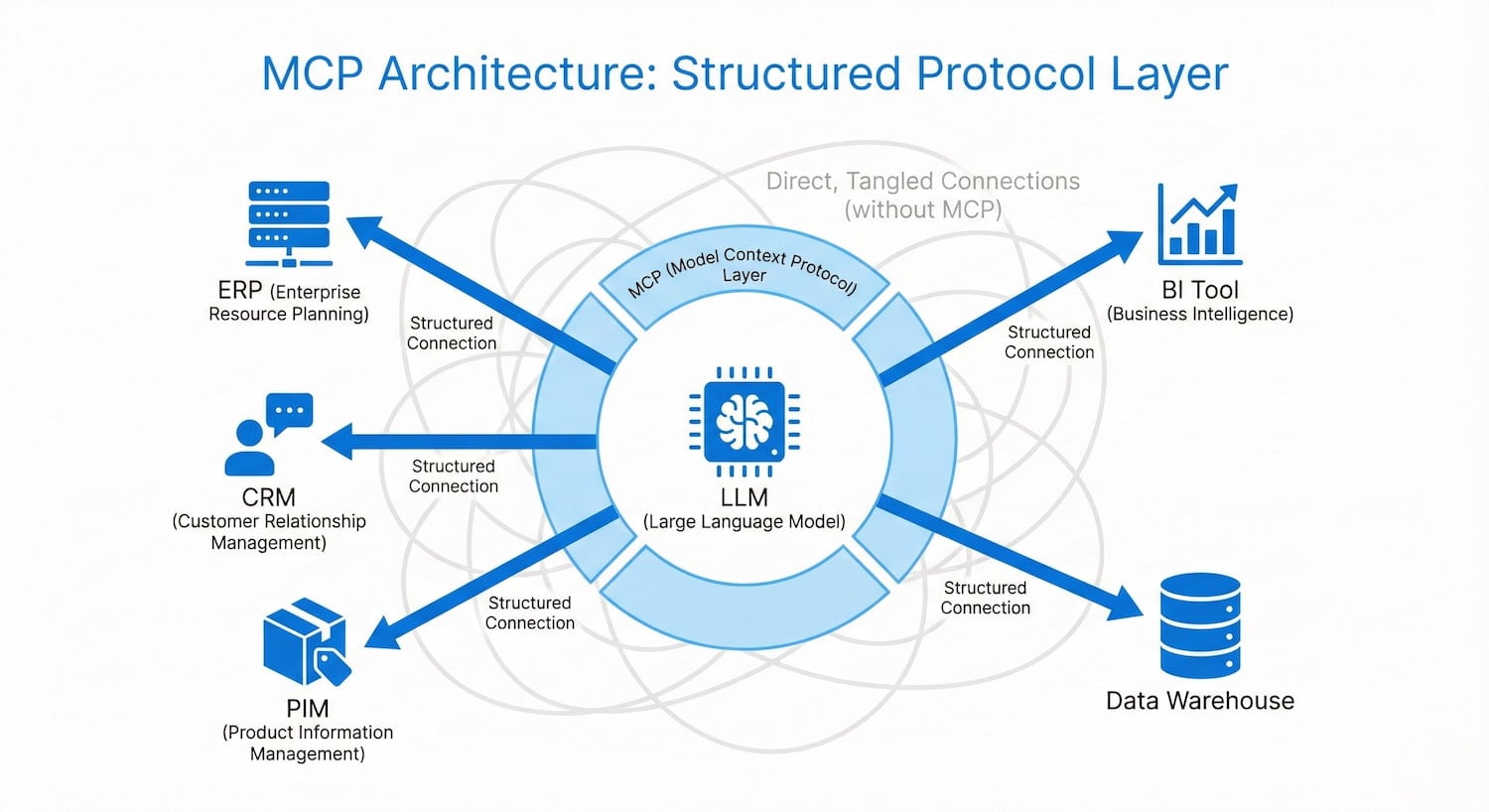
For most companies, the source of truth sits in an ERP, CRM, PIM, BI tool, data warehouse, or some combination of them. The good news is that these systems usually expose an API, so at least the data is accessible. But accessibility is not the same thing as usability for an LLM. We cannot just tell the model “go there and fetch my info” and expect precision, because without a strict interface it will fill gaps with assumptions, or query the wrong thing, or misunderstand what a field actually means. If we want reliable answers instead of polite hallucinations, we need to give the LLM a clear, structured way to talk to the API.
How MCP Works
This is where MCP comes in. Think of MCP as a shared protocol that describes what tools exist, what data they can return, and how to call them in a predictable format. It is basically a contract between your systems and the model: “here are the actions you can take, here is the input you must provide, and here is what the output will look like.” Once that contract is in place, the LLM stops improvising and starts operating like a careful analyst who knows exactly which button to press, and when. It also becomes much easier to add guardrails: limit what can be accessed, log requests, enforce permissions, and make the whole thing auditable.
Custom Systems Need Custom Solutions
In some popular ecosystems, you can already find MCP servers or ready made integrations online, which makes the first steps faster. But in the B2B world, the interesting stuff is often “non popular” by definition: custom ERPs, legacy data models, weird product catalogs, and workflows that only make sense inside one company. In those cases, it is not about downloading a connector, it is about designing the protocol properly. At Atwix, this is exactly the type of problem we like, because the pain is real and the payoff is measurable: less time spent digging through dashboards, fewer manual exports to Excel, and faster decisions with fewer arguments.
Real Application: Sirius Enterprise Integration Platform
A concrete example is Sirius, Atwix Enterprise Integration Platform. While working on Sirius, we teach the platform to communicate with popular ERP frameworks and business systems, not just to “pull data”, but to understand how that data should be used safely and consistently. The goal is simple: customers should not need to navigate thousands of charts and complicated graphs just to answer basic questions like “What will be our best sellers next summer?” or “Which accounts show churn risk signals?” Instead, they should be able to ask in human language, get a number they can trust, and see where it came from. Sirius LLM operates on real time data and connects to systems through MCP based integrations, which allows secure access, clear boundaries, and predictable results even when the underlying data changes constantly.
From Questions to Answers
MCP is not about replacing analysts, dashboards, or existing systems. It is about removing friction between people and the data they already own, and letting questions turn into answers without weeks of back and forth. When language becomes an interface, decision making becomes faster, clearer, and far less exhausting. And if you would like to start communicating with your business data in the same natural way you talk to your team, just contact us.