

A B2B buyer compares prices in your self-serve portal, calls a rep to confirm, and closes through a sales agent. Same buyer, same order, three channels. They expect the price and the stock count to be identical at every step. McKinsey’s B2B Pulse research finds buyers now use an average of 10 channels in a single purchase, up from 5 in 2016.
This guide covers what omnichannel B2B eCommerce means in 2026, the trends moving it, the benefits worth chasing, the challenges that sink most rollouts, and a five-step plan to start. The thread running through all of it: the channel mix is the easy part. Making the systems behind those channels agree in real time is the part teams underestimate.
Why B2B Businesses Should Have an Omnichannel Approach
The way B2B buyers engage with businesses has changed. More of them now research products and place orders from a phone, so a mobile-responsive storefront is the floor, not a feature. Today, flexibility is the baseline expectation, not a differentiator. Buyers move across email, social, live chat, sales reps, and self-serve portals inside a single purchase, and they expect each handoff to carry their context with it. Here is why that matters in 2026.
Omnichannel Sales Drive Superior Results
Hybrid sales models, combining in-person, remote, and digital self-service, are now the standard B2B motion rather than an emerging one. McKinsey ties true omnichannel execution to roughly two-times-greater market-share gains versus single-channel sellers. Companies that run omnichannel well are not just selling in more places. They are removing friction at every touchpoint a buyer crosses.
Customers Engage Across More Channels Than Ever
B2B buyers are more digitally active than ever, with most using ten or more channels throughout a single purchase. That puts the burden on you to maintain a consistent presence across all of them, from email and phone to live chat, mobile apps, and social. The buyer should be able to switch modes without losing their cart, their pricing, or their order history.
Enhanced Customer Satisfaction and Loyalty
Buyers stay with brands that make the experience easy. Companies with strong omnichannel engagement retain about 89% of their customers, against roughly 33% for those with weak omnichannel engagement. The gap comes from consistency: real-time order updates, accurate availability, and pricing that does not change depending on which channel the buyer used to reach you.
Increased Operational Efficiency
Omnichannel does more than improve the buyer experience. By connecting sales, marketing, and service into one system, you cut redundant work, tighten inventory management, and keep product and pricing data consistent across every touchpoint. That saves time and frees your teams to work on growth instead of reconciling numbers between systems.
Gaining a Competitive Edge
The B2B market is crowded, and the sellers that stand out are the ones that adapt to buyer expectations fastest. AI-driven personalization, real-time inventory visibility, and unified customer data are becoming table stakes. Getting there first wins new clients and signals that you operate like a modern commerce business, not a catalog with a checkout bolted on.
5 B2B eCommerce Omnichannel Trends to Watch
Five trends are shaping omnichannel B2B commerce in 2026. The first four are about buyer behavior. The fifth, data and integration, is the one that determines whether the other four actually work.
1. Emphasis on Hyper-Personalization
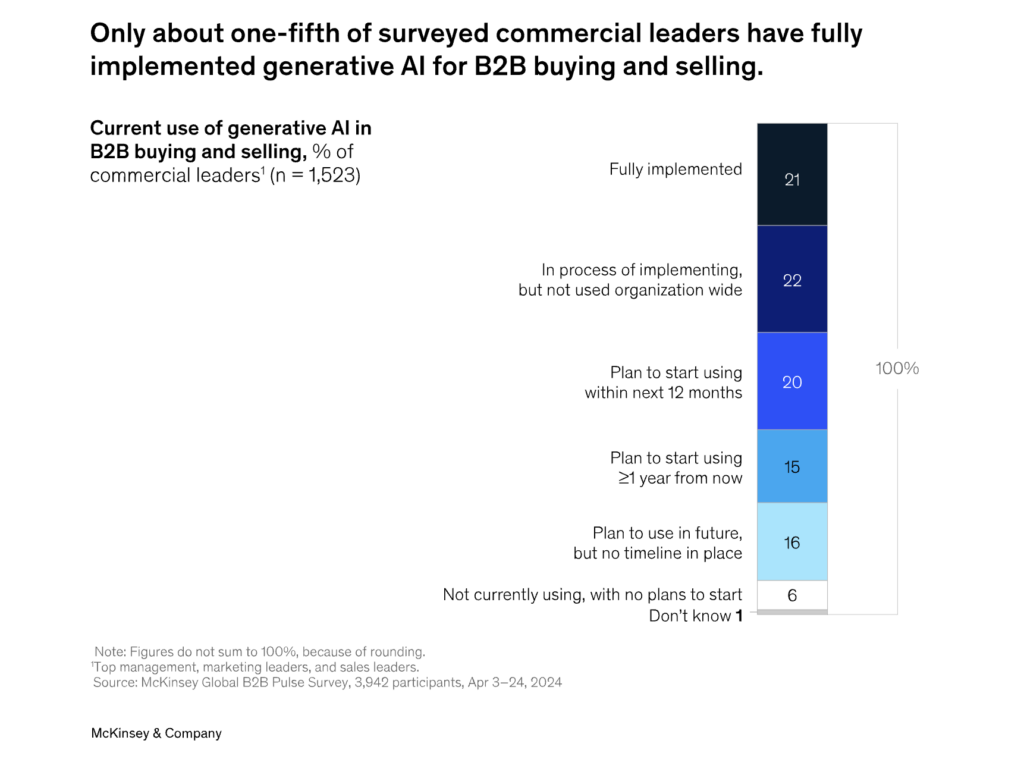
B2B buyers now expect experiences tuned to their preferences, the same way they do as consumers. According to McKinsey, companies experimenting with generative AI gain an edge in connecting customer data across channels, which makes one-to-one interactions possible at scale. Done well, this raises retention and revenue per client. The mechanism is the same every time: use first-party data to make each interaction relevant to that specific buyer.
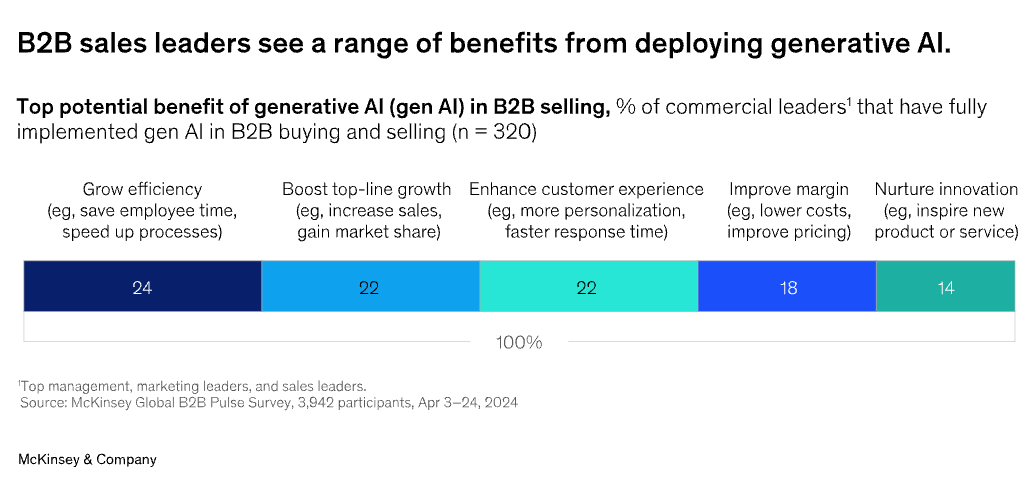
Source: McKinsey
2. Integration of Advanced Sales Technologies
AI-driven CRM systems and real-time analytics are changing how B2B sales teams operate, cutting manual work and putting decisions on a data footing. Forrester reports that organizations using AI in sales see gains in both conversion rates and team productivity. The payoff is that reps can anticipate what a buyer needs, personalize outreach, and close faster.
3. Expansion of Digital Sales Channels
Digital-first buying now dominates B2B, with buyers moving across eCommerce platforms, marketplaces, and social. BigCommerce reports that more than 80% of B2B buyers expect the same convenience they get in B2C, which pushes sellers to be present and consistent across every touchpoint.
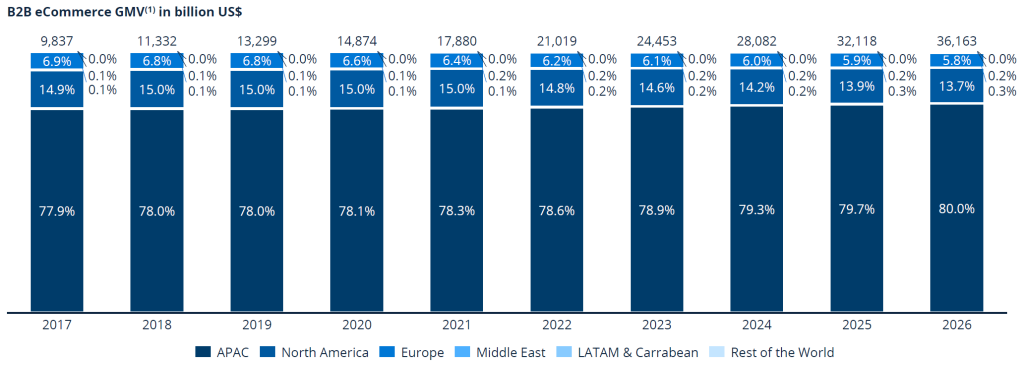
The market backs this up. Global B2B eCommerce GMV reached roughly $28 trillion in 2024 and continues to grow at double-digit rates, with Asia-Pacific accounting for close to 78% of the worldwide total.
Most B2B sales interactions now happen through digital channels. Gartner forecast this shift in 2020, and McKinsey’s 2024 B2B Pulse data confirms it: buyers now split their time across in-person, remote, and digital self-serve in roughly equal thirds at every stage of the journey.
4. Adoption of Hybrid Selling Models
Hybrid selling, which blends in-person interactions with remote and digital self-service, has become the standard in B2B commerce. It matches how buyers actually move through a purchase, switching modes inside a single deal, which is why it correlates with stronger share gains rather than being a passing preference.
Tools like virtual product demos and interactive digital catalogs let sales teams connect with buyers wherever they are.
5. Focus on Data Hygiene and Integration
Accurate, synchronized data is what makes every other trend work. Personalization, real-time inventory, hybrid selling, all of it depends on the storefront, ERP, CRM, and order management system agreeing on the same numbers at the same time. When they do not, a buyer sees one price in your portal and hears a different one from a rep, and that single mismatch does more damage than any missing feature.
This is where most omnichannel rollouts actually break. The strategy is usually sound and the channels get stood up, but the systems underneath were each built to own their own version of the truth, so they drift. Closing that gap takes a deliberate integration layer that keeps pricing, inventory, orders, and account data in lockstep, and that handles the cases B2B is full of: contract pricing, customer-specific catalogs, credit limits, partial fulfillment. We make the full case for why this is an engineering problem rather than a planning one in B2B omnichannel strategy is an integration problem.
Customer satisfaction data shows how much room there is to get this right. A survey conducted in March 2024 found that 23.5% of B2B buyers reported very negative experiences on eCommerce platforms, with another 14.9% reporting somewhat negative experiences, while only 15.2% described their experience as very positive. Fixing the data and integration layer underneath is what moves buyers out of that first group.
5 Benefits of B2B Omnichannel eCommerce
What do you stand to gain from an omnichannel B2B eCommerce strategy? Five benefits are worth the work.
1. Increased Sales and Revenue
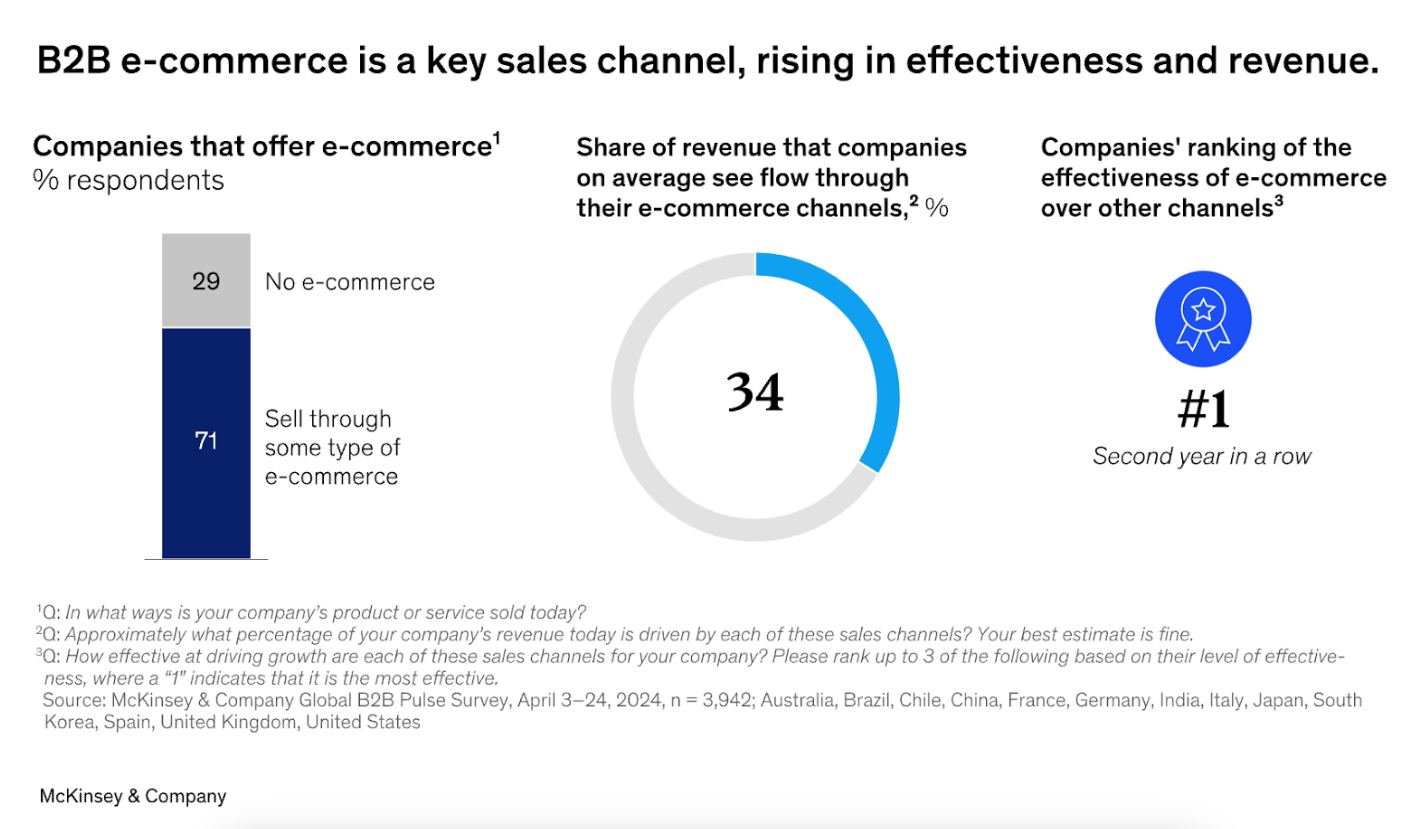
An omnichannel approach lets you meet buyers where they already are and complete the sale without friction. According to McKinsey & Company, eCommerce has become the leading revenue-generating channel for B2B sellers, ahead of in-person sales. Capturing that revenue depends on clearing the usual obstacles first, integrating legacy systems and keeping the experience consistent across channels.
2. Improved Customer Satisfaction and Loyalty
A consistent experience across channels raises satisfaction, and satisfaction compounds into retention. Companies with strong omnichannel engagement retain about 89% of their customers, against roughly 33% for those with weak engagement. That retention gap is where long-term profitability comes from.
3. Enhanced Operational Efficiency
Omnichannel pulls separate sales and communication channels into one system, which cuts duplicate work and improves inventory accuracy. B2B companies that commit to digital transformation report measurable efficiency gains and a better ability to meet demand, a pattern Deloitte has documented across the sector.
4. Competitive Advantage
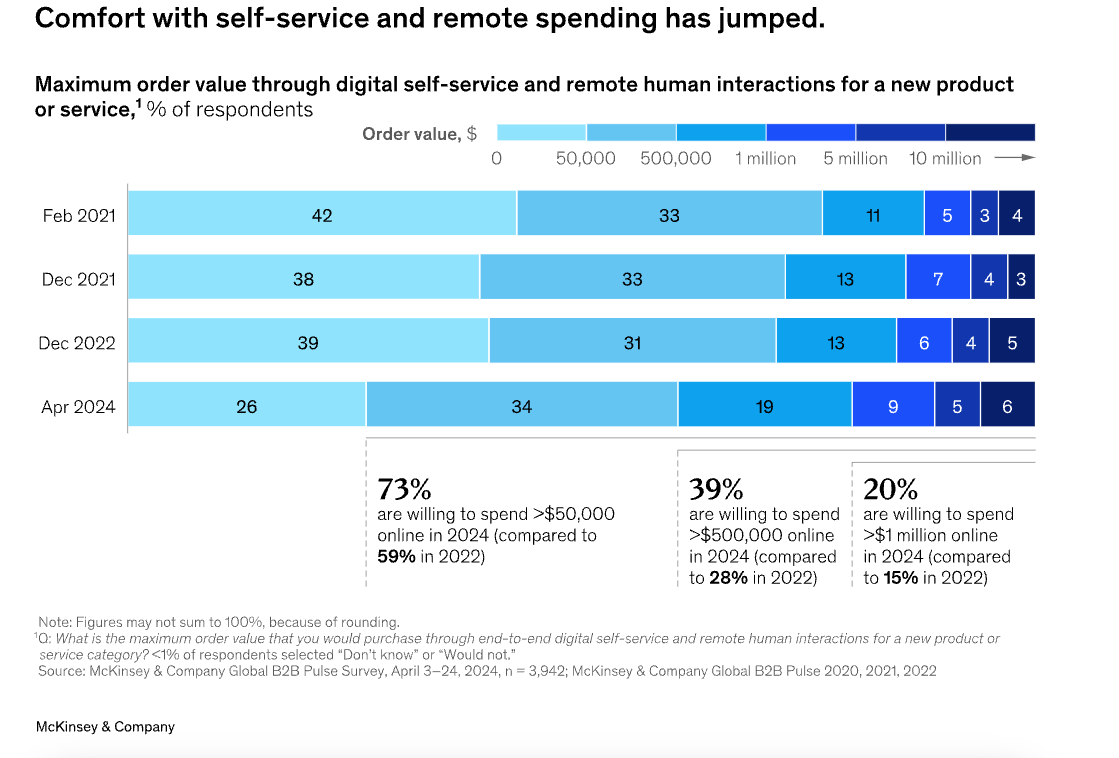
B2B buyers expect the experiences they get in B2C, and the sellers that deliver consistent, personalized interactions across channels separate themselves from the field. Using customer data to tailor what you offer is what creates that edge. McKinsey’s B2B Pulse data shows how far buyers will now go digitally: 39% say they will spend over $500,000 in a single online transaction, and 20% will place orders above $1M.
5. Greater Market Reach
An omnichannel presence puts you in front of buyers across eCommerce sites, social, and mobile apps, widening your audience and matching how modern buyers move between channels. That reach keeps you accessible and relevant as buying behavior keeps shifting. Capturing it depends on solving the cross-channel coordination problem underneath, fragmented data and inconsistent information, so the experience holds together everywhere a buyer finds you. (Retail TouchPoints)
How to Get Started with Omnichannel B2B eCommerce
Ready to go omnichannel? Here is a five-step plan to start.
Assess your current business operations
Before you map the route to where you want to be, understand your starting point. Assess:
- Which channels your customers already use
- How those channels interact with one another
- How you collect, organize, and store online and offline customer and order data
- How you handle channel conflicts, if you do
- What slows down customer service, sales, and order management today
Identify your target audience and their needs
An omnichannel B2B strategy only works if it is built around the customer. Research existing and intended buyers to pin down:
- Preferred channels by segment and journey stage
- Pain points and needs, such as performance guarantees or real-time service
- Causes of dissatisfaction, such as slow site performance or inconsistent information across channels
- Must-have features, such as 360-degree product viewing or live pricing and availability
Review transaction logs, interaction logs, and customer feedback to get there. Clear segmentation lets you target specific buyer personas with messaging that fits, which lifts engagement across every touchpoint.
Choose the right omnichannel B2B commerce platform
If your current platform does not handle omnichannel out of the box, you can either build the capability on a platform like Adobe Commerce or migrate to one that supports it natively.
Magento and Adobe Commerce are worth a look here. Available as an open-source solution, Magento ships with a full range of omnichannel features for managing inventory, connecting sales channels, and delivering a consistent experience. It is API-led, which allows for secure custom integrations, and it includes pre-built integrations for social commerce and marketplaces, plus real-time inventory tracking and multi-currency sales.
Implement your omnichannel B2B eCommerce strategy
Putting the platform in place takes real technical depth. If you do not have it in-house, you will work with a service vendor. Making omnichannel real comes down to integration: connecting digital and physical channels so the order, price, and inventory a buyer sees stay consistent no matter how they reach you.
To pick a reliable partner:
- Ask for references from past clients
- Favor companies with experience on similar projects
- Check reputation on review platforms like Clutch
- Look at the pre-sales process for communication, transparency, and a client-first approach
Implementation is not only technical. Expect to rework team workflows, manage resistance to change, and resolve channel conflicts inside your own organization.
Monitor and measure your results
The right KPIs tell you whether the strategy worked. Track these to monitor the omnichannel customer experience:
- Customer satisfaction score
- Net promoter score
- Customer loyalty index
- Average order value
- Customer lifetime value
- Churn rate
5 Challenges of Omnichannel B2B eCommerce
The benefits are real, but the rollout has obstacles. Here are the five that sink most omnichannel projects.
1. Data Integration and Management
In an omnichannel setup, data pours in from eCommerce platforms, social, and in-person interactions, and pulling it into one system is the hard part. Fragmented profiles and inconsistent records get in the way of personalization and decision-making. According to McKinsey, B2B customers use an average of ten channels during a purchase, which is exactly why the data behind those channels has to be unified.
2. Maintaining Consistent Customer Experiences
A consistent experience across channels is essential and hard to hold. Gaps in product information, pricing, or service erode trust fast. McKinsey finds that 54% of B2B buyers will switch suppliers after a poor omnichannel experience. What buyers want is not a smoother menu of channels, it is one experience that follows them without dropping context.
3. Organizational Silos and Change Management
Traditional B2B companies often run in silos, with separate teams owning separate channels. Those silos create friction the moment you move to a unified strategy. Breaking them down means restructuring teams, redefining roles, and putting collaborative tools in place. Hybrid sales models, blending in-person, remote, and self-service, have proven effective at bridging the gap.
4. Inventory Visibility and Real-Time Updates
Keeping inventory accurate across channels is genuinely complex. Stock has to sync in real time across warehouses, eCommerce sites, and physical locations to avoid overselling and stockouts. Buyers expect live availability and delivery timelines, and when they do not get it, trust and sales both drop.
5. Managing Technology and Integration Costs
Omnichannel usually means real investment, from connecting CRM and ERP systems to adopting AI tools for personalization. Balancing that spend against expected ROI is a judgment call, and running legacy systems alongside new technology adds friction and complexity on top.
Considering omnichannel eCommerce for your business? Reach out to Atwix and find out how our solutions can help. Contact us.
How Atwix Helps Ace Omnichannel B2B eCommerce
As a full-service B2B and B2C eCommerce company, we have helped many B2B companies launch omnichannel solutions and clear their biggest obstacles. Want to see the work? Browse our case studies to see our services in action.
We build omnichannel B2B solutions around the specific constraints of each client. The hard part of these projects is rarely the front end. It is connecting the new storefront to the systems already running the business, which is where an experienced integration partner earns its keep.
Byrne Electrical Specialists
Byrne, a leading provider of power and data solutions, wanted a B2B portal that would streamline operations and improve customer engagement. We built a comprehensive eCommerce platform featuring:
- ERP system integration: seamless data flow between the storefront and internal systems
- 360-degree product views: detailed visual information to support purchasing decisions
- Efficient order management: a simpler order process and a better user experience
The result gave Byrne a stronger competitive position in its industry.
Comdiel
Comdiel, a Chilean telecom and IT equipment seller, was hitting scalability limits on its existing platform. We ran a full audit and implemented:
- Website performance optimization: more speed and reliability to support growing traffic
- User experience improvements: interface and navigation changes driven by customer feedback
Those upgrades let Comdiel handle higher sales volumes without strain.
At Atwix, a one-size-fits-all approach does not work in B2B eCommerce. We build solutions that fit each client’s business processes and customer expectations.
— Atwix Team
For more on our work, see additional case studies or visit our B2B eCommerce Custom Solutions page.
The Bottom Line
The benefits of omnichannel B2B eCommerce are real, but they are downstream of one decision: whether your systems can keep a single source of truth across every channel. Get that right and the sales, retention, and efficiency gains follow. Among the broader advantages of B2B eCommerce are stronger customer relationships, better data insights, and the ability to scale. Get it wrong and no amount of channel coverage saves the experience.
Going omnichannel is not without its challenges, which is why many companies bring in an experienced partner. If you want an expert hand making your omnichannel B2B eCommerce work with minimal disruption, contact us to talk through your goals.
Frequently Asked Questions
Got some questions? We’re here to answer. If you don’t see your question here, drop us a line with out Contact form.
What’s the hardest part of going omnichannel in B2B?
The integration layer, not the channel mix. Standing up a portal, a mobile app, or a sales-rep tool is straightforward. The difficulty is keeping pricing, inventory, orders, and account data identical across all of them in real time, especially with B2B complications like contract pricing and customer-specific catalogs. Most omnichannel failures are integration failures, not strategy failures.
What are the key factors influencing B2B omnichannel pricing?
B2B omnichannel pricing depends on the complexity of your business model, the number of sales channels, the integrations you need (ERP, CRM, or third-party tools), and your scalability requirements. Atwix assesses your requirements and builds a pricing plan that fits your goals while keeping ROI in view.
How can Atwix help with building an omnichannel B2B eCommerce solution?
Atwix builds omnichannel B2B eCommerce solutions that streamline operations, improve the customer experience, and raise efficiency. That includes integrating systems like ERP and CRM, enabling real-time data flow, and designing platforms around your industry. We build for scale so the solution holds up as you grow.
Can you share B2B omnichannel examples from your portfolio?
It has made them customer-centric. Buyers expect to move between online and offline touchpoints without friction, which has made real-time inventory visibility, personalized recommendations, and integrated communication channels essential to driving sales and keeping customers.
How has the omnichannel experience changed B2B sales strategies?
It has made them customer-centric. Buyers expect to move between online and offline touchpoints without friction, which has made real-time inventory visibility, personalized recommendations, and integrated communication channels essential to driving sales and keeping customers.
What are the most common challenges when adopting an omnichannel B2B strategy?
The usual ones are keeping data consistent across channels, integrating legacy systems with new technology, and holding a unified experience across every touchpoint. Atwix helps companies through these with tailored solutions, hands-on guidance, and ongoing support.