

Protocol and platform information checked October 8, 2026.
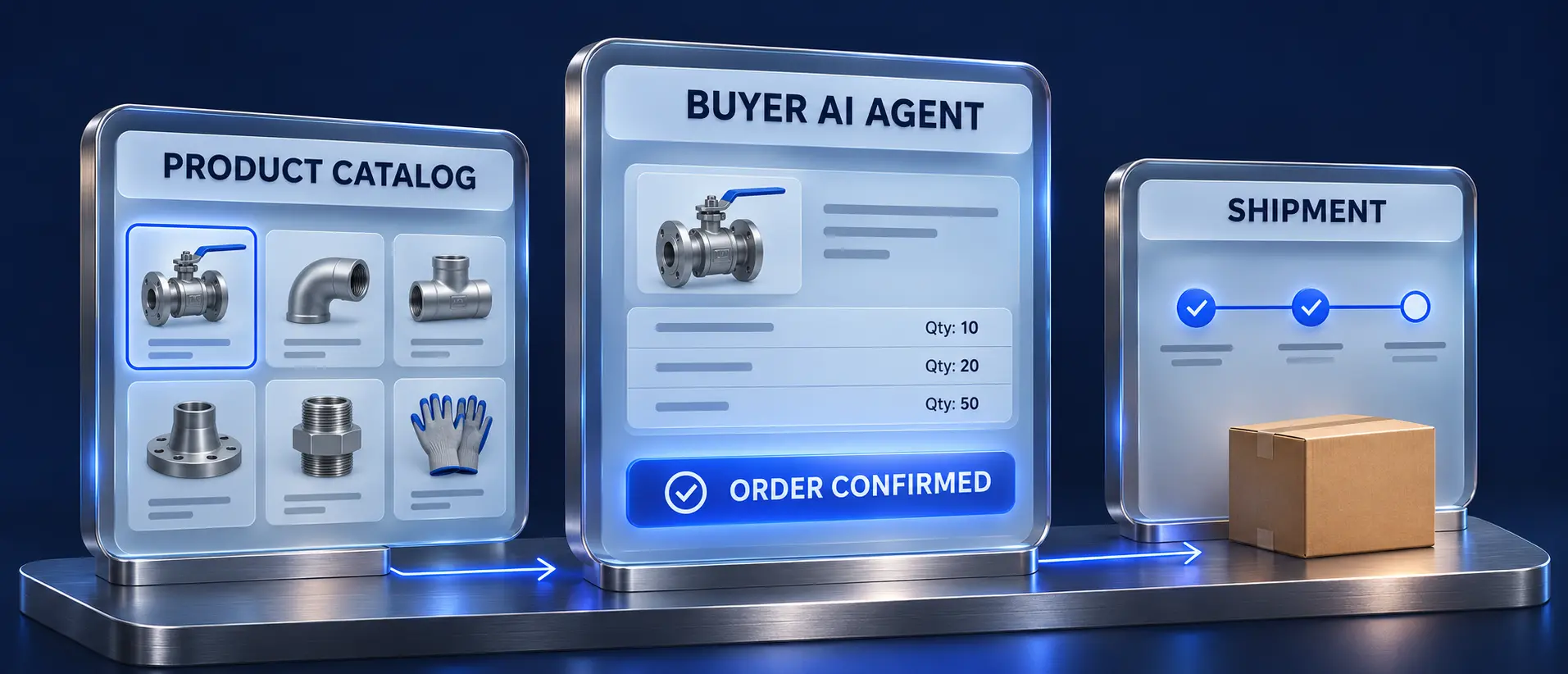
B2B buyers already ask AI assistants to shortlist suppliers, and the assistants are starting to place orders too. Most explanations of what agentic commerce is were written for consumer retail, with one shopper, one price and one card. A distributor or manufacturer sells on contract prices, branch inventory, credit terms and approval chains, and an AI agent can use none of that unless the seller’s systems expose it. This guide defines the term, shows how agents find, compare and buy, explains the four protocols you will hear about and what each commerce platform supports, and lists the ERP data work to start this quarter.
What is agentic commerce?
Agentic commerce is buying and selling in which an AI agent acts for the buyer: it finds products, compares offers and completes some or all of the purchase within limits the buyer sets. The buyer states a goal (“reorder the bearings we ran out of, at our contract price, delivered by Friday”), and the agent does the searching, checking and ordering a person would otherwise do on a website or by phone.
“Agentic” means the software takes actions as well as answering questions. That separates an agent from the AI features most stores already run:
| Tool | What it does | Who places the order |
|---|---|---|
| Recommendation engine | Suggests products based on behavior | The buyer, on the seller’s site |
| AI shopping assistant | Answers questions and builds a shortlist in a chat | The buyer, after clicking through |
| AI agent (agentic commerce) | Searches, compares, fills the cart and submits the order, with or without a final human confirmation | The agent, inside rules the buyer approved |
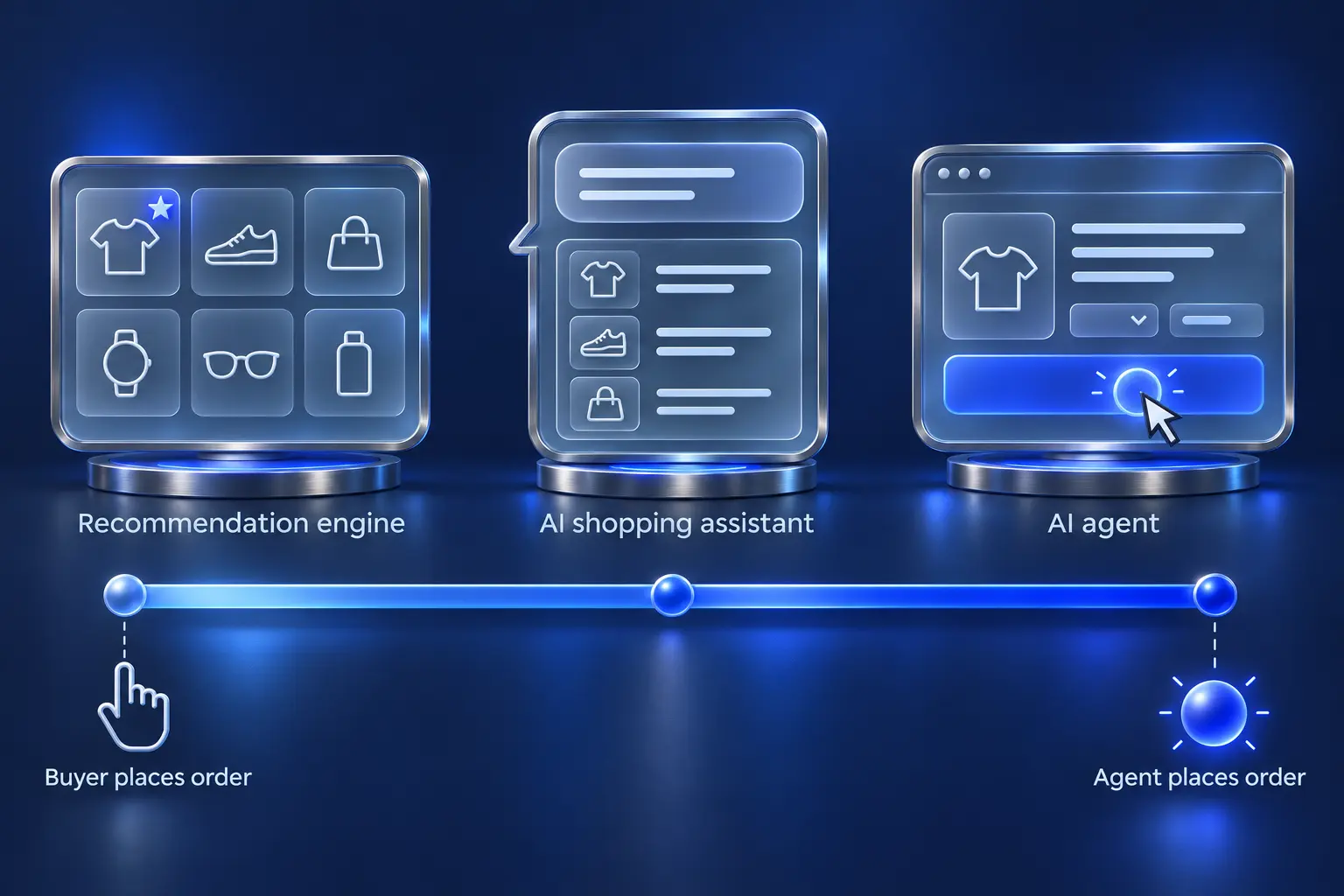
An agent that hands the final step to a human, or to the seller’s own checkout, still counts: the software acted for the buyer up to that point.
How AI agents discover, compare and buy
An agent goes through the same three stages a human buyer does, but it reads data instead of pages, and it fails quietly when the data is missing or wrong.
| Stage | What the agent does | What it needs from the seller |
|---|---|---|
| Discover | Finds candidate products and suppliers for the stated need | Structured product data: attributes, specs, cross-references, compatibility, a feed or API it can query |
| Compare | Checks price, availability, delivery date and fit | Prices and stock that are correct for this buyer, plus lead times and shipping rules |
| Buy | Builds the order, applies payment or terms, submits it, tracks it | A way to create an order or quote, the buyer’s payment method or credit terms, order status updates |
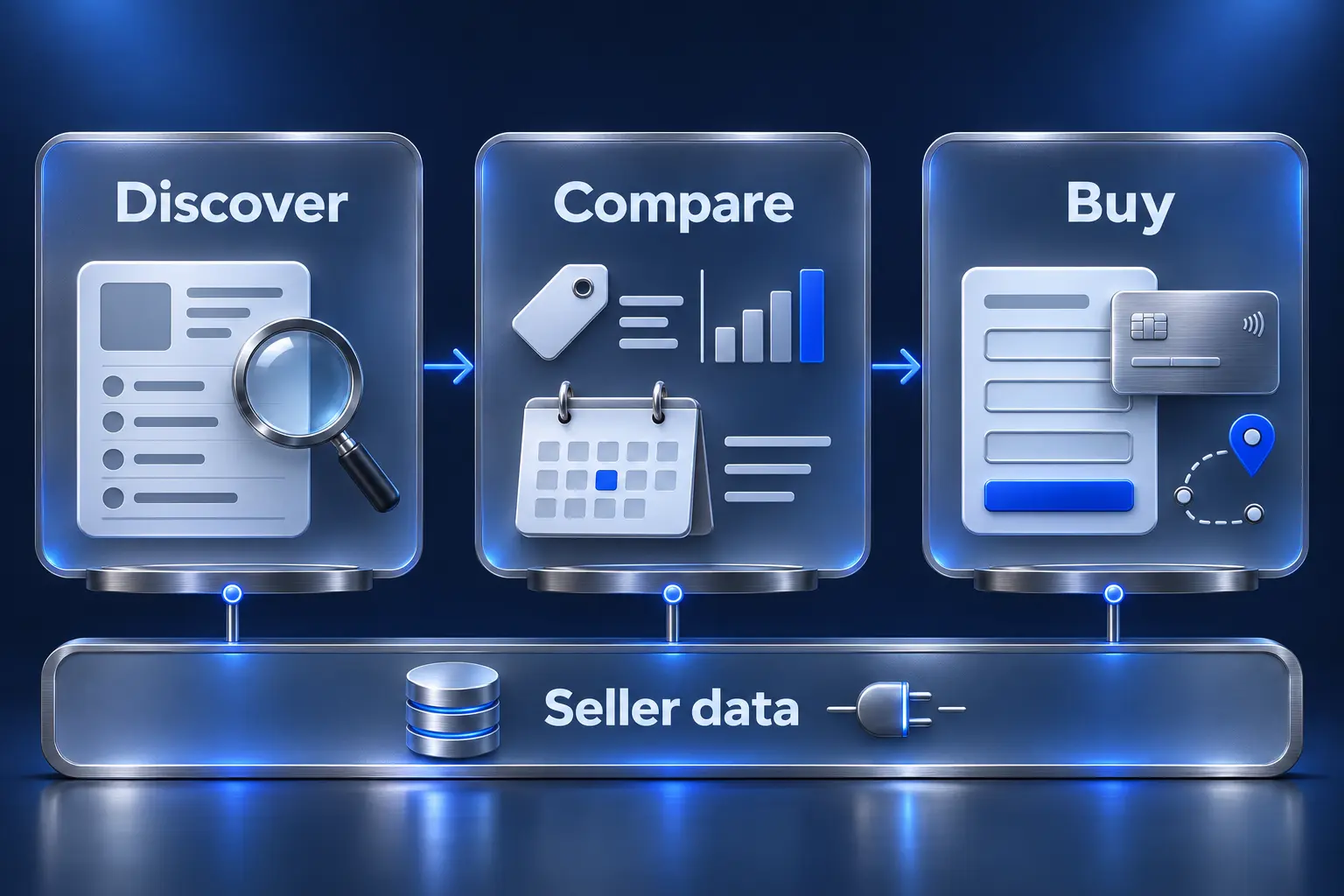
Consumer agents can get through the first two stages with a public catalog and a list price. A business buyer’s agent can’t, because the right answer at the compare stage depends on who is asking.
A hypothetical example: a procurement agent reorders plant parts
The companies and numbers below are invented to show how it works.
A food-packaging plant runs its purchasing through procurement software with an AI agent attached. Its maintenance system flags that stock of a sealed bearing has dropped below the reorder point, and that a conveyor belt is due for replacement. The plant buys both from a regional distributor with 45,000 SKUs and three branches.
- Discover. The agent searches the distributor’s catalog for the bearing’s part number and the belt’s width and length. It finds both, plus an equivalent bearing from a second brand.
- Compare. The public price for the bearing is $6.25 each. The plant’s contract price is $4.10. The agent also needs to know that the distributor sells this bearing in boxes of 10, that the nearest branch has 25 in stock and a second branch has 60, and that the belt ships from the manufacturer in five business days.
- Buy. The agent builds an order for 40 bearings ($164.00) and two belts at $1,450 each ($2,900.00), for $3,064.00 in total. Two rules apply here: the plant’s approval policy sends any order over $2,500 to the maintenance manager, and the distributor’s ERP shows the account at $48,200 of a $50,000 credit limit on net-30 terms, so this order would push it over.
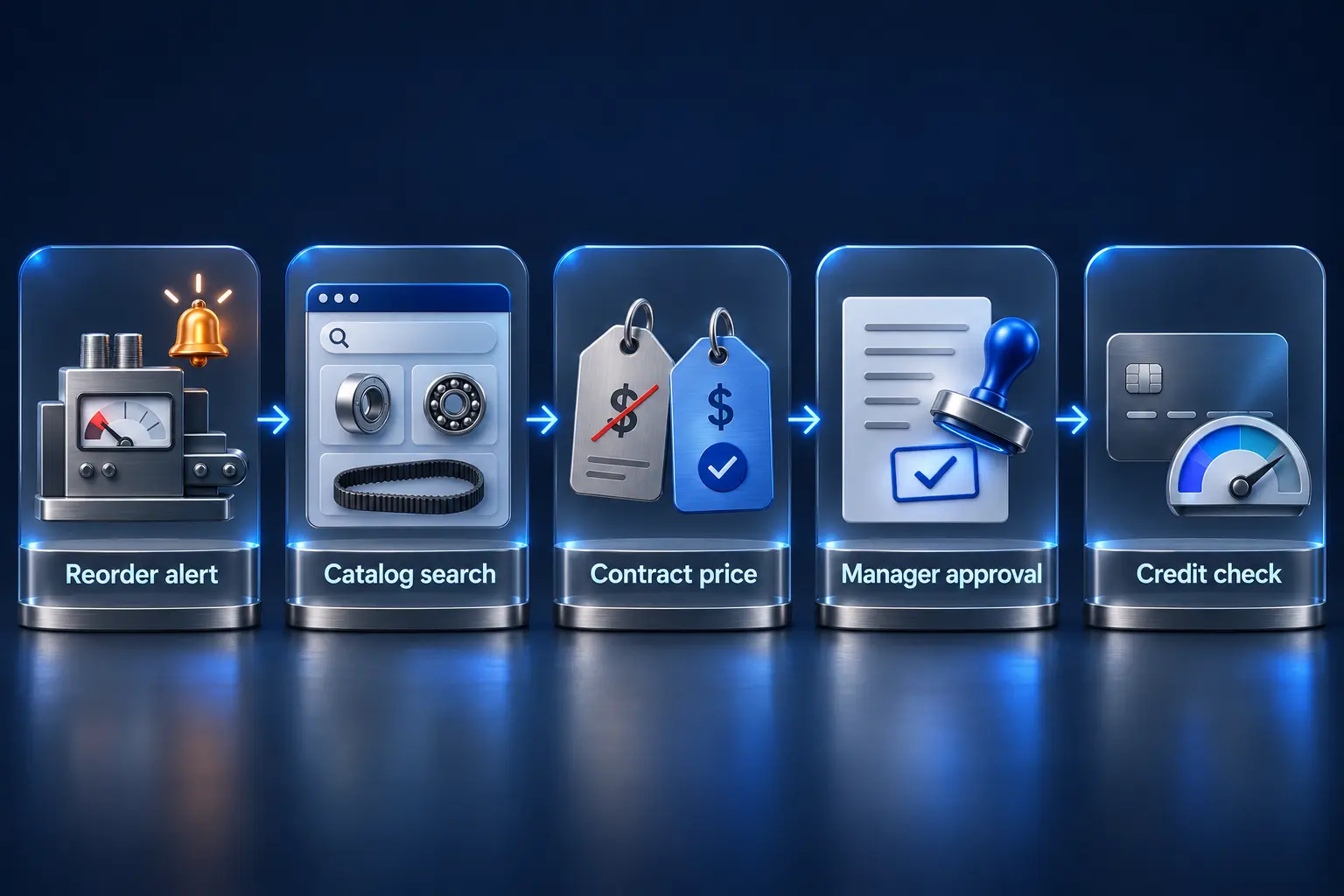
A well-built agent stops at step 3, sends the order to the manager and flags the credit issue. A poorly fed agent quotes $6.25, orders 40 boxes instead of 40 bearings, or submits an order the ERP will put on credit hold. Each failure comes from data the agent couldn’t see, and on a distributor’s side most of that data lives in the ERP.
Where agentic commerce stands in 2026
Agents are strong at finding products and still early at checkout, as the OpenAI and Google programs show.
- OpenAI launched Instant Checkout in ChatGPT and open-sourced the Agentic Commerce Protocol on September 29, 2025. On March 24, 2026, OpenAI said the first version of Instant Checkout fell short of the flexibility it wanted, began letting merchants use their own checkout, and focused the protocol on product discovery. ChatGPT’s help center still shows Instant Checkout for some eligible products and merchants.
- Google introduced the Universal Commerce Protocol on January 11, 2026 to power buying in AI Mode in Search and the Gemini app.
Traffic from AI tools is growing and converting. Adobe’s AI Traffic Trends Report (August 2026), based on more than one trillion visits to US retail sites, found AI-referred retail traffic up 62% year over year in July 2026, and AI-referred visitors converting at a rate 60% higher than other traffic. The report covers consumer retail and counts referrals, not purchases completed by agents.
Business buyers use agents for research far more than for buying. In G2’s 2026 Buyer Behavior Report (a global survey of 1,038 B2B decision-makers, fielded June 2026), over 60% of buyers said they use or plan to use AI agents in software buying, but only 9% are comfortable letting agents make purchases within approved limits. Nearly half (47%) would let an agent research and recommend while humans make all final decisions. The survey asked about software purchases, so treat it as a signal for parts and supplies, not a measure.
Gartner goes further. Prediction (Gartner, October 2025): “By 2028, 90% of B2B buying will be AI agent intermediated, pushing over $15 trillion of B2B spend through AI agent exchanges.”
Our prediction: B2B agents will handle discovery and reorders of known items at scale well before they handle first-time purchases from new suppliers. A reorder comes with a clear specification, an existing contract and an existing account, which is the data an agent needs and a new-supplier purchase lacks.
Agentic commerce protocols: ACP, UCP, MCP and AP2
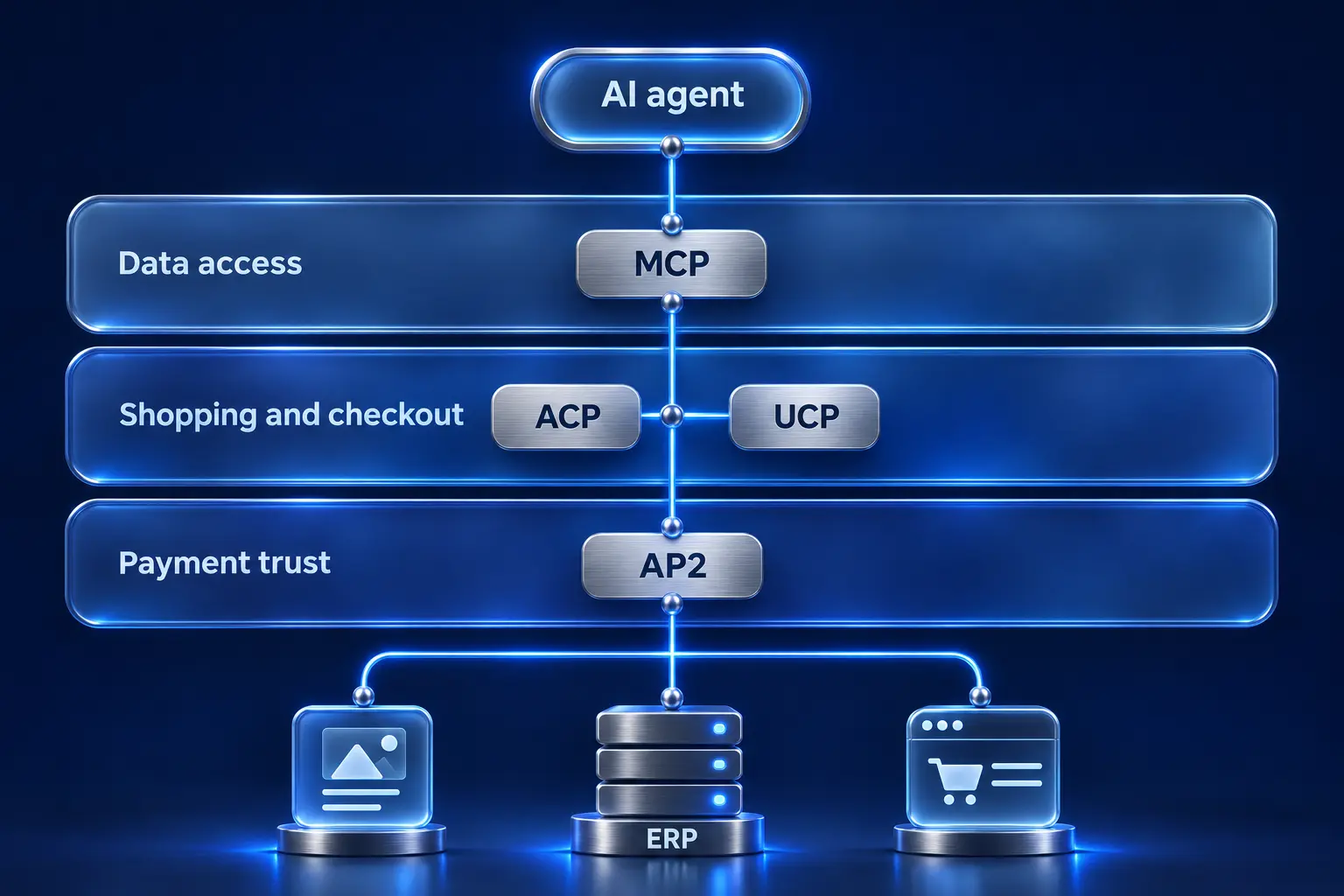
A protocol is a shared set of rules that lets an AI agent and a store’s systems talk without a custom integration for each pair. A B2B seller will most likely hear about four: two for shopping and checkout, one for data access and one for proving a payment was authorized.
| Protocol | Who created it | What it’s for | Status (October 2026) |
|---|---|---|---|
| Agentic Commerce Protocol (ACP) | OpenAI and Stripe | Getting products found in ChatGPT, plus checkout and payment | Open source, in beta; mainly used for product discovery since March 2026 |
| Universal Commerce Protocol (UCP) | Google, with Shopify, Etsy, Wayfair, Target and Walmart at launch | Catalog search, cart, checkout and orders across Google’s AI surfaces and others | Open source; latest release August 25, 2026 |
| Model Context Protocol (MCP) | Anthropic, now under the Linux Foundation | Connecting any AI assistant to your own tools and data; not specific to commerce | Open standard; latest specification July 28, 2026 |
| Agent Payments Protocol (AP2) | Google, now under the FIDO Alliance | Signed proof of what the buyer authorized the agent to buy | Open protocol, early (v0.2) |
ACP (Agentic Commerce Protocol)
ACP is the open standard behind shopping in ChatGPT, and since March 2026 OpenAI uses it mainly for product discovery. The ACP repository names OpenAI and Stripe as founding maintainers, and Stripe’s documentation adds Meta as a co-creator. Our UCP vs ACP comparison covers how the two differ.
UCP (Universal Commerce Protocol)
UCP is Google’s open standard for agent-led shopping and checkout. A store publishes what it supports in one profile file on its own domain, so agents can find its capabilities without a custom integration. The August 25, 2026 release added deferred payments, deposits, installment schedules and split payments, which we read as the first sign of buying on terms in a consumer protocol. Our UCP guide for stores explains the integration options.
MCP (Model Context Protocol)
MCP matters most for B2B data today. Anthropic introduced MCP in November 2024 as an open standard for secure, two-way connections between data sources and AI tools, and since December 2025 it has sat under the Agentic AI Foundation at the Linux Foundation. An MCP server exposes your data and actions to an AI assistant, and the current specification requires the assistant to get the user’s consent before it runs an action. UCP and ACP both work over MCP, so an MCP server is a reasonable place to put account-aware data. I covered the model in more depth in MCP as a modern language for LLMs.
AP2 and the card networks
AP2 answers the finance team’s question: how does a seller prove the buyer authorized an order? Google announced AP2 in September 2025, built around signed records of what the buyer asked for and approved. In April 2026, Google donated AP2 to the FIDO Alliance, which continues the work with Mastercard and Visa chairing the payments group.
The card networks run their own programs too. Visa’s Trusted Agent Protocol helps merchants tell trusted agents from malicious bots, and Visa Intelligent Commerce Connect, in pilot since April 2026, gives businesses one integration for agent payments across ACP, UCP and Visa’s own protocol. Mastercard’s Agent Pay includes a B2B example with a virtual corporate card.
What Shopify, Adobe Commerce, Shopware and BigCommerce support
| Platform | Native agentic commerce support |
|---|---|
| Shopify | Agentic storefronts, on by default for eligible stores, list products in ChatGPT, Google AI Mode and Gemini, Microsoft Copilot and Meta; with direct checkout turned on, buyers in the Google, Copilot and Meta channels can complete the purchase without leaving them. Shopify co-developed UCP and offers MCP servers for catalog, cart, checkout and orders. |
| Adobe Commerce | Adobe has committed to supporting UCP and ACP (February 2026). At Adobe Summit in April 2026 it announced native product feeds built for AI assistants and introduced a Commerce MCP server, which the documentation marks “Coming soon.” |
| Shopware | An experimental Agentic Commerce sales channel, added in Shopware 6.7.10.0 (May 2026), generates a product feed for ChatGPT. Shopware’s free Agentic Commerce (Beta) extension adds UCP support. |
| BigCommerce | Endorsed UCP in January 2026, and Catalyst 1.12.0 (September 2026) serves UCP on a Catalyst storefront’s own domain. Its MCP server, in beta, includes B2B Edition tools for shopping lists, shopping-list approvals and quotes. |
A B2B seller doesn’t need to pick a protocol yet. Publish your public catalog through your platform’s native channel, and put the account-specific effort into a controlled data layer that an MCP server or API can sit on. Clean, account-aware data carries over to any of these protocols.
Why consumer definitions of agentic commerce miss B2B
AI in B2B ecommerce has to handle a company account with many buyers, prices negotiated per customer, and payment on terms. UCP’s August 2026 release added payment terms and installment schedules, but neither ACP nor UCP covers credit limits or buyer approval chains.
| Consumer assumption | B2B reality | Where the answer lives |
|---|---|---|
| One price per product | Contract, tier, volume and job pricing per account | ERP pricing records, sometimes a CPQ tool |
| “In stock” or “out of stock” | Stock by branch or warehouse, allocated stock, lead times | ERP or WMS |
| Sold as “each” | Sold by box, case, pallet, foot or pound, with conversions | ERP item master |
| Pay by card now | Net terms, credit limits, POs, open invoices | ERP accounts receivable |
| One buyer decides | Buyer, approver and budget holder, with spend limits | Commerce platform or the buyer’s procurement system |
The commerce platforms already model some of this for human buyers. Adobe Commerce B2B purchase order approval rules let a company control who can create purchase orders and how much they can spend, and Shopify B2B supports payment terms of net 7, 15, 30, 45, 60 or 90 days. An agent needs the same rules exposed as data it can query. BigCommerce’s beta MCP server covers part of this: an agent can submit a shopping list for approval or request a quote, within the buyer’s B2B Edition permissions.
ERP data is the prerequisite for B2B agentic commerce
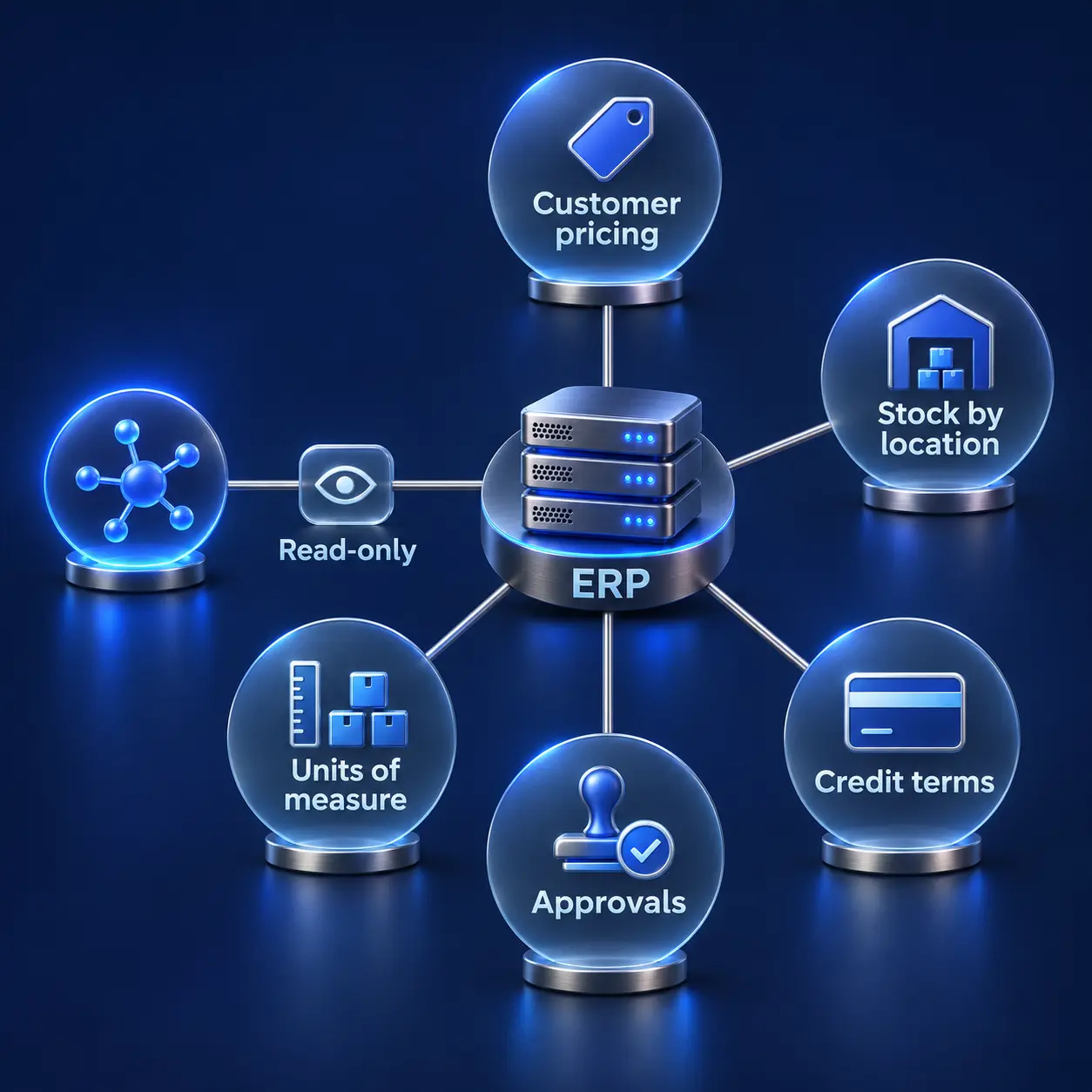
For a distributor or manufacturer, an agent can only be as correct as the ERP data it can reach. The storefront often holds a copy of prices and stock; the ERP holds the version the invoice will use. Five data sets decide whether an agent’s answer is right:
- Customer-specific pricing. The agent must get the price this account will be invoiced, including contract, quantity breaks and freight rules. A list price answer is worse than no answer, because the buyer’s agent will compare it against competitors.
- Inventory by location. Availability per branch or warehouse, with lead times for non-stock items. Nightly sync fails here: an agent that promises Friday delivery from stale stock creates a problem your team has to fix by phone. Our guide to real-time ERP inventory sync covers the sync patterns.
- Credit terms and account status. Terms, credit limit, available credit and holds: enough of the receivables picture to know whether the ERP will accept the order.
- Units of measure. Sell unit, pack quantity and conversions, stored in structured fields, not in a product description. In the example above, one missing conversion turns 40 bearings into 400.
- Approval workflows. Who can order what, up to which amount, and who approves the rest. This often lives in the commerce platform or the buyer’s procurement system, but the seller must accept and return the approval state.
In our integration work, units of measure and customer-specific pricing are the two areas where storefront data most often drifts from the ERP.
The pattern that works is a controlled layer between the ERP and everything that reads from it. When Atwix replatformed Graphic Solutions Group to Adobe Commerce, the team integrated the store with GSG’s Kodaris supply chain solution, so the site never needs to call Infor CSD’s APIs directly, and added real-time price updates with customer-specific pricing. The same principle applies when the reader is an AI agent: one layer that knows the ERP’s data model, applies permissions and serves every channel.
We are applying that principle to AI on Infor CloudSuite Distribution. In the Sirius MCP early-access program, a team’s own AI assistant queries CSD data through an MCP server, and access depends on the user’s role, such as sales rep, finance, warehouse or customer support, so each person sees only the data their role allows. Bring your own AI to your ERP explains how it works.
What are the risks of agentic commerce?
The main risks are wrong answers, unauthorized orders and data exposure, and each has a control you can put in place now.
| Risk | What it looks like | Control |
|---|---|---|
| Wrong price or stock | Agent quotes list price or stale availability | Serve price and stock from the ERP, with a timestamp the agent can see |
| Unauthorized purchase | Agent orders above a buyer’s limit | Approval rules enforced on the order, plus signed authorization such as AP2 where supported |
| Data exposure | One account’s prices visible to another | Account-level sign-in and role-based permissions on every query |
| Bad bots posing as agents | Scrapers pulling your price list | Agent identification (for example Visa’s Trusted Agent Protocol), rate limits and signed-in access for account data |
| Disputes | Buyer says “I didn’t order that” | Order logs showing what the agent requested and what the buyer approved |
Our note on the web turning bot-majority covers why telling a customer’s agent from a scraper is still hard.
What to do this quarter
None of these steps requires choosing a protocol, and each one also improves ordering for human buyers.
- Run a 20-SKU agent test. Take the 20 SKUs your top five accounts reorder most and check whether a system outside your storefront can get the right contract price, branch stock, sell unit and lead time for a named account through an API. Log every miss by data set.
- Map the five data sets to their source. For pricing, inventory, credit, units of measure and approvals, write down the system of record, its owner and how fresh the storefront copy is. Anything synced nightly goes on the fix list.
- Clean units of measure and attributes for your top SKUs. Put pack quantities, conversions and key specs into structured fields, because agents read fields and skip descriptions.
- Set an access policy before anyone asks. Decide which data an agent may read, for which accounts and roles, and keep anything that writes (orders, quotes) behind human approval for now.
- Measure AI traffic separately. Tag AI referrers in analytics and review bot and agent traffic in your CDN or firewall logs, so you have a baseline.
- Put AI on your own ERP data first. Let sales and customer service query the ERP through an AI assistant before you open anything to outside agents. Your staff will show you which questions matter and where the data is wrong.
- Train the team that will run it. Byrne Electrical Specialists put more than 90 employees across six business functions through a four-week AI program with Atwix, built around the workflows they handle every day.
- Publish your public catalog where agents shop. Use your platform’s native channel from the table above, and keep account pricing out of public feeds.
Reinders, a turf and irrigation company, rebuilt its site search so customers get more relevant results faster, and an agent depends on the same product data to find the right item. If you run Adobe Commerce, Shopware or Shopify, our post on preparing your commerce stack for AI buyers covers platform-specific architecture.
FAQ
What is the difference between agentic AI and agentic commerce?
Agentic AI is any AI system that plans and takes actions toward a goal, such as booking a meeting or filing a ticket. Agentic commerce is agentic AI applied to buying and selling: the agent finds, compares and purchases goods or services for a buyer. OpenAI’s agent mode, which carries out tasks in a browser, is an example of general-purpose agentic AI.
Can you give an example of agentic commerce?
In consumer retail, a shopper asks an AI assistant to find running shoes under $120 in their size, and the agent compares options and hands off to checkout. In B2B, a plant’s procurement agent notices low stock on a spare part, checks the distributor’s contract price and branch inventory, and sends the order to a manager for approval.
Is agentic commerce the same as conversational commerce?
No. In conversational commerce a person buys through a chat and makes each choice. In agentic commerce the software makes choices and takes steps for the buyer within set limits. ChatGPT’s shopping features do both: they started as product discovery, added in-chat checkout in September 2025, and from March 2026 let merchants use their own checkout.
Do I need to support ACP or UCP to sell to AI agents?
Not to start. Both protocols help your public catalog appear in AI assistants such as ChatGPT, Google AI Mode and Gemini, and the platform table above shows what your platform supports natively. UCP added payment terms in August 2026, but neither protocol handles contract pricing, credit limits or approval chains, which is the bigger gap for B2B sales.
Will AI agents replace B2B sales reps?
Prediction: not in the next few years. Agents will take over routine reorders and status questions, and reps will spend more time on quotes, new accounts and exceptions, with humans approving most orders.
Get your catalog and ERP ready for AI buyers
For a B2B seller, the first agentic commerce project is a data project: the prices, stock, terms and units an agent needs must come from the ERP, correct for each account. Atwix runs AI services for ecommerce, from an AI-readiness (GEO) audit to AI and ERP integration. Start with the audit to see how AI assistants find and describe your catalog today. If the gaps sit in ERP data such as prices, stock, terms or units, our AI and ERP integration work covers that layer.