


B2B companies evaluating eCommerce platforms need decision-ready comparison data beyond generic features. With the B2B eCommerce market valued at $36.86 trillion in 2026 and projected to reach $61.66 trillion by 2031, platform selection directly impacts growth and competitive positioning.
This analysis examines the top eCommerce platforms for B2B based on real business requirements: custom pricing, ERP integration complexity, scalability metrics, and total cost of ownership. Discover which platforms deliver genuine B2B functionality versus retrofitted B2C solutions.
Top eCommerce Platforms for B2B: 2026 Comparison Matrix
| Platform | B2B-Specific Features | Integration Capabilities | Scalability Metrics | Total Cost of Ownership (Annual) |
|---|---|---|---|---|
| Adobe Commerce | • Advanced company hierarchies• Shared catalogs• Quote management• Purchase orders• Requisition lists | ERP/CRM integration capabilities, 1,000+ marketplace extensions, API-first architecture | 200,000+ orders/hour, unlimited SKUs, multi-entity support | $40,000 – $150,000+ (plus hosting, implementation, and maintenance) |
| Shopware | • Customer-specific pricing• Bulk ordering• Budget management• Sales rep tools• Rule-based pricing engines | API-first, Shopware Nexus integration hub, extensive integration ecosystem | 4,000+ orders/minute, 140,000+ SKUs, modular architecture | $7,200 – $78,000+ annually SaaS/PaaS includes hosting; scales with GMV) |
| Shopify Plus | • Native B2B checkout (all plans)• Wholesale pricing• Company accounts• Payment terms• Volume discounts | 16,000+ apps, strong API coverage (REST & GraphQL), native B2B features on all plans | Nine expansion stores, 10,000+ checkouts/minute, hybrid B2B/B2C | $27,600+ (0.2% transaction fee with Shopify Payments) |
Advanced B2B eCommerce Feature Analysis
While the matrix provides an at-a-glance comparison, understanding how these features address real procurement workflows requires deeper analysis.
Custom Pricing and Account Management
Adobe Commerce leads with sophisticated company hierarchies supporting unlimited organizational levels, which is critical for enterprises with complex procurement chains. Multi-round RFQ negotiations and customer-specific shared catalogs enable contract-based selling at scale. The platform handles company credit limits, approval workflows, and requisition management natively.
Shopware delivers customer-specific pricing through flexible rule-based engines that accommodate volume tiers, customer segments, and time-based promotions simultaneously. Shopware Nexus provides an event-driven orchestration layer that simplifies B2B integration complexity.
As of April 2026, Shopify extended native B2B features to all plan tiers, not just Plus. This democratizes access to company accounts, custom catalogs (up to three on non-Plus plans), and volume pricing. Plus retains advanced capabilities, including unlimited catalogs and partial payments.
Bulk Operations and Purchase Orders
Implementation depth varies across platforms. Adobe Commerce processes large volumes via requisition lists and CSV uploads, supporting up to 999 lists per buyer account. Shopware offers quick reorder functionality and automated approval workflows that streamline repeat purchases. Shopify provides native quick-order lists with additional specialized apps available for advanced bulk scenarios, including custom order forms.
Integration Complexity Assessment
Integration Implementation Difficulty Ratings
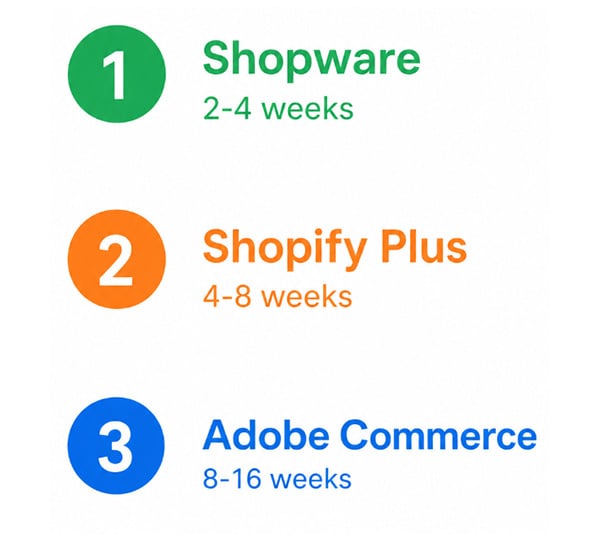
Rated from 1 (easiest) to 3 (hardest).
- Shopware – API-first architecture with Shopware Nexus (2-4 weeks typical ERP integration)
- Shopify Plus – Extensive app ecosystem, custom development often needed (4-8 weeks)
- Adobe Commerce – Comprehensive but complex options (8-16 weeks)
ERP and CRM Connectivity
Salesforce Integration: Adobe Commerce offers the deepest integration with bi-directional sync of customer data, orders, and service cases. Shopify Plus provides the quickest setup through certified apps with pre-built data flows. Shopware delivers flexible API-based integration with customizable field mapping.
SAP Integration: Adobe Commerce provides robust SAP connectivity through certified connectors, handling complex data mapping and real-time synchronization. Shopware offers streamlined SAP integration via API connections and Shopware Nexus. Shopify Plus typically requires middleware solutions like Celigo or Jitterbit for enterprise SAP deployments.
NetSuite Connectivity: Shopify Plus offers native apps with pre-built data flows for rapid deployment. Shopware provides flexible REST API connections with real-time data synchronization capabilities. Adobe Commerce delivers the most comprehensive integration: advanced workflow automation and financial reconciliation for multi-entity scenarios.
Microsoft Dynamics Integration: Shopware excels in Dynamics 365 connectivity through modular architecture and pre-built connectors optimized for European markets. Adobe Commerce supports both Dynamics NAV and 365 with extensive customization for multi-entity scenarios. Shopify Plus offers marketplace apps with varying levels of sophistication depending on the Dynamics version.
Oracle and Sage ERP: Adobe Commerce provides enterprise-grade connectors that support complex multi-entity scenarios and advanced financial workflows. Shopware handles Oracle integration through an API-first approach with custom mapping capabilities. Shopify Plus typically requires specialized integration partners for Oracle and Sage connectivity.
Implementation Timeline and TCO Analysis
Resource Requirements by Platform
- Adobe Commerce: 6-12 months requiring senior PHP/Magento developers and certified system integrators
- Shopware: 6-12 weeks with PHP/Symfony developers and Shopware-certified partners
- Shopify Plus: 3-6 months with Liquid/React developers and Shopify Partners
Three-Year TCO Scenarios
Mid-Market Manufacturer (1,000-5,000 orders/month):
- Adobe Commerce: $200,000-$350,000 (licensing, implementation, cloud hosting, maintenance)
- Shopware: $90,000-$165,000 (SaaS/PaaS hosting and support included)
- Shopify Plus: $120,000-$200,000 (including transaction fees and apps)
Enterprise Distributor (10,000+ orders/month):
Higher transaction volumes significantly shift the cost equations. Adobe Commerce becomes increasingly cost-effective at enterprise scale through flat licensing. Shopify Plus transaction fees can exceed $60,000 annually for high-volume merchants. Shopware provides predictable costs regardless of order volume with transparent licensing that includes hosting and core updates for SaaS/PaaS deployments.
Hidden Cost Considerations
- Adobe Commerce: Cloud infrastructure scaling, security patches, third-party module licenses
- Shopware: Additional plugin costs for advanced features, migration services for complex catalogs, and self-hosted deployments require separate hosting
- Shopify Plus: App subscription fees ($50-$500/month per app), transaction fees (waived with Shopify Payments), theme customization costs
Platform Selection Framework
Matching platform capabilities to your specific requirements accelerates implementation and reduces replatforming risk.
Choose Adobe Commerce when you need:
- Complex multi-brand operations with extensive customization
- Deep enterprise system integration across ERP, PIM, and CRM
- Proven scalability exceeding 10,000 orders monthly
- Advanced B2B workflows including multi-round negotiations and complex approval hierarchies
- Multi-entity support for global operations with localized catalogs
| Red flag: Avoid if you lack in-house PHP/Magento expertise or need to launch within 6 months. |
Choose Shopware when you prioritize:
- Rapid implementation timelines (6-12 weeks) with comprehensive B2B features
- Transparent, predictable pricing with built-in AI capabilities
- Strong European market presence and GDPR compliance
- Modular architecture supporting composable commerce strategies
- Cost efficiency for mid-market to enterprise growth trajectory
| Red flag: Limited North American agency ecosystem compared to other platforms. |
Choose Shopify Plus when you prioritize:
- Fastest time-to-market with extensive app ecosystem (16,000+ apps)
- Native B2B capabilities now available across all Shopify plans
- Strong hybrid B2B/B2C capabilities from single platform
- Proven enterprise reliability with simplified operational complexity
- Minimal technical resource requirements for ongoing management
| Red flag: Transaction fees and app costs can exceed initial budget projections at scale. |
The Bottom Line:
Selecting the top eCommerce platforms for B2B requires analyzing business-specific requirements, integration complexity, and total cost of ownership. Each platform serves different market segments: Adobe Commerce for enterprise complexity and unlimited customization, Shopware for rapid deployment with European market strength and cost efficiency, and Shopify Plus for speed-to-market with hybrid B2B/B2C models.
Success depends on implementation expertise and strategic utilization of B2B-specific capabilities. Consider proof-of-concept development, five-year cost modeling that includes hidden expenses, and an integration assessment specific to your existing technology stack.
Why Work With an Experienced Implementation Partner
Working with experienced implementation partners accelerates deployment and reduces risk. Atwix maintains #1 Magento contributor status globally and Platinum Shopware Partner certification, with proven B2B implementations across Adobe Commerce, Shopware, and Shopify Plus. Our multi-platform expertise enables objective recommendations based on your requirements rather than vendor relationships.
Recent B2B implementations include complete portal transformations delivered in 8 weeks (Byrne Electrical), 230% revenue growth through platform optimization (PowerPak), and 73% reduction in product discovery time through AI-powered search (Reinders).
Contact Atwix today to discuss your B2B eCommerce requirements and receive expert recommendations for the top eCommerce platforms for B2B that align with your growth objectives.