
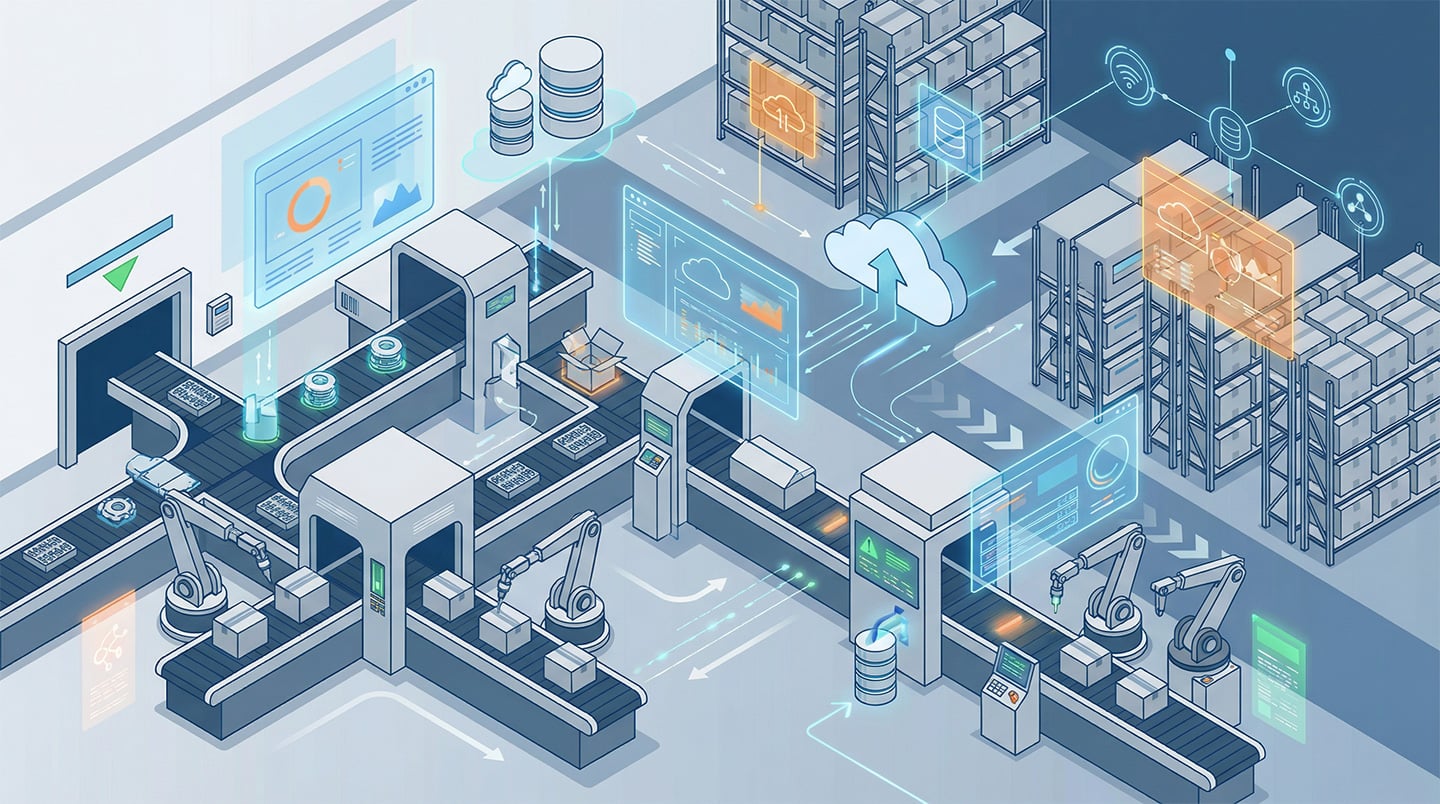

Manufacturing companies evaluating top ERP systems for manufacturing face a critical decision that impacts operational efficiency, eCommerce integration, and competitive positioning. According to VML’s 2023-2024 B2B Future Shopper Report, 49% of all B2B spending now occurs online, and 68% of buyers plan to increase their use of digital shopping channels. This makes the right ERP system the foundation for digital transformation, connecting production, inventory, pricing, and order fulfillment across all sales channels.
This ERP software comparison guide evaluates leading platforms based on eCommerce integration complexity, implementation timelines, and real-world manufacturing applications, differentiating from generic software reviews by focusing on how these systems connect with modern eCommerce platforms.
ERP Comparison Chart: Top ERP Systems for Manufacturing
The table below breaks down the top ERP systems for manufacturing, followed by detailed reviews of each platform.
| Rank | ERP System | Integration Com-plexity | Timeline | Cost Range | Best For | Platform Com-patibility |
|---|---|---|---|---|---|---|
| 1 | NetSuite ERP | Medium (RESTlet APIs, SuiteTalk) | 4-8 months | $999/mo base + modules | Mid-market manufacturers, cloud-first | Magento, Shopify Plus, Shopware, Big-Commerce |
| 2 | SAP S/4HANA | High (OData, 160+ integrations) | 6-12 months | $200+/user/mo | Global enterprises, complex operations | Magento, Shopify Plus, Shopware |
| 3 | Infor CloudSuite Industrial | High (ION middleware, extensive connectors) | 5-8 months | $150-$250/user/mo | Industry-specific (automotive, aerospace) | Magento, Shopify Plus, Shopware, Big-Commerce |
| 4 | Microsoft Dynamics 365 | Medium (REST APIs, Power Platform) | 3-6 months | $80-$110/user/mo | SME manufacturers, Microsoft ecosystem | Magento, Shopify Plus, Shopware, Big-Commerce |
| 5 | Epicor Kinetic | High (REST APIs, 250+ integrations) | 4-6 months | $175+/user/mo | Complex discrete manufacturing | Magento, Shopify Plus, Shopware |
| 6 | Oracle ERP Cloud | High (REST APIs, extensive ecosystem) | 6-10 months | $175-$500/user/mo | Large enterprises, multi-national | Magento, Shopify Plus, Shopware |
| 7 | Acumatica Cloud ERP | Medium (RESTful APIs, open architecture) | 2-4 months | Usage-based ($15K-$150K/year) | Growing mid-market, unlimited users | Magento, Shopify Plus, Shopware, Big-Commerce |
| 8 | Plex Smart Manu-facturing | Medium-High (APIs, IoT-focused) | 3-5 months | Custom pricing | IoT-enabled factories, Industry 4.0 | Magento, Shopware, custom platforms |
Cost Disclosure: All pricing represents only the starting subscription costs. Total investment varies based on user count, modules, customization, ERP integration architecture, and data migration. Budget 50-150% of annual software costs for implementation services.
Top ERP Software: Individual System Breakdowns
1. NetSuite ERP: Cloud-Native Leader

Oracle NetSuite pioneered cloud ERP with strong eCommerce integration capabilities. RESTlet APIs enable bi-directional synchronization with Magento, Shopify Plus, Shopware, and BigCommerce. Real-time inventory updates prevent overselling, while customer-specific pricing flows automatically to eCommerce storefronts. The platform excels at handling complex pricing scenarios, including volume discounts, contract pricing, and channel-specific markups.
NetSuite’s SuiteSuccess methodology delivers pre-configured workflows specifically designed for manufacturing, reducing implementation time by up to 60% compared to custom configurations. The platform handles:
- Work order management
- Production scheduling
- Routing and bill of materials (BOM) management
- Quality control
- Multi-location inventory optimization
Advanced supply chain planning capabilities include:
- Demand forecasting
- Automated inventory replenishment
- Procurement optimization
The system’s unified architecture means manufacturing, financials, CRM, and eCommerce operate from a single database, eliminating the data silos that plague multi-system environments. This unified approach enables manufacturers to track customer interactions from initial quote through production, fulfillment, and repeat orders.
For manufacturers pursuing omnichannel strategies that sell through distributors, direct sales, and eCommerce simultaneously, NetSuite’s multi-channel order management ensures a consistent customer experience across all touchpoints.
Best For: Mid-market manufacturers ($10M-$500M revenue) requiring rapid deployment with strong eCommerce capabilities.
2. SAP S/4HANA: Enterprise Standard

SAP delivers comprehensive solutions for large-scale manufacturing. Built on HANA in-memory database, it provides real-time analytics with Joule AI automation. OData APIs and 160+ pre-built integrations through SAP Open Connectors support complex B2B eCommerce. Production planning and detailed scheduling (PP/DS) handles multi-level BOMs, co-products, and constraint-based finite scheduling.
S/4HANA’s manufacturing execution system (MES) capabilities provide shop-floor control, real-time production tracking, quality management integration, and asset management across global facilities. The platform’s strength lies in handling the most complex manufacturing scenarios:
- Global multi-site operations with transfer pricing
- Joint ventures requiring inter-company transactions
- Regulated industries demand comprehensive audit trails
SAP’s quality management module integrates directly with production processes, enabling statistical process control, certificate-of-analysis generation, and automated non-conformance handling.
For manufacturers with complex supply chains spanning multiple continents, S/4HANA’s global trade management functionality automates compliance with import/export regulations, manages restricted party screening, and calculates landed costs, including duties and tariffs. The embedded analytics provide real-time visibility into manufacturing performance metrics, including Overall Equipment Effectiveness (OEE), which measures plant performance and operational efficiency. While implementation complexity and cost are higher than alternatives, manufacturers requiring comprehensive depth across all business functions find S/4HANA unmatched in capabilities.
Best For: Global manufacturers with multi-site operations and revenue exceeding $500M.
3. Infor CloudSuite Industrial: Industry Specialist

Infor delivers pre-configured workflows for regulated industries, including automotive and aerospace. ION middleware provides robust integration with extensive CloudSuite connectors. Atwix’s Infor Pre-Integrated Solution significantly accelerates implementation timelines. Mixed-mode manufacturing supports make-to-stock, make-to-order, engineer-to-order, and configure-to-order scenarios.
CloudSuite Industrial’s industry-specific approach means manufacturers in the automotive, aerospace, defense, and industrial equipment industries benefit from pre-configured compliance workflows for standards such as AS9100, ISO 13485, and ITAR. The system handles complex requirements, such as:
- Serialized traceability (tracking individual components from raw materials through finished goods)
- Engineering change order (ECO) management with revision control
- Advanced quality management with first-article inspection (FAI) documentation
These vertical-specific capabilities significantly reduce configuration effort compared to horizontal ERP platforms requiring extensive customization.
The platform’s project manufacturing capabilities excel for complex capital equipment manufacturers and custom machinery builders. Job costing tracks actual costs against estimates at granular levels, while resource scheduling balances workload across production facilities and external subcontractors.
Configuration management capabilities enable manufacturers to offer product variations without creating separate SKUs for every combination, which is critical for companies offering engineered-to-order products with thousands of potential configurations. Infor’s focus on usability means shop floor workers, quality inspectors, and production planners can access relevant information through role-based dashboards without extensive training.
Best For: Manufacturers in regulated industries requiring compliance tracking and mixed-mode production.
4. Microsoft Dynamics 365 Business Central: SME Value

Dynamics 365 offers exceptional value within the Microsoft ecosystem. REST APIs and 1,000+ Power Platform connectors facilitate eCommerce integration. Power Platform enables the creation of custom workflows without extensive coding. It supports discrete manufacturing with MRP, capacity planning, and quality management. Process manufacturing capabilities are available through third-party extensions.
For manufacturers already using Microsoft 365, Teams, and Azure, Business Central delivers immediate productivity benefits through familiar interfaces and native integration. Employees can access inventory levels, production schedules, and customer information directly within Teams without switching applications. Power BI provides embedded analytics with pre-built manufacturing dashboards tracking production efficiency, inventory turns, and order fulfillment metrics. The Power Apps framework enables business users to create custom mobile applications for shop floor data collection, quality inspections, and inventory counting without engaging professional developers.
Business Central’s production management capabilities support both backward and forward flushing for material consumption, capacity planning based on work center availability, and subcontracting workflows for outsourced operations. The system handles manufacturing BOMs, routing configurations, and production order tracking with adequate depth for most small-to-medium discrete manufacturers. While less comprehensive than SAP or Infor for extremely complex scenarios, Business Central delivers a 40-50% lower total cost of ownership than enterprise ERP alternatives. The platform scales effectively as businesses grow, allowing manufacturers to start with core financial and manufacturing modules and add distribution, CRM, and service management capabilities as requirements evolve.
Best For: Growing manufacturers ($5M-$100M revenue) seeking rapid implementation with Microsoft integration.
5. Epicor Kinetic: Discrete Manufacturing Expert

Epicor specializes in complex discrete manufacturing, including job shops and engineer-to-order operations. Advanced planning tools optimize production sequences based on material availability and capacity constraints. Finite scheduling models shop floor capacity realistically, accounting for machine maintenance and operator skill levels.
Kinetic’s Advanced Planning and Scheduling (APS) module provides constraint-based scheduling that considers material availability, tooling requirements, operator skills, machine capacity, and setup times simultaneously. What-if scenario planning enables production schedulers to evaluate the impact of rush orders or priority changes before disrupting existing schedules. The system automatically resequences work orders when materials arrive late or machines require unplanned maintenance, minimizing production disruptions. For job shops managing hundreds of concurrent work orders with varying priorities, this intelligent scheduling capability transforms chaotic shop floors into efficient operations.
The platform’s engineering change management capabilities track revisions across BOMs, routings, and work instructions, ensuring shop floor operators always work from current specifications. Material Requirements Planning (MRP) handles complex component requirements, including phantom assemblies, co-products, and alternate materials. Quality management integrates with production operations for in-process inspections, non-conformance tracking, and corrective action workflows.
For manufacturers quoting custom projects, Epicor’s estimating module links directly to BOMs and routings, enabling accurate job costing that feeds back into future estimates. The system’s flexibility accommodates the reality of discrete manufacturing: last-minute customer changes, material substitutions, and production improvisation that rigid systems struggle to handle.
Best For: Job shops and make-to-order manufacturers with complex scheduling requirements.
6. Oracle ERP Cloud: Multi-National Operations
Oracle ERP Cloud provides centralized data management for large enterprises across multiple countries. Automated supply chain optimization leverages AI to optimize inventory levels and supplier selection. The system consolidates financial reporting while maintaining local compliance.
Oracle’s cloud-based architecture delivers global process standardization while accommodating local requirements for tax reporting, statutory accounting, and regulatory compliance. The multi-currency transaction management handles complex scenarios, including inter-company transfers with automatic elimination entries for consolidated reporting. Global accounting engines maintain both corporate and local GAAP simultaneously, producing consolidated reports for headquarters while generating statutory reports meeting local regulatory requirements.
Supply chain management capabilities leverage AI and machine learning for:
- Demand forecasting
- Safety stock optimization
- Supplier performance prediction
The platform automatically suggests optimal replenishment quantities based on historical consumption patterns, lead time variability, and demand volatility. Supplier collaboration portals enable vendors to view forecasts, confirm purchase orders, and update delivery schedules, reducing expediting costs and improving on-time delivery.
For manufacturers operating global supply chains with hundreds of suppliers across multiple continents, Oracle’s supplier management, procurement optimization, and logistics coordination provide the control and visibility required for efficient operations. The platform’s scalability supports the largest manufacturing enterprises, with thousands of users, millions of daily transactions, and complex organizational structures spanning business units, legal entities, and geographic regions.
Best For: Large enterprises with global operations requiring comprehensive financial controls.
7. Acumatica Cloud ERP: Flexible Pricing

Acumatica’s consumption-based pricing charges for resource usage rather than named users, enabling unlimited user access. Its open API architecture facilitates custom integrations without vendor lock-in. The modular design allows manufacturers to add capabilities as requirements evolve. Native Shopify Plus integration supports both B2B and B2C commerce.
The unlimited user licensing model eliminates the restrictions that force manufacturers to limit system access. Shop floor operators, warehouse workers, quality inspectors, and customer service representatives can all access the information they need without increasing subscription costs. This democratization of data access improves operational efficiency by enabling employees to make better decisions based on real-time information rather than outdated reports or verbal communications. The consumption-based model proves particularly valuable for seasonal manufacturers with fluctuating staffing levels or growing companies adding employees rapidly.
Acumatica’s manufacturing edition provides:
- Production management
- Material requirements planning
- Capacity planning
- Quality control
- A product configurator
The modular architecture allows businesses to implement financial management and basic manufacturing first, then add advanced features like field service management, project accounting, or distribution management as operational complexity grows.
The platform’s open API architecture and extensive marketplace of pre-built integrations enable manufacturers to connect specialized applications, such as CAD systems, quality management software, and advanced planning tools, without custom development. For mid-market manufacturers seeking an affordable, scalable ERP with strong eCommerce integration and no user-count penalties, Acumatica delivers exceptional value.
Best For: Mid-market manufacturers in growth phases wanting unlimited user access.
8. Plex Smart Manufacturing: IoT Integration
Plex offers a multi-tenant cloud architecture optimized for connected manufacturing. Its strong IoT integration connects production equipment directly to the ERP, providing real-time shop-floor visibility. Machine data flows automatically from CNC equipment and assembly lines.
Plex Production Monitoring, powered by Plex Mach2, provides seamless connectivity to machines on the plant floor. Production data flows automatically from CNC machines, injection molding equipment, stamping presses, and assembly systems, capturing cycle times, parts produced, downtime events, and quality measurements without manual data entry. This real-time data collection enables accurate OEE (Overall Equipment Effectiveness) calculations, identifies production bottlenecks immediately, and provides operators with actionable alerts when processes drift out of specification.
The platform’s multi-tenant SaaS architecture means all customers operate on the same code base, receiving automatic updates with new features and functionality without disruptive upgrade projects. This approach ensures manufacturers always operate on the latest software versions while eliminating the maintenance burden of traditional on-premises systems. Quality management closely integrates with production operations, tracking test results, managing non-conformances, and supporting inventory quality controls. Supply chain management provides supplier collaboration capabilities and purchasing management functionality. For manufacturers pursuing Industry 4.0 initiatives with connected equipment, predictive maintenance, and digital twin implementations, Plex provides the infrastructure and capabilities to realize a smart manufacturing vision.
Best For: Manufacturers prioritizing Industry 4.0 capabilities and IoT-enabled production monitoring.
Use Case Scenarios: Matching ERP to Manufacturing Models
Discrete Manufacturing (Automotive Parts, Electronics)
- Recommended: Epicor Kinetic or Infor CloudSuite
- Integration Priority: Real-time inventory, complex BOM management, serial/lot tracking
- Key eCommerce Features: Part number lookup, compatibility filtering, CAD file downloads
Process Manufacturing (Chemicals, Food & Beverage)
- Recommended: SAP S/4HANA or Infor CloudSuite
- Integration Priority: Batch/lot traceability, quality control data, compliance documentation
- Key eCommerce Features: Certificate of analysis downloads, regulatory documentation access
Engineer-to-Order (Custom Machinery)
- Recommended: Epicor Kinetic or Microsoft Dynamics 365
- Integration Priority: Project-based costing, custom configuration, quote-to-order workflow
- Key eCommerce Features: Product configurators with dynamic pricing, RFQ functionality
Integration Considerations: ERP Within Complete Digital Strategy
ERP integrations are rarely standalone projects. Successful manufacturing eCommerce implementations position ERP within a comprehensive digital transformation that includes eCommerce platforms, PIM, CRM, WMS, and CPQ systems.
The Middleware Advantage
Middleware provides a unified integration layer that connects all business systems. Rather than point-to-point integrations, middleware orchestrates data flow through a centralized hub with single integration points, data transformation, error handling, and reduced maintenance complexity.
[Insert link to Sirius landing page once live]
Real-Time Pricing: The Atwix Differentiator
Legacy integration patterns update pricing daily via batch processes, leading to pricing discrepancies and failed orders. Atwix’s integration solutions provide real-time pricing, ensuring customers view current, accurate contract-specific pricing pulled directly from your ERP.
- Halron Lubricants partnered with Atwix to implement Shopware as an open, flexible B2B commerce platform fully integrated with Infor CloudSuite Distribution. The solution ensured accurate product, pricing, and customer data across all ordering channels while giving Halron full control over content, customers, and catalog management without vendor dependency.
- Byrne Electrical Specialists implemented a custom Adobe Commerce (Magento) B2B portal with full ERP integration in just 8 weeks. The platform featured seamless ERP order information transfer and processing, 360-degree product views, non-catalog product functionality, and Magepack integration for enhanced site speed. The transformation led to improved customer satisfaction and employee productivity through automated order management.
Atwix specializes in complex ERP integrations for manufacturers, with over 150 certifications across major ERP platforms and proven expertise with Infor CloudSuite, NetSuite, SAP, Microsoft Dynamics, and Epicor. Our integration framework delivers enterprise-grade real-time synchronization for eCommerce platforms.
Key advantage: Experienced partners position ERP integration within your complete digital strategy, not as an isolated technical project. Whether launching eCommerce or expanding into new markets, specialized partners ensure your ERP integration supports larger business objectives.
Why eCommerce-Specific ERP Comparison Matters
Manufacturing has fundamentally changed. Today’s buyers research products online, configure complex solutions through web portals, and expect real-time pricing and inventory visibility across all channels. Your ERP system must power seamless customer experiences that drive revenue and competitive differentiation.
eCommerce integration quality directly determines whether your ERP investment accelerates growth or creates bottlenecks. Modern manufacturing eCommerce demands:
- Real-time synchronization between ERP and storefronts
- Customer-specific pricing complexity (contract terms, tiered discounts, promotional pricing)
- Multi-warehouse inventory allocation based on fulfillment priorities
- Product configuration capabilities that validate against engineering rules while calculating accurate pricing.
Traditional ERP evaluations focus on accounting features and back-office efficiency, missing these critical customer-facing capabilities entirely.
Manufacturers with superior eCommerce-ERP integration achieve measurable competitive advantages:
- Reduced sales cycle friction as customers self-serve standard orders
- Improved order accuracy eliminates costly manual data entry errors
- Enhanced customer experience builds loyalty through B2C-level digital capabilities
- Operational efficiency gains that scale without proportional increases in overhead
This transforms your ERP from a cost center into a revenue driver, which is why evaluating top ERP systems for manufacturing requires focusing on eCommerce integration quality alongside traditional ERP capabilities.
Frequently Asked Questions
How long does a manufacturing ERP integration project take?
Integration timelines range from 3 to 12 months, depending on complexity. NetSuite with BigCommerce may be completed in 3-4 months, while SAP with a custom Magento solution requires 8-12 months. Plan additional time for data migration, custom pricing logic, and multi-warehouse configuration.
What’s the total cost of ERP integration?
Budget 100-200% of annual ERP subscription costs for integration services. A $100,000 annual subscription typically requires $100,000 to $200,000 in implementation costs. Ongoing costs include maintenance (15-20% annually for on-premise systems) and platform improvements.
Can I integrate the existing ERP with new eCommerce platforms?
Yes, modern eCommerce platforms support integration with established ERP systems through APIs and middleware. Legacy ERPs with limited APIs may require middleware solutions for reliable connectivity.
Which ERP system has the best eCommerce integration?
NetSuite offers a strong, eCommerce-ready architecture with cloud-native APIs and extensive pre-built connectors for platforms such as Shopify, BigCommerce, Adobe Commerce, and WooCommerce. However, “best” depends on your manufacturing model; Infor CloudSuite excels for industry-specific requirements, while Microsoft Dynamics offers rapid SME deployment.
How does Atwix’s approach differ from standard implementations?
Atwix focuses specifically on the eCommerce-ERP connection with specialized integration expertise and proven methodologies for real-time pricing and inventory synchronization. Our Infor Pre-Integrated Solution significantly accelerates deployment timelines by pre-integrating Infor ERP with Adobe Commerce (Magento).
Selecting the Right ERP for Manufacturing eCommerce Success
Choosing among the top ERP systems for manufacturing requires evaluating how each platform connects with your eCommerce strategy. This ERP comparison chart presents leading options for 2026, each offering distinct strengths for different manufacturing scenarios.
NetSuite delivers cloud-native flexibility with strong eCommerce connectivity across Magento, Shopify Plus, Shopware, and BigCommerce. SAP S/4HANA provides unmatched capabilities for global enterprises. Infor CloudSuite Industrial offers specialized functionality, supported by Atwix’s Pre-Integrated Solution, which significantly reduces implementation timelines.
ERP implementations succeed or fail based on the quality of their integrations. Your ERP must seamlessly integrate with eCommerce platforms, CRM, and warehouse management systems. Manufacturers increasingly partner with specialized integration experts who understand both technical requirements and business context.
Ready to discuss your manufacturing ERP integration needs? Contact Atwix to explore how specialized ERP integration services can accelerate implementation, reduce costs, and deliver real-time synchronization. With 150+ successful integrations and deep manufacturing expertise, Atwix transforms ERP investments into competitive advantages.