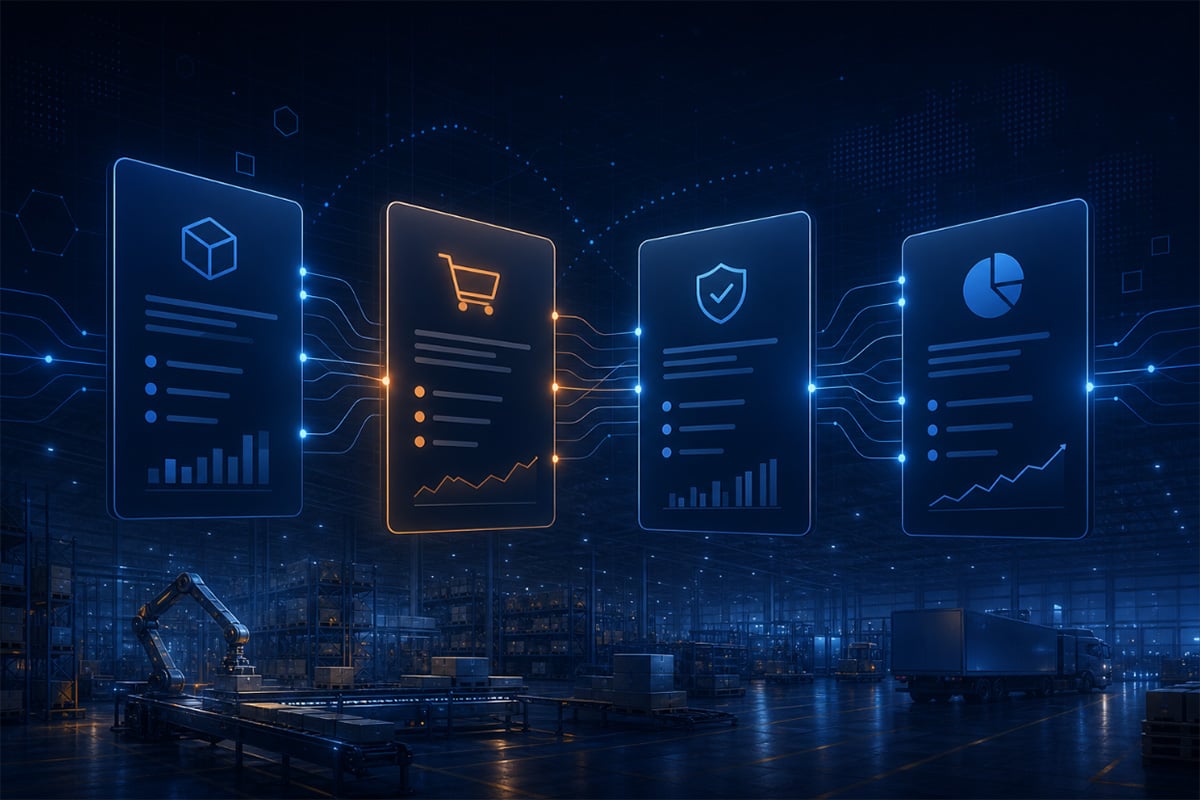

INTEGRATION SERVICES
eCommerce Integration Services
Atwix connects your store to the systems your business already runs on. ERP, CRM, PIM, payment gateways, shipping, marketplaces.
There are three ways to build that connection, and they cost and break in different ways. Most agencies sell you the one they happen to have. We start by telling you which one your situation calls for.
#1 global Magento contributor since 2018
Adobe Gold · Shopify Plus · Shopware Platinum · BigCommerce Certified
Which integration approach do you need?
Pick the wrong approach and you pay for it twice: once building it, again replacing it. The choice comes down to how far your processes sit from what a connector vendor assumed when they built theirs.
| Pre-built connector | Middleware / iPaaS | Custom API integration | |
|---|---|---|---|
| Fits when | Standard platform, standard ERP, standard processes | Several systems to link, requirements still moving | Proprietary or heavily customized systems, non-standard business logic |
| Speed | Fastest to launch | Moderate | Slowest to launch |
| Upfront cost | Lowest | Moderate, plus platform licence | Highest |
| Ongoing cost | Vendor licence, per connection | Platform licence, scales with volume | Maintenance only, no licence |
| Where it breaks | Your process differs from the connector’s assumptions and you cannot change either one | Transform complexity or record volume outgrows your plan tier | Nobody documented it and the person who built it left |
| What Atwix does | Implement, extend, and tell you when it will not stretch far enough | Build and operate on your platform of choice | Build to your logic, or deploy Sirius for ERP |

Pre-Built Connector
Best for standard platforms, standard ERPs, and standard order flows. This is the fastest and least expensive approach to launch, but it usually includes a recurring vendor license and depends on your processes fitting the connector’s predefined field mapping. Atwix implements and extends connectors, and will say when one is unlikely to stretch far enough.

Middleware
Best when you are connecting several systems or expect requirements to change. Middleware takes longer and costs more than a basic connector because of the platform license, but it gives your team a configurable layer for managing transformations and workflows without a developer ticket every time.

Custom API Integration
Best for proprietary systems, legacy ERPs, B2B contract pricing, multi-warehouse allocation, and other business logic that generic connectors cannot express. Custom integration has the highest upfront cost and the longest launch timeline, but it avoids per-transaction license fees and gives Atwix full control over the data flow.
Sirius: our ERP integration middleware
We built Sirius because we kept hitting the same wall on ERP projects. Connectors could not handle client-specific pricing tiers or multi-warehouse allocation, and every custom build restarted from zero.
Sirius sits between your store and your ERP as a middleware layer we own and maintain. You get the speed of a connector with the flexibility of a custom build, and no per-transaction licence.

eCommerce Integration Services We Build
Atwix covers the full scope of back-office connectivity, from the ERP that owns your inventory to the marketplace that resells it.

ERP integration
Keep orders, inventory, pricing, and customer data synchronized between your storefront and ERP. Atwix delivers eCommerce ERP integration for SAP, Microsoft Dynamics 365, NetSuite, Infor, Oracle, and Sage. For complex pricing, warehouse, or business logic requirements, Sirius provides a flexible middleware layer without per-transaction license fees.

CRM integration
Give sales and support teams a complete customer view by connecting purchase history, support tickets, and campaign data. eCommerce CRM integration connects your store with Salesforce, HubSpot, Zoho, and Microsoft Dynamics 365.

PIM integration
Keep product information accurate across every sales channel by centralizing attributes, descriptions, and images in Akeneo, Pimberly, or Syndigo. Atwix then synchronizes approved catalog data across storefronts and marketplaces.

Payment Gateway Integration
Simplify checkout across markets by connecting your store with PayPal, Stripe, Authorize.net, Braintree, Amazon Pay, and regional processors. Atwix manages currency logic, fraud rules, and payment method routing.

Shipping and Fulfillment Integration
Move orders from checkout to delivery with less manual work by connecting your store with ShipStation, Shippo, AfterShip, and Easyship. Automate carrier selection, rate shopping, label generation, and tracking updates.

Marketplace Integration
Expand your sales channels while keeping product data and inventory aligned by syncing your store with Amazon, eBay, Walmart, and Faire. Orders and stock levels stay coordinated across marketplaces and your primary storefront.
Integration services by platform

Gold Partner
Adobe Commerce
Enterprise eCommerce integration services for Adobe Commerce stores: ERP, CRM, and PIM integrations supporting multi-store inventory management, advanced pricing rules, and custom catalog synchronization.

Top Contributor 2018-2026
Magento Open Source
Custom API integration for Magento 2 stores and any third-party system. When a connector does not exist, we build directly against the API, database, or file interface.

Shopify Plus Partner
Shopify
Connect Shopify and Shopify Plus to ERP, CRM, and PIM systems. Shopify integrations built to handle the B2B workflows that standard apps do not support, including account-based pricing, draft orders, and multi-location inventory.
Platinum Partner
Shopware
API-first integrations for Shopware’s native B2B capabilities, including customer group-based pricing, multi-warehouse stock display, and ERP-driven product data.

Certified Partner
BigCommerce
Connect BigCommerce to SAP, NetSuite, Salesforce, and other back-office systems using BigCommerce’s native API and our established integration framework.
How an integration project runs

Systems audit
We map what you have, what talks to what today, and where people are manually retyping data.

Approach decision
We recommend connector, middleware or custom, and show the cost of each over three years rather than just at contract signature.

Field and process mapping
The unglamorous step that decides whether the project works. Order states, tax logic, pricing tiers, and warehouse rules are documented before a line of code is written.

Build and test
Implementation with regression testing built in, not as an afterthought.

Launch and ongoing support
24/7 monitoring, proactive maintenance, and regression testing against every platform or ERP upgrade.
What are eCommerce integration services?
eCommerce integration services connect an online store to the back-office systems that hold the rest of the business data, so orders, inventory, customers and product information move between them without anyone retyping it.
- What gets connected: ERP, CRM, PIM, payment gateways, shipping and fulfillment, marketplaces, accounting
- Three ways to build it: pre-built connector, middleware platform, custom API integration
- Who needs one: any merchant running more than one system of record
- What decides the approach: how far your processes sit from the connector vendor’s assumptions
- Most common failure: nobody owns the integration after launch
Not sure which approach you need?
Send us your stack. We will tell you whether a connector covers it, and say so plainly when it does.
Frequently Asked Questions
Still deciding which approach fits your stack? Ask us directly →
How long does an eCommerce integration take?
A pre-built connector implementation runs the shortest, and a custom API integration runs the longest. The variable that most affects the timeline is how long your team takes to agree on field mapping and order-state logic. Projects stall in workshops, not in development.
Do I need middleware or a custom build?
Choose middleware when you are connecting multiple systems and expect your requirements to keep changing. Middleware gives you a platform to reconfigure without a developer ticket each time, though the license cost scales with volume. Build custom when your business logic, including pricing tiers, warehouse allocation rules, and proprietary workflows, cannot be expressed in a platform’s standard transforms. The line between the two usually lies in the stability of your requirements.
What is eCommerce API integration?
eCommerce API integration connects your store to another system through that system’s API rather than through a packaged connector. You control what data moves, when, and how it transforms. It suits proprietary systems, legacy ERPs, and any process that a connector cannot express.
Can you integrate with a legacy or proprietary ERP?
Yes. Systems with no public connector are a large share of the integration work we do. If it exposes an API, a database, or even a file drop, we can build against it.
What happens when my platform or ERP gets upgraded?
Custom integrations we build get regression-tested against platform upgrades as part of maintenance. This is the question most buyers forget to ask, and the reason integrations that worked at launch quietly break eighteen months later.
How much does eCommerce integration cost?
Cost tracks the approach, not the platform. Connectors carry the lowest build cost and a recurring license. Custom builds cost the most upfront and nothing per transaction. Over three years, the two often converge, which is why we model both before recommending either.
What are B2B eCommerce integrations?
B2B eCommerce integrations connect a B2B storefront to back-office systems such as ERP and CRM while handling the complexities that distinguish B2B from retail: account-based pricing, multi-warehouse allocation, approval workflows, and customer-specific catalogs. Standard retail connectors rarely cover these requirements without significant customization.