
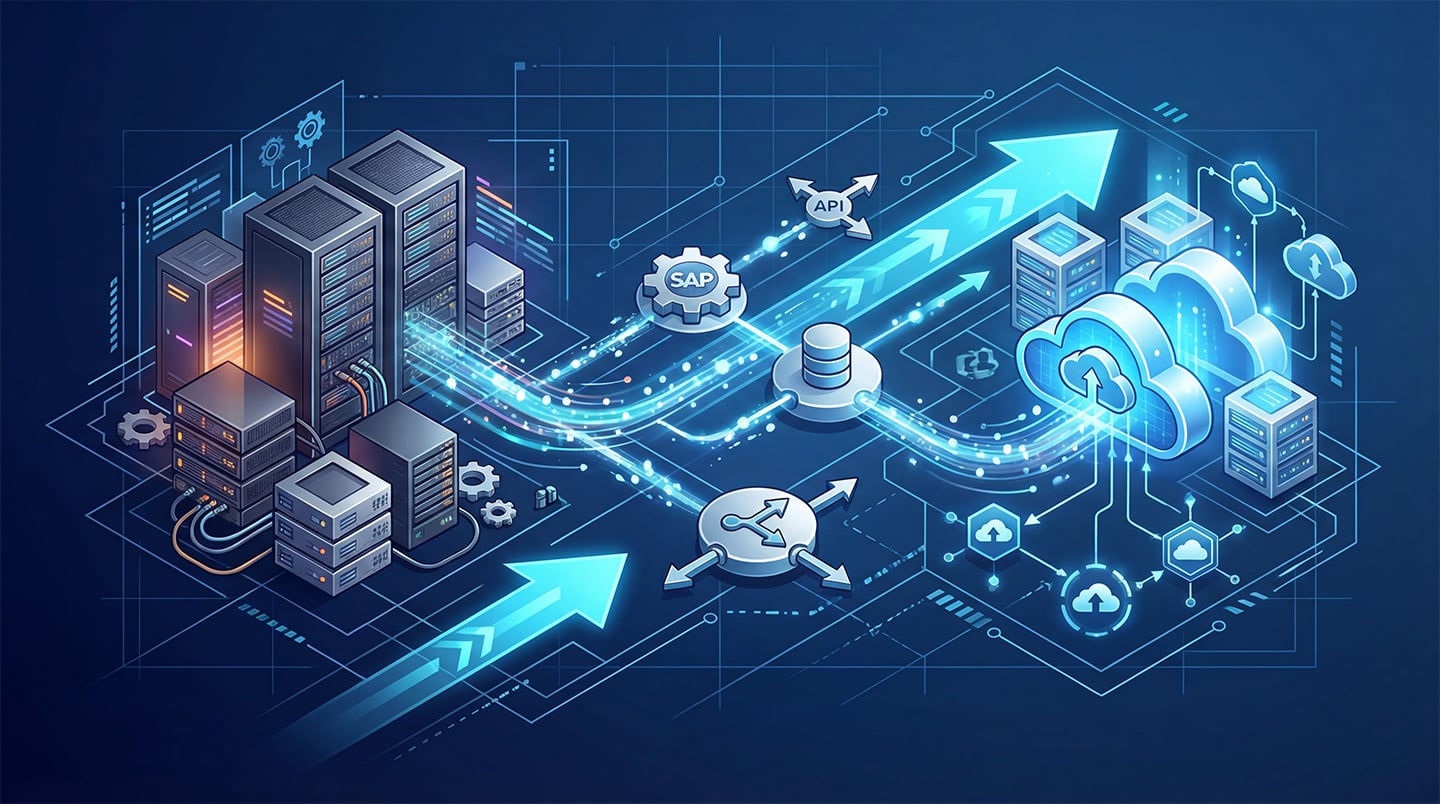

Enterprise manufacturers, distributors, and wholesalers currently running SAP Commerce Cloud are increasingly evaluating alternatives. As operational costs climb, implementation complexity mounts, and more flexible platforms emerge, SAP Commerce Cloud migration has moved from theoretical consideration to active strategic evaluation.
But here’s what most vendors won’t tell you: the wrong migration approach will cost you millions while reproducing the exact problems you’re trying to escape.
This guide is different. Built on 20+ years of enterprise migration experience, we’re going to be transparent about where SAP Commerce Cloud migration projects fail, what data migration actually costs, and how to evaluate Adobe Commerce, Shopify Plus, and composable architectures against your specific B2B requirements.
Why SAP Commerce Cloud Migration Can’t Wait
SAP Commerce Cloud migration discussions typically start with one of four pain points:
Escalating costs with GMV-based pricing
SAP Commerce Cloud’s revenue-based licensing model means your platform costs increase as your business grows, whether or not you need additional features. For high-volume distributors, annual licensing can reach hundreds of thousands of dollars, making total cost of ownership difficult to predict or control.
Complex implementation and ongoing maintenance requirements
SAP Commerce Cloud demands specialized technical expertise that’s increasingly scarce and expensive. Updates require careful planning and extensive testing. What should be routine platform maintenance often becomes a major project requiring dedicated resources.
Longer time-to-market for new features and capabilities
Structured update cycles and complex deployment processes mean simple changes take weeks instead of days. For B2B companies trying to respond quickly to market demands or customer requests, this operational drag becomes a competitive disadvantage.
Over-engineering for organizations without SAP backends
SAP Commerce Cloud delivers maximum value when deeply integrated with SAP ERP or S/4HANA. For companies running Infor, NetSuite, Microsoft Dynamics, or other ERP systems, much of SAP Commerce Cloud’s native integration advantage becomes irrelevant, while the complexity and cost remain.
| Business Profile | SAP Commerce Cloud Pain Point | Alternative Platform | Primary Benefit |
|---|---|---|---|
| Mid-market distributor (single ERP, standard B2B) | High cost, complex maintenance | Shopify Plus | Lower TCO, faster deployment |
| Enterprise with non-SAP ERP (Infor, NetSuite) | Over-engineered, integration complexity | Adobe Commerce | Native B2B features, flexible ERP integration |
| Multi-brand manufacturer (global operations) | Slow time-to-market, update cycles | Adobe Commerce or Composable | Development flexibility, faster iteration |
| Hybrid B2B/B2C operation | Platform complexity for simple needs | Shopify Plus | Simplified operations, managed infrastructure |
The Data Migration Reality: Where SAP Commerce Cloud Migration Projects Actually Fail
Let’s address the pain point every vendor glosses over: data migration is where complex B2B replatforming projects die.
Not from technical impossibility. From catastrophic underestimation of scope, complexity, and parallel workload requirements.
Why B2B Data Migration Complexity Explodes
Consumer ecommerce migration moves products, orders, and customers. B2B environments running SAP Commerce Cloud manage fundamentally different data structures:
Customer hierarchies with 6-8 organizational levels. Parent companies, regional divisions, local branches, and individual buyers, each with distinct credit terms, approval workflows, and pricing matrices. Migrating this structure while preserving account relationships, approval routing, and purchase history requires surgical precision.
Customer-specific pricing that changes by product, volume, contract term, and delivery location. A single distributor account might have 2,500 negotiated prices across 800 SKUs with quarterly adjustment schedules. That pricing logic lives in SAP Commerce Cloud, your ERP, and spreadsheets maintained by your sales operations team.
Migrating pricing means reconciling three sources of truth that haven’t aligned since implementation.
Complex product configurations with dependencies. Manufacturers selling configurable equipment store configuration rules across multiple systems. SAP Commerce Cloud handles front-end logic. Your ERP validates compatibility. Your PIM manages technical specifications.
Migration requires mapping how those three systems interact, then rebuilding that logic on your target platform while maintaining operational continuity.
Multi-ERP environments where different business units run different systems. Your North American operation runs SAP S/4HANA. European division uses Infor CloudSuite. The recent acquisition still operates on Microsoft Dynamics. Each ERP integration was custom-built. None shares the same data schema.
SAP Commerce Cloud migration in multi-ERP environments means rebuilding the integration architecture for each system, simultaneously, while maintaining transaction flow for every business unit.
The Parallel Evaluation Approach That Prevents Disaster
Most organizations select a platform, then discover during implementation that their data complexity requires extensive custom development, which the demo never revealed. A strategic approach inverts this: conduct deep data discovery before platform selection, then run parallel proof-of-concept migrations across candidate platforms.
Test your most complex data structures, including customer hierarchies, pricing matrices, product configurations, and ERP integrations, on each platform. If you’re considering Adobe Commerce/Magento, Shopify Plus, or a composable architecture, parallel evaluation reveals which platforms handle your specific complexity gracefully and which require expensive workarounds.
What Migration Actually Costs
Economy migrations that cut corners don’t reduce costs; they defer them into perpetual operational drag.
A migration that leaves 30% of pricing logic requiring manual updates creates ongoing operational overhead, from staff time reconciling discrepancies, customer service handling errors, and lost revenue from incorrect quotes. Over three years, the accumulated operational cost exceeds what proper migration would have cost upfront, while delivering an inferior customer experience.
This is “buy once, cry once” economics: invest in complete data migration, deep ERP integration, and proper testing now (cry once at the upfront price), rather than paying less initially but dealing with ongoing maintenance premiums and operational inefficiencies that cost more over time (cry repeatedly).
What drives costs: Data complexity, not volume. ERP integration architecture, real-time versus batch processing, determines upfront investment versus perpetual operational overhead. Platform capability gaps require custom development. Strategic evaluation requires a 3-5-year total cost of ownership analysis, not just first-year costs.
Deep ERP Integration: The Non-Negotiable Requirement
Surface-level SAP Commerce Cloud migration treats your ERP as a data source. Strategic migration treats ERP integration as the operational core determining your entire commerce capability.
Middleware batch processing creates 15-minute to 4-hour data latency. Pricing and inventory update on batch cycles. Order confirmations delay 2-4 hours. This approach costs less upfront but creates ongoing operational overhead, including manual reconciliation, delayed updates, and pricing discrepancies that require customer service intervention.
Deep native integration delivers real-time, bidirectional data flow with 30-120-second updates. Customer-specific pricing is calculated from ERP on every page load. Order placement triggers immediate ERP receipt and warehouse notification. Same-day fulfillment becomes operationally feasible. The upfront investment eliminates ongoing operational drag while enabling capabilities that are impossible with batch processing.
For multi-ERP environments, orchestration architecture routes orders, unifies customer views, and consolidates inventory across systems. Atwix’s abstraction layer approach enables your commerce platform to reference “inventory” and “pricing” without knowing which ERP provides that data, accommodating new ERP additions as your business structure evolves without touching existing connections.
Your Strategic SAP Commerce Cloud Migration Roadmap
Phase 1: Assessment (4-6 weeks)
Deep data discovery. Catalog actual customizations, ERP integration complexity, data volume. Identify which SAP Commerce Cloud features are critical versus convenience. Document current operational pain points driving migration consideration.
Phase 2: Parallel Platform Evaluation (6-8 weeks)
Build proof-of-concept migrations for your most complex data structures on 2-3 candidate platforms. Test customer hierarchies, pricing matrices, product configurations, ERP integrations. Score platforms against actual requirements, not vendor demos.
Phase 3: Platform Selection and Partner Engagement (2-4 weeks)
Select implementation partner with proven B2B expertise, multi-platform capability (Adobe Commerce, Shopify Plus), and deep ERP integration experience.
Phase 4: Implementation (4-18 months depending on complexity)
Data migration architecture, ERP integration design, feature rebuild, testing, validation, cutover rehearsal.
Phase 5: Go-Live and Optimization
Launch on new platform with comprehensive rollback procedures. Post-migration optimization, staff training, performance monitoring.
The Atwix Advantage: Dual Platform Expertise + Multi-ERP Integration Mastery
Most agencies specialize in one platform. Atwix brings certified expertise in both Adobe Commerce/Magento and Shopify Plus, fundamentally changing how we approach platform selection and the SAP Commerce Cloud migration strategy.
Our credentials:
- #1 Magento contributor globally (2018-2024)
- Adobe Commerce Contributor Partner with 300+ certifications
- Shopify Partner with proven enterprise B2B implementations
- 20+ successful ERP integrations: SAP, Infor, NetSuite, Microsoft Dynamics
This means platform-agnostic recommendations based on your actual requirements, an accurate complexity assessment from implementing both platforms at enterprise scale, and a proven migration methodology refined across hundreds of enterprise B2B implementations.
Partner with Migration Experts Who Understand Complex B2B Commerce
SAP Commerce Cloud migration represents the largest commerce technology decision your organization will make in the next decade. The wrong platform selection or cut-rate implementation reproduces existing problems on new infrastructure, while consuming millions in capital and opportunity costs.
Atwix helps enterprise manufacturers, distributors, and wholesalers make platform decisions based on real implementation experience on Adobe Commerce, Shopify Plus, and complex multi-ERP architectures. We build systems designed to scale with your business for years to come, whether that means deep ERP integration, unlimited customization, or simple managed infrastructure.
Contact Atwix’s B2B eCommerce migration specialists to discuss your SAP Commerce Cloud migration strategy and explore which platform future-proofs your operations.