
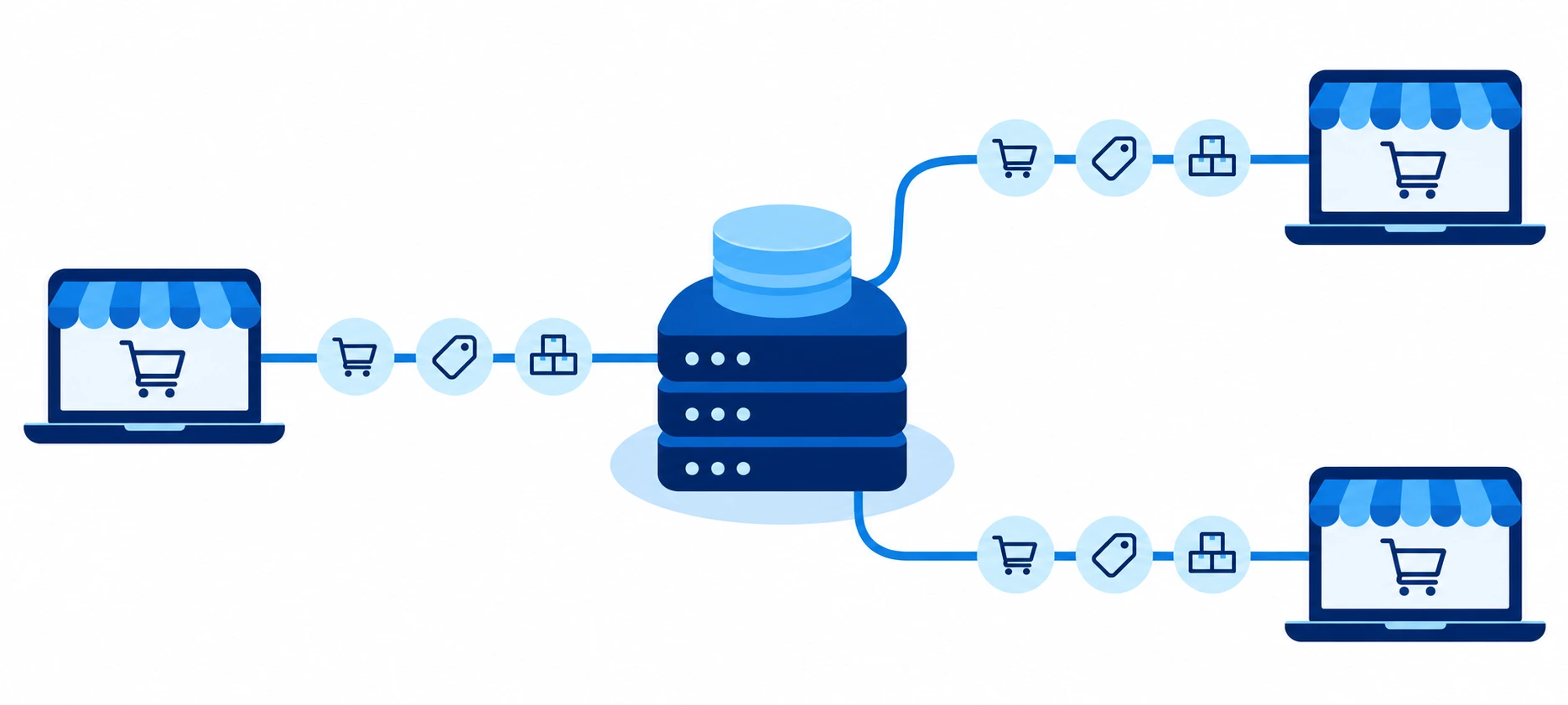

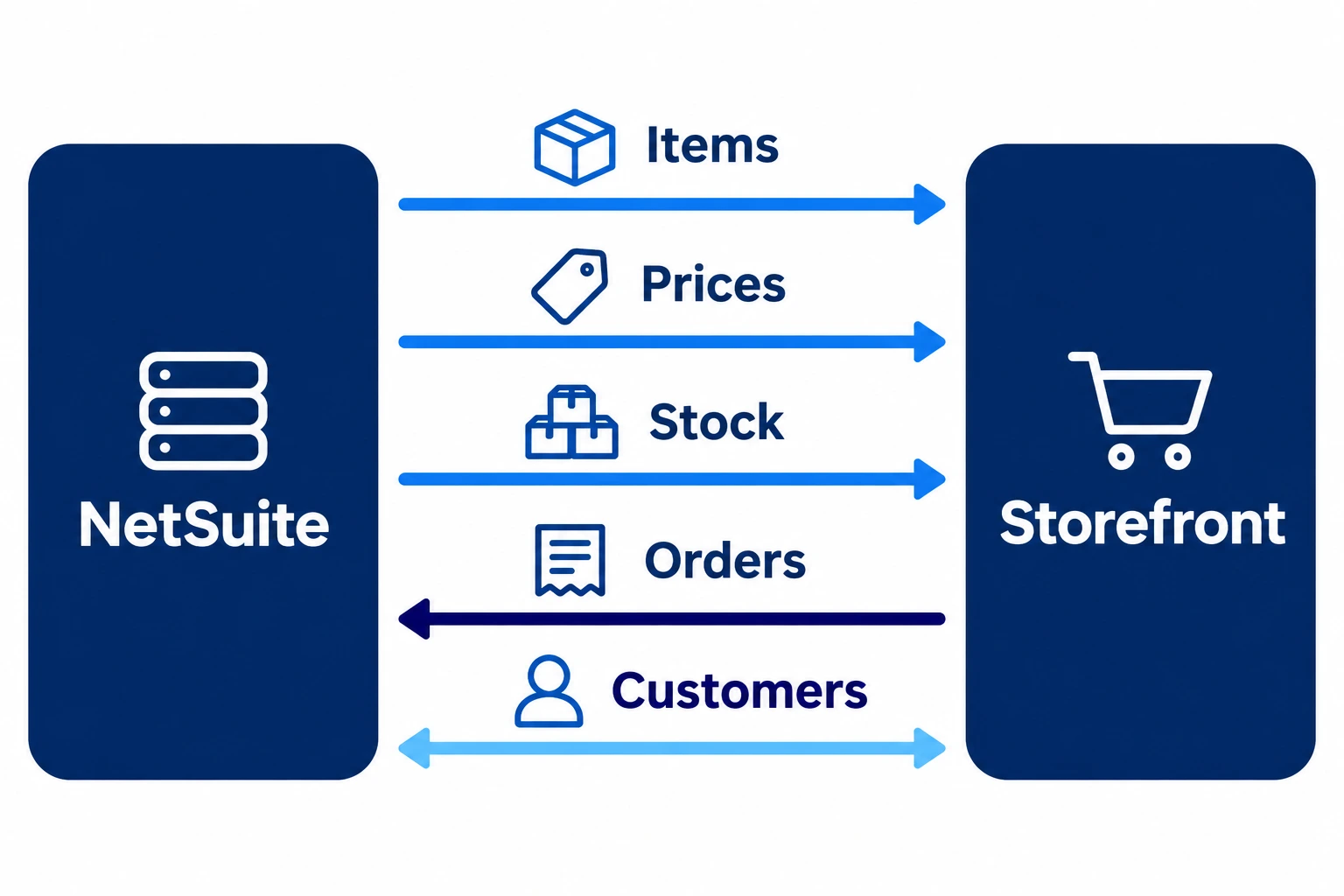
NetSuite holds your items, prices, customers and stock, and your storefront needs all four. A NetSuite ecommerce integration decides which system owns each record and how fast a change in one reaches the other. Oracle’s own connector covers some storefronts and leaves others out. SOAP-based integrations stop working by the NetSuite 2028.2 release at the latest, and those on older SOAP endpoints stop sooner. This guide compares the options for Adobe Commerce, Shopify and Shopware, with a field map and the acceptance tests to run before go-live.
NetSuite ecommerce integration options by platform
Your storefront decides which options you have. Oracle’s NetSuite Connector covers Shopify for B2C and B2B, covers Adobe Commerce for B2C, and does not list Shopware.
| Storefront | NetSuite Connector (Oracle) | Middleware or iPaaS | Custom build on REST |
|---|---|---|---|
| Adobe Commerce | Listed as “Adobe Commerce B2C” | Fits B2B stores with company accounts and negotiated prices | Fits unusual order or pricing logic |
| Shopify | Listed as “Shopify B2C and B2B”, plus Shopify POS | Fits multi-store or multi-system setups | Seldom needed when the connector covers your flows |
| Shopware | Not listed | Fits when several systems join the chain | Fits a single store with stable requirements |
The connector column comes from Oracle’s NetSuite Connector product page and its list of supported storefronts: Amazon Seller Central, Amazon Vendor Central, BigCommerce, eBay, Magento 2, ShipStation, Shopify, Shopify POS, Walmart and WooCommerce.
A quick way to place yourself:
- Standard B2C flows on Shopify, Adobe Commerce, BigCommerce or WooCommerce. Start with NetSuite Connector.
- B2B on Shopify. The connector lists Shopify B2B, but it syncs companies from Shopify into NetSuite, assigns catalogs per company rather than per location, and needs a separate B2B allotment. Test it against your companies, locations and price lists, and confirm it works on your Shopify plan.
- B2B on Adobe Commerce, any Shopware store, or several systems in the chain. Plan for middleware or a custom build.
- Standard storefront needs, with catalog and customer data already in NetSuite. Consider SuiteCommerce and skip the integration.
First decision: SuiteCommerce or an external storefront
Decide whether you need an integration at all. SuiteCommerce is NetSuite’s own ecommerce product, and Oracle describes it as natively unified with NetSuite inventory, order management and financials. The storefront reads the same records as the ERP, so no sync job sits between them.
SuiteCommerce fits when your catalog, prices and customer accounts already live in NetSuite and your storefront needs are standard. SuiteCommerce Advanced adds code-level access for developers who need to change more.
An external storefront fits when the storefront itself carries requirements NetSuite does not: the B2B features of Adobe Commerce, the checkout and app ecosystem of Shopify, or the open architecture of Shopware. You then accept an integration as the price of that choice. Atwix builds on Adobe Commerce, Shopify and Shopware and not on SuiteCommerce, so weigh our view with that in mind.
Three ways to connect an external storefront
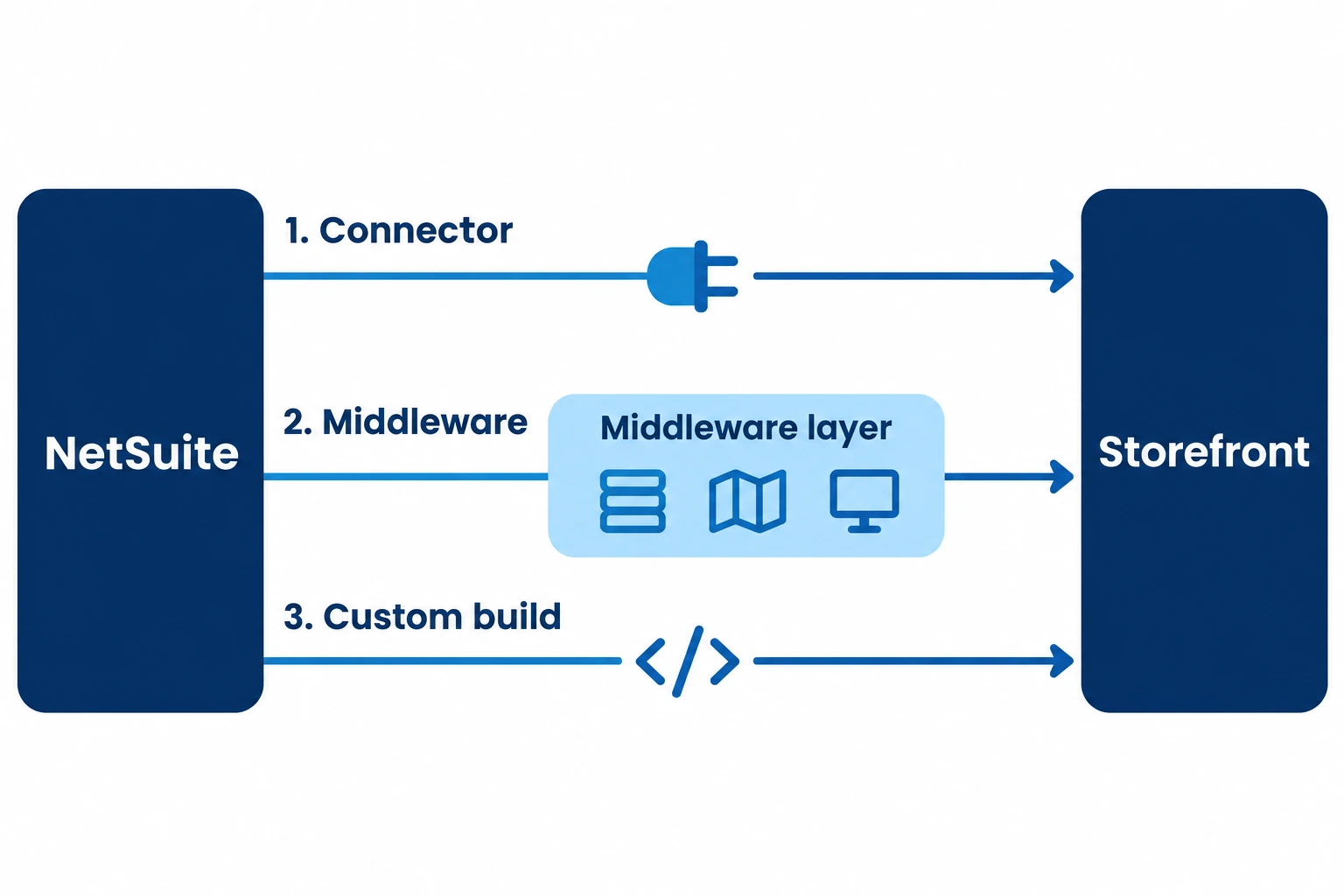
Pick the lightest option that carries your data model. Each option to the right in this table adds control and adds maintenance. An iPaaS (integration platform as a service) is middleware sold as a hosted service, such as Celigo.
| Criterion | NetSuite Connector | Middleware or iPaaS | Custom build |
|---|---|---|---|
| What it is | Oracle’s prebuilt connector for listed storefronts, marketplaces and logistics providers | A separate layer that maps, queues and monitors data between systems | Code written against NetSuite REST web services and RESTlets |
| Data scope | The flows Oracle maps for each storefront | Any record both APIs expose | Any record both APIs expose |
| Who maintains it | Oracle | The middleware vendor and your integrator | Your team or your agency |
| Fits | Standard B2C order, stock and fulfillment flows | B2B pricing, several storefronts, or other systems in the chain | Logic no product covers |
| Watch for | The B2C or B2B label on your storefront | Per-flow license costs and a second vendor | Testing against two NetSuite releases a year |
On our NetSuite projects we have used Celigo with custom modules, and our own connector. The failures we see most are orders that never reach NetSuite, and customer records that don’t match or carry fields NetSuite rejects. The acceptance tests below start there.
Oracle says order status updates in NetSuite pass to the ecommerce system as orders ship, and that settlement reports, refunds, returns and cancellations are processed automatically with certain ecommerce applications. Ask which of those apply to your storefront before you sign.
Middleware earns its place when the ERP cannot answer every storefront request in real time. A queue holds orders while NetSuite is busy, a cache serves prices without a call per page view, and a log shows which record failed and why. Our guide to real-time inventory management covers the stock side of that design.
Build on REST, because SOAP has an end date
Any NetSuite integration you start now should use REST web services with OAuth 2.0. Oracle has scheduled the removal of SOAP web services, and its SOAP removal FAQ sets out the dates:
| NetSuite release | What changes |
|---|---|
| 2025.2 | The last planned SOAP endpoint |
| 2026.1 | New integrations should use REST web services with OAuth 2.0 |
| 2027.1 | No new integrations can be built on SOAP. New integrations must use OAuth 2.0 |
| 2028.2 | SOAP is removed. Existing SOAP integrations stop working |
The 2028.2 date is the latest an integration can last. Each release disables the oldest SOAP endpoint, so an integration on an older endpoint stops sooner. Ask every connector and middleware vendor two questions: does your NetSuite connection use REST or SOAP today, and if it uses SOAP, which endpoint and when does it move?
NetSuite also applies concurrency governance to web services and RESTlets, which caps how many requests an account processes at once. Design for a queue with retries. A storefront that fires one ERP call per page view can reach that cap on a busy day.
The field map
Agree on the system of record for each entity before anyone writes a mapping. When two systems both own a field, they overwrite each other, and no mapping fixes that.
| Entity | System of record | NetSuite record | Direction | Decide first |
|---|---|---|---|---|
| Customer or company | NetSuite for B2B accounts. The storefront for new B2C sign-ups | Customer, with contacts | Both ways | How a web sign-up matches an existing NetSuite customer |
| Item and SKU | NetSuite | Item. Matrix items for products with options | NetSuite to storefront | Which item fields are content, and whether a PIM owns them |
| Price | NetSuite | Price levels and customer-specific pricing | NetSuite to storefront | Synced price lists or a price request at cart |
| Inventory | NetSuite | Quantity available by location | NetSuite to storefront | Which locations count toward web availability |
| Order | Storefront at capture, NetSuite after | Sales order | Storefront to NetSuite | How the web payment is recorded: a customer deposit on the sales order, an invoice and payment after fulfillment, or a cash sale instead of a sales order |
| Fulfillment | NetSuite | Item fulfillment | NetSuite to storefront | Partial shipments and tracking numbers |
| Invoice and credit | NetSuite | Invoice, credit memo | NetSuite to storefront | Whether buyers see and pay invoices online |
| Return | Storefront request, NetSuite approval | Return authorization | Both ways | Who approves, and when the refund fires |
| Tax | One system only | Tax on the sales order | Storefront to NetSuite | Which system calculates tax, so totals match |
Run this exercise with finance in the room. Our ERP checklist for B2B distributors and manufacturers lists the ERP-side questions to settle first.
Platform notes
Adobe Commerce and NetSuite
Oracle lists the connector for Adobe Commerce B2C. A B2B store on Adobe Commerce carries company accounts, shared catalogs, negotiable quotes and requisition lists, and each needs a mapping decision the B2C label does not promise. Decide where a quote lives: in Adobe Commerce, in NetSuite, or in both with one owner.
On NetSuite, we have connected Adobe Commerce B2B stores through Celigo and through our own connector. That work covers quotes, orders, invoices with online payment links, available credit and delivery dates calculated in NetSuite. Our Magento ERP integration services page covers how we scope it.
Shopify and NetSuite
Shopify is the best covered of the three. Oracle lists the connector for Shopify B2C and B2B, plus Shopify POS. Check the B2B scope before you rely on it: the connector syncs companies from Shopify into NetSuite and assigns catalogs per company, not per location.
B2B coverage matters more than it did a year ago. Since April 2, 2026, merchants on Basic, Grow and Advanced can use Shopify’s native B2B features, so more Shopify stores now need companies and price lists synced from the ERP. Our post on Shopify Plus ERP integration describes four ways those syncs fail.
Shopware and NetSuite
Shopware is not on Oracle’s supported list, so the connection runs through middleware or a custom build against Shopware’s Admin API. Budget for mapping work the listed storefronts get out of the box, and ask any middleware vendor for a live Shopware and NetSuite reference.
Acceptance tests before go-live
Test the failures, because the happy path passes on day one. Run each scenario in a NetSuite sandbox with production-like data. The first four cover the failures we see most: orders that never arrive and customer records that don’t match.
| Scenario | Pass when |
|---|---|
| A web order with three lines, a discount and shipping | One sales order appears in NetSuite with matching totals and tax |
| The same order is sent twice | NetSuite holds one sales order |
| A web sign-up uses an email that already exists as a NetSuite customer | The buyer is linked to the existing customer, not duplicated |
| A sync run gets an empty or partial response from NetSuite | The storefront keeps its existing customers, prices and stock, stops the run and alerts someone |
| NetSuite is unavailable for an hour | Orders queue, then post once each when it returns |
| A new B2B customer is created in NetSuite | The buyer can sign in and sees the right prices and terms |
| A price changes on one price level | Only customers on that price level see the new price |
| Stock reaches zero at one location | Web availability follows the location rule you set |
| A partial shipment | The storefront shows the shipped lines with tracking and leaves the rest open |
| A return and refund | The credit in NetSuite equals the refund on the storefront |
Repeat the suite before each NetSuite release. Oracle ships two a year, and a custom integration is yours to retest.
Where Atwix fits
Atwix integrates ERPs with Adobe Commerce, Shopify and Shopware. On NetSuite, we have connected Adobe Commerce B2B stores through Celigo and through our own connector, and we scope the system-of-record decisions before the build starts. If NetSuite is new to your business and the storefront is changing in the same year, read how to sequence an ERP migration and an eCommerce replatform first. The order of those two projects changes the integration you build.
NetSuite ecommerce integration: frequently asked questions
Got some questions? We’re here to answer. If you don’t see your question here, drop us a line using our Contact form.
What is NetSuite ecommerce integration?
It is the connection that moves customers, items, prices, stock and orders between NetSuite and a storefront. The integration defines which system owns each record, the direction of each sync and how fast changes travel.
Does Shopify integrate with NetSuite?
Yes. Oracle’s NetSuite Connector lists Shopify for B2C and B2B, plus Shopify POS. For B2B, test how it handles your companies, locations and price lists. Stores with several storefronts or custom pricing logic often use middleware.
What ecommerce platforms work with NetSuite?
Oracle’s connector supports BigCommerce, Magento 2, Shopify and WooCommerce as storefronts, along with marketplaces such as Amazon, eBay and Walmart. Other platforms, including Shopware, connect through middleware or a custom build on NetSuite’s REST web services.
Is SuiteCommerce better than integrating an external storefront?
SuiteCommerce removes the integration, because the storefront and the ERP share one set of records. An external storefront adds an integration and gives you that platform’s features and ecosystem. Choose by storefront requirements first.
Do existing NetSuite SOAP integrations need to change?
Yes. Oracle removes SOAP web services with the 2028.2 release, and integrations on older SOAP endpoints stop working sooner, because each release disables the oldest one. Plan the move to REST web services with OAuth 2.0 now.
Scope your NetSuite integration
If you run NetSuite and are choosing or replacing a storefront, start with the field map and the list of flows the business needs on day one. We will review both and tell you whether Oracle’s connector, middleware or a custom build fits.