

A B2B buyer researches you in a self-serve portal. Then calls a rep to confirm pricing. Then closes through a sales agent. Same buyer, same purchase, three different channels. And at every handoff, they expect the order, the price, and the inventory to be exactly what they were a minute ago.
Most commerce stacks can’t promise that. And that, not strategy, is where omnichannel actually breaks.
What McKinsey found
McKinsey’s B2B Pulse research keeps landing on the same pattern. At any stage of the buying journey, buyers split roughly into thirds: one-third want in-person, one-third want remote, one-third want digital self-serve. The split holds across geographies, industries, company sizes, and deal values. The same buyer moves between all three inside a single purchase.
The Rule of Thirds Is a Plumbing Problem
The strategy implication is obvious: meet buyers in every mode. So a B2B omnichannel strategy gets written, the channels get stood up, and the plan looks complete. The part teams underestimate is what that plan demands from the systems underneath.
Because offering the channels isn’t the win. More than half of B2B buyers (54%) say they’ll switch suppliers after a poor omnichannel experience. They don’t want a menu of disconnected channels. They want one experience that follows them. For B2B sellers specifically, where catalogs are customer-specific and pricing is negotiated, that expectation is harder to meet and more costly to miss.
Where it actually breaks
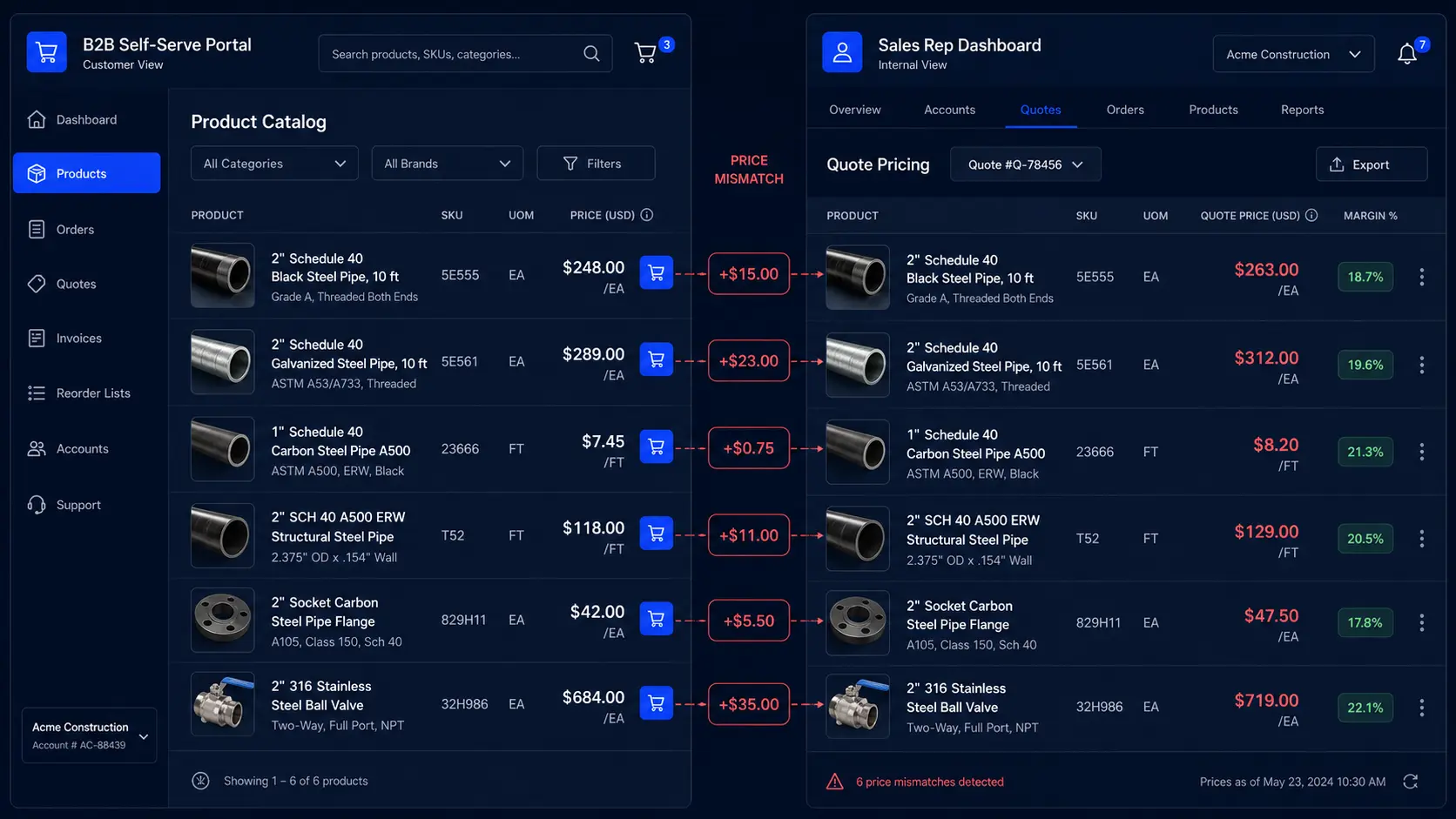
Picture the failure. A buyer sees a price in your portal. They call a rep to place the order, and the rep’s screen shows a different number. Maybe the contract pricing didn’t sync. Maybe inventory is fresh in one system and a day stale in another. The buyer doesn’t see a sync error. They see a company that doesn’t know its own prices. And they start looking at your competitor.
The rule of thirds only works if the same order, the same pricing, the same account history, and the same stock figure show up identically in every mode. That’s a single-source-of-truth requirement. The storefront, the ERP, the CRM, and the order management system all have to agree, in real time, every time.
Most omnichannel failures aren’t strategy failures. They’re integration failures.
Why this is an engineering problem
Real-time consistency is harder than it sounds, because every system was built to own its own version of the truth. The ERP owns pricing and inventory. The CRM owns the relationship. The storefront owns the experience. Left alone, they drift.
Making them agree takes more than nightly batch jobs and brittle point-to-point connections that snap every time one system updates. It takes a deliberate integration layer, one that keeps pricing, inventory, orders, and account data in lockstep across the stack, and handles the edge cases B2B is full of: contract pricing, customer-specific catalogs, credit limits, partial fulfillment.
This is the work teams skip when they treat omnichannel as a front-end project. A B2B omnichannel strategy lives or dies on this layer, not on the channel mix. It’s also the work that separates the leaders from everyone else. McKinsey ties true omnichannel to roughly two-times-greater share gains. The strategy is settled. The hard part is the plumbing.
How Atwix approaches it
We build the integration layer that makes omnichannel consistency work on Adobe Commerce (Magento) , Shopware, Shopify or BigCommerce. Sometimes that’s a custom integration. Sometimes it’s middleware. For teams running an ERP behind their storefront, one of the tools we reach for is Sirius, our ERP integration product, which keeps the storefront and ERP agreeing on pricing, inventory, orders, and customer data in real time.
The right answer depends on your stack, and Sirius is one option among several, not a default. The point isn’t the product. The point is that omnichannel consistency is an engineering outcome. It has to be designed, not assumed.
If your channels disagree
If your portal and your reps quote different numbers, if inventory is accurate in one place and stale in another, or if you’re scoping an omnichannel rollout and want the integration question answered before you build the front end, that’s the conversation we have every week.
Tell us what your stack looks like and where the numbers stop agreeing. We’ll tell you what it takes to make them line up.