

Shopify Plus costs about $24,000 a year more than the Advanced plan on a three-year term, and most of the advice on when to upgrade still rests on a revenue rule of thumb. The real comparison between Shopify vs Shopify Plus comes down to two things: how much of your sales volume runs through card fees that Plus lowers, and whether you need a feature only Plus offers. This guide shows the current plan facts, the fee math at different sales levels, three worked merchant scenarios, and the cases where staying on your current plan is the better call.
The short answer
Upgrade to Shopify Plus when you need a Plus-only capability, such as full checkout customization, custom Shopify Functions, more than one storefront, or B2B with more than three catalogs, and the business value of that capability covers the extra fee. On card fees alone, at the three-year starting price and the best-case Plus card rate, Plus breaks even at roughly $9.6 million a year in online card sales through Shopify Payments, or about $6 million with a third-party gateway. At that volume Shopify may move you to a variable platform fee, so get your quote before relying on the math. Below those levels, Advanced usually wins unless a Plus feature earns its keep.
Shopify plans compared
Shopify now sells four main plans: Basic, Grow (formerly called Shopify), Advanced, and Plus. The table below uses the US figures on Shopify’s pricing page as of late October 2026.
| Basic | Grow | Advanced | Plus | |
|---|---|---|---|---|
| Price, billed monthly | $39/mo | $105/mo | $399/mo | $2,500/mo (1-year term) or $2,300/mo (3-year term) |
| Price, billed yearly | $29/mo | $79/mo | $299/mo | 1- or 3-year term only |
| Online card rate (Shopify Payments) | 2.9% + 30¢ | 2.7% + 30¢ | 2.5% + 30¢ | From 2.25% + 30¢ |
| Third-party payment provider fee | 2% | 1% | 0.6% | 0.2% |
| Staff accounts | None extra | 5 | 15 | Unlimited |
| Inventory locations | 10 | 10 | 10 | 200 |
| B2B catalogs | Up to 3 | Up to 3 | Up to 3 | Unlimited |
| Checkout customization | Limited | Limited | Limited | Full |
| API rate limits | Standard | Standard | Up to 2x on select APIs | Up to 10x on select APIs |
| Headless storefronts | 1 | 1 | 1 | 25 |
| Expansion stores | None | None | None | Up to 9 included |
| POS Pro | $89/mo per location | $89/mo per location | $89/mo per location | 20 locations included, up to 200 with Shopify Payments |
| Support | Live chat | Live chat | Enhanced live chat | Priority support |
Shopify also lists features available only on Plus: high-volume checkout, custom functions to personalize the store, bot protection, Combined Listings, Shopify Audiences, custom user groups, Plus Certified apps, and early access to test new features.
What Shopify Plus costs
In the US, Shopify Plus costs $2,500 a month on a one-year term or $2,300 a month on a three-year term, according to Shopify’s pricing page and its Help Center. Prices differ in other currencies. Shopify’s pricing FAQ states that on a one- or three-year Plus subscription, you can cancel when the term commitment expires.
Three costs sit on top of the base fee:
- A variable platform fee for larger merchants. Shopify says more complex, higher-volume businesses might pay a variable platform fee based on revenue and business model, and that it differs for B2B and D2C companies. It does not publish the rate or the revenue level where it starts. The Plus contract is usually negotiated with a Shopify sales rep, so get the fee quoted in writing before you sign.
- Card processing. Plus card rates start lower, but premium cards (2.95% + 30¢ on Plus) and international cards (an extra 1%) still apply.
- Apps and development. Checkout extensions, custom Functions, and expansion stores need build work. The plan fee gives you access to these features; building them is a separate budget line. The plan change itself needs no rebuild, so the effort depends on which Plus-only features you adopt.
Where the money moves: the fee math
The extra subscription cost is fixed, while the card-fee savings grow with your sales. That makes break-even a simple division.
| Advanced (billed yearly) | Plus (3-year term) | |
|---|---|---|
| Annual subscription | $3,588 | $27,600 |
| Extra cost vs Advanced | $24,012 | |
| Break-even with Shopify Payments (0.25-point lower card rate) | ~$9.6M a year in online card sales | |
| Break-even with a third-party provider (0.4-point lower surcharge) | ~$6.0M a year in online sales |
Atwix calculation from Shopify’s published US rates, using the three-year Plus price and the best-case Plus card rate of 2.25%. It covers the percentage part of online standard card fees only and excludes the 30¢ per-transaction fee, premium and international cards, in-person sales, the variable platform fee, and apps.
On a one-year term at $2,500 a month, the extra cost rises to $26,412 a year and break-even to about $10.6 million with Shopify Payments, or about $6.6 million with a third-party provider.
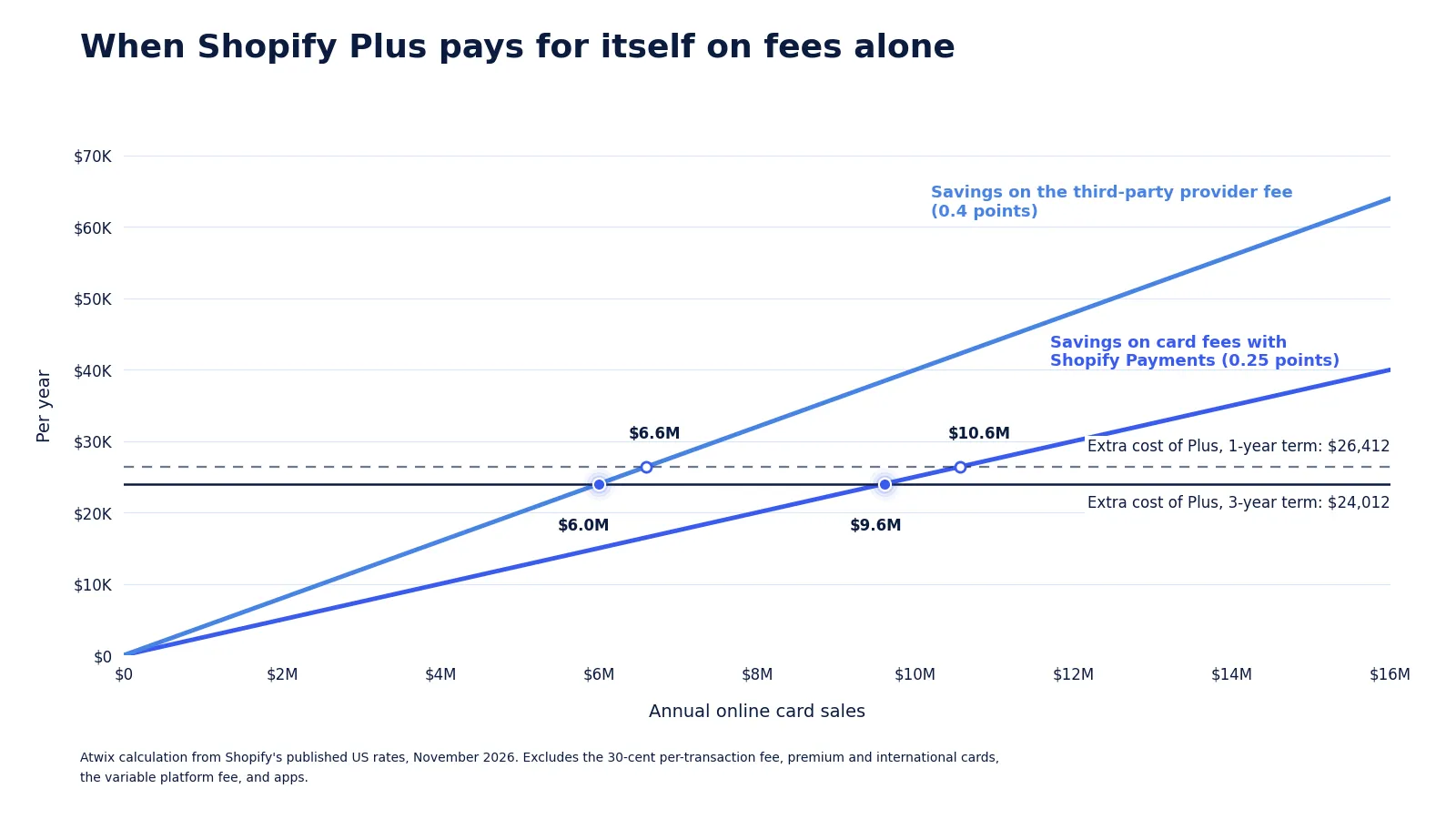
Two conclusions follow. First, a merchant doing $2 to $5 million a year will not recover the Plus fee through card rates; the case has to rest on features. Second, if you pay the third-party surcharge, the bigger lever may be the payment setup rather than the plan. On Advanced, a 0.6% surcharge on $7 million of sales costs $42,000 a year.
What Plus unlocks that Advanced can’t
Five capabilities separate Plus from Advanced in practice: full checkout customization, custom Functions, expansion stores, API headroom, and higher scale limits. Shopify lists each one as Plus-only or as much larger on Plus. When we scope Shopify builds, customer-specific catalogs and custom checkout logic usually decide the plan, followed by multi-store setups.
- Full checkout customization. Advanced allows limited checkout changes. Plus allows checkout extensions and custom logic, which matters when checkout needs B2B rules, custom validation, or brand-specific steps.
- Custom Functions. Discount, payment, and delivery logic written for your store, such as hiding a payment method for one customer group or applying tiered pricing that apps can’t express.
- Expansion stores. Plus includes up to nine additional stores. For a merchant running two or three separate Advanced stores for brands or regions, this can offset part of the Plus fee.
- API headroom. Advanced offers up to 2x the standard rate limit on select APIs; Plus offers up to 10x. That matters for stores that sync large catalogs, prices, or inventory with an ERP several times an hour.
- Scale limits. Unlimited staff accounts, 200 inventory locations instead of 10, and 25 headless storefronts (custom-built frontends connected to Shopify) instead of 1.
B2B is no longer a reason to upgrade on its own
Since April 2026, Shopify B2B is included on Basic, Grow, and Advanced, with up to three catalogs assigned through B2B markets, according to Shopify’s changelog. Plus removes the limit and is the only plan that can assign a catalog to an individual company. A wholesaler with one wholesale price list and one distributor price list can run B2B on Advanced. A distributor with customer-specific catalogs for dozens of accounts needs Plus.
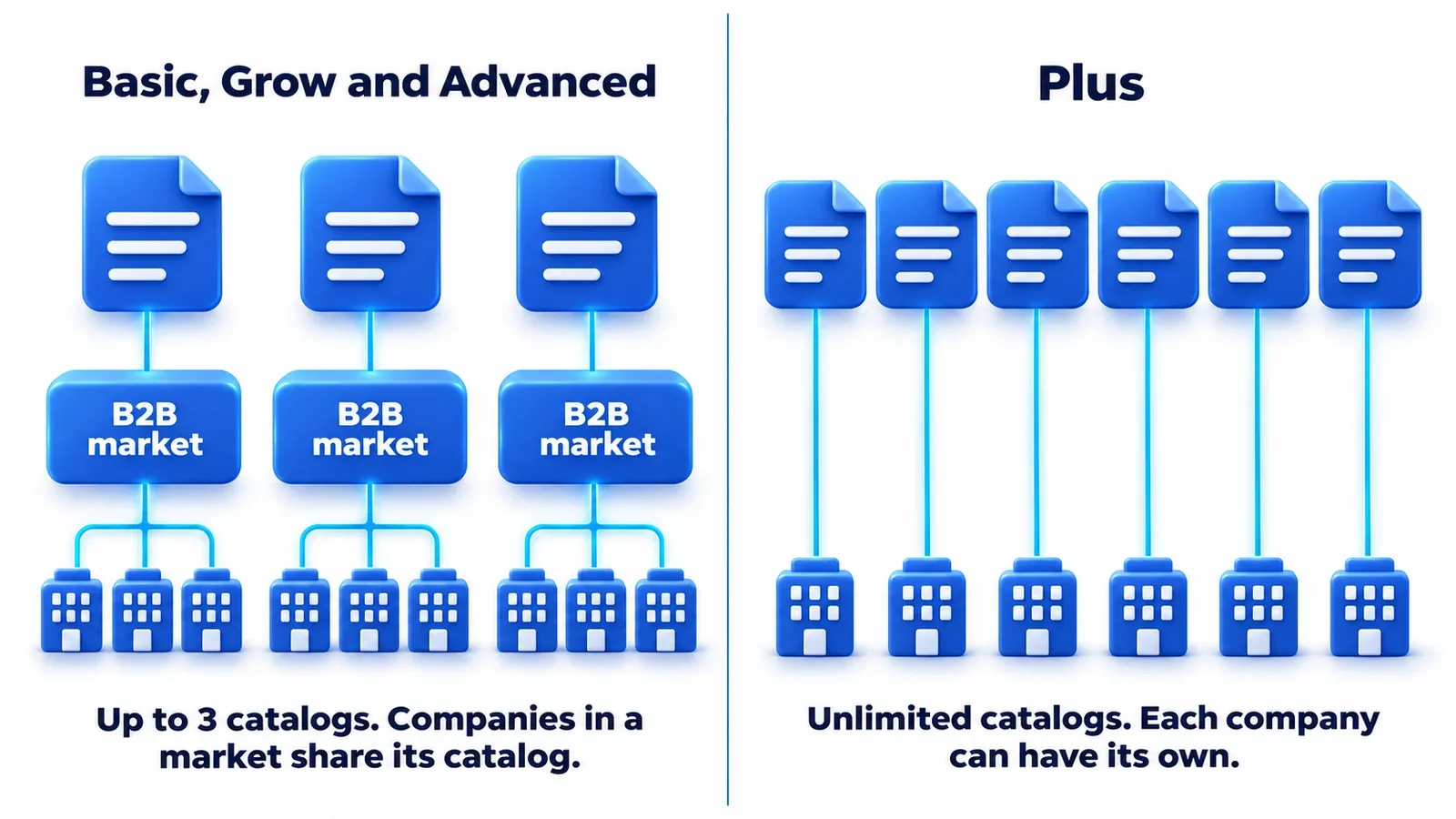
Other B2B differences show up in real projects. On Basic, Grow, and Advanced, a catalog used in two markets counts as two of the three. Deposits, partial payments, and payment requests per fulfillment are Plus-only. So are custom B2B rules built with Functions in a custom app, such as credit-limit or order validation, and checkout UI extensions on the information, shipping, and payment steps. Contextual storefront and checkout through Shopify Markets is available on Advanced and Plus, but not on Basic or Grow.
Three merchant scenarios
At $3 million a year the fee math says stay on Advanced. At $14 million Plus fits, but the variable fee decides whether it saves money. At $7 million with a third-party processor, the payment setup matters more than the plan. These scenarios use labelled assumptions and Shopify’s published US rates. They show the method; your own numbers will differ.
Scenario A: a direct-to-consumer skincare brand, $3 million online, one market. All sales run through Shopify Payments, the team has eight staff, and checkout needs no custom logic. Plus saves about $7,500 a year in card fees and costs $24,012 more, a net cost of about $16,500. Stay on Advanced unless a Plus-only feature adds more than $16,500 a year in gross profit.
Scenario B: a home goods retailer, $14 million online, two brands plus wholesale. The retailer runs two Advanced stores today and wants customer-specific catalogs for 40 retail accounts. Plus saves about $35,000 in card fees, replaces the second Advanced subscription, and removes the three-catalog limit. Before any variable fee, Plus comes out about $14,600 a year ahead. At about $1.17 million a month, though, Shopify may well move the retailer to its variable platform fee, which could shrink that gain or turn it into a net cost. Plus still fits for the catalogs and the second brand, but get the variable-fee quote in writing before you count on any savings.
Scenario C: an outdoor gear retailer, $7 million online, contracted third-party processor. On Advanced the retailer pays a 0.6% surcharge, about $42,000 a year. Plus lowers that to 0.2% and nets roughly $4,000 a year after the higher subscription. Price Shopify Payments against the processor contract before deciding on the plan, because removing the surcharge entirely is worth more than the upgrade.
When staying on your current plan makes sense
Staying put is the right call more often than plan comparisons suggest. We often start new Shopify merchants on Grow or Advanced and move them to Plus when a specific trigger appears, most often customer-specific contract pricing or extensive checkout customization. Stay on Advanced or Grow if:
- Your online card sales sit well below the break-even point (about $9.6 million a year with Shopify Payments, or $6 million with a third-party gateway) and no Plus-only feature has a clear business case.
- Your checkout works with standard Shopify settings and existing apps.
- You run one store and one market, or Shopify Markets on a single store covers your regions.
- Your B2B needs fit within three catalogs.
- Your integrations run comfortably inside Advanced’s API limits. Our list of Shopify integrations for B2B shows which common tools work on any plan.
Revisit the decision each year at contract or budget time. The break-even point moves as your sales mix, payment setup, and store count change.
Frequently Asked Questions
Got some questions? We’re here to answer. If you don’t see your question here, drop us a line using our Contact form.
How much is Shopify Plus per month?
Shopify Plus costs $2,300 a month on a three-year term or $2,500 a month on a one-year term in the US. Higher-volume businesses may move to a variable platform fee, which Shopify quotes individually.
Is Shopify Plus worth it?
Shopify Plus is worth it when a Plus-only capability, such as full checkout customization, custom Functions, expansion stores, or unlimited B2B catalogs, produces more value than the roughly $24,000 a year it costs over Advanced. On card fees alone, it breaks even at about $9.6 million a year in online card sales through Shopify Payments, on the three-year price and before any variable platform fee.
What is the difference between Shopify Advanced and Shopify Plus?
Shopify Plus adds full checkout customization, custom Functions, up to nine expansion stores, unlimited staff accounts, 200 inventory locations, unlimited B2B catalogs, higher API limits, and lower card and third-party fees. Advanced costs $299 a month billed yearly; Plus costs $2,300 a month on a three-year term ($2,500 on a one-year term).
Do I need Shopify Plus for B2B?
Not always. Basic, Grow, and Advanced include Shopify B2B with up to three catalogs assigned through B2B markets. You need Plus for account-specific catalogs, deposits or partial payments, or custom B2B checkout logic.
Is there a minimum revenue for Shopify Plus?
Shopify’s pricing page lists no revenue minimum for Plus. The decision depends on the fee math and on whether you need Plus-only features.
How do I upgrade to Shopify Plus?
You upgrade the same store, so your products, customers, orders, and theme stay in place. You contact Shopify or start the Plus option on the pricing page and sign a one- or three-year term. The implementation work comes after the contract: building checkout extensions, moving custom logic to Functions, and setting up any expansion stores.
Get a Shopify platform-fit review
If you are weighing Shopify vs Shopify Plus, the answer sits in your own payment mix, store count, and checkout requirements. Atwix is a certified Shopify Plus partner that builds for both retail and B2B merchants. Get the break-even math run on your numbers, plus a clear stay-or-upgrade recommendation.