

Shopify Plus migration has become a strategic priority for enterprise merchants in 2026. With over 47,000 merchants now on the platform and 558 new migrations in the last 90 days alone, the momentum is undeniable. This guide provides the complete tactical roadmap for executing a Shopify Plus migration that protects SEO and positions your brand for growth.
This Shopify Plus migration guide covers everything from pre-migration planning through post-launch optimization.
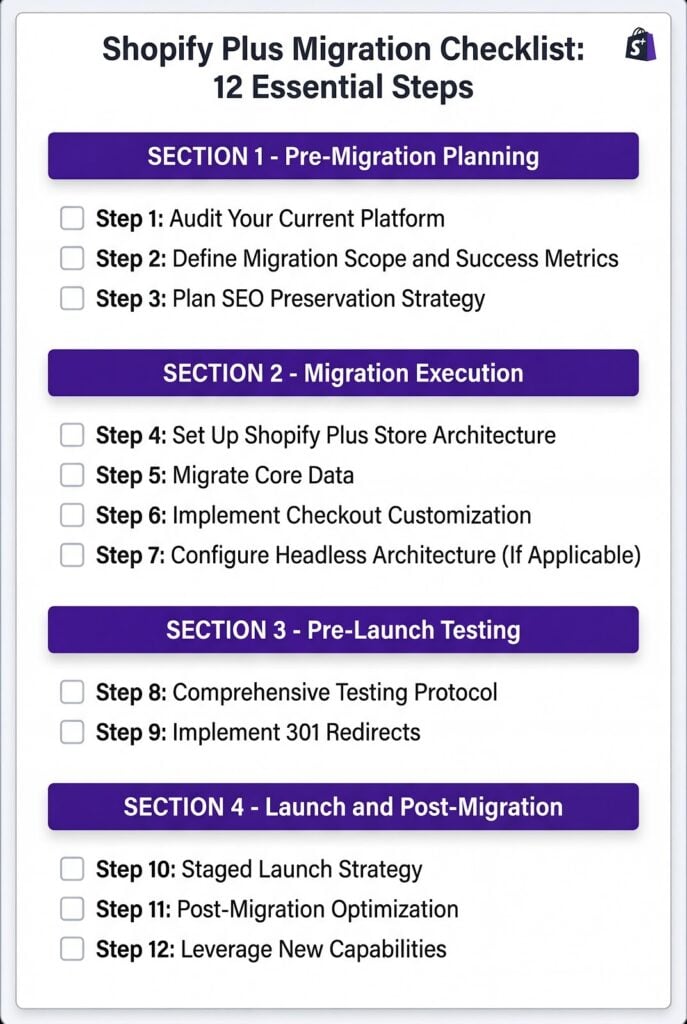
The Complete Shopify Plus Migration Checklist
Successful Shopify Plus migration requires methodical planning. Follow this proven checklist to minimize risk and protect revenue.
Pre-Migration Planning
1. Audit Your Current Platform
Export and document:
- Product catalog (variants, SKUs, collections)
- Customer data (accounts, order history, lifetime value)
- Order history and transaction records
- URL structures and high-performing pages
- Custom functionality and integrations
- Blog content and media assets
2. Define Migration Scope and Success Metrics
Determine:
- Must-have vs. nice-to-have features
- Custom functionality requirements
- Headless vs. traditional storefront architecture
- Integration requirements (ERP, CRM, 3PL, payment gateways)
- Success KPIs (conversion rate, page speed, SEO traffic, revenue)
3. Plan SEO Preservation Strategy
- Create a comprehensive URL redirect map (301 redirects). Missing redirects are the #1 cause of SEO traffic loss
- Document metadata for all pages
- Validate canonical tags and structured data
- Prepare XML sitemap for resubmission
Migration Execution
4. Set Up Shopify Plus Store Architecture
- Configure company structure and user permissions
- Set up payment gateways and tax settings
- Configure shipping zones and rates
- Implement B2B catalogs and pricing (if applicable)
- Install essential apps and integrations
5. Migrate Core Data
Execute in this order to prevent data integrity issues:
- Products and collections
- Customer accounts (with secure password migration)
- Historical order data
- Blog content and media
- Custom pages and navigation
6. Implement Checkout Customization
- Build checkout extensions using Checkout Extensibility
- Test custom fields, upsells, and branding
- Integrate third-party checkout apps if needed
- Configure Shop Pay and express checkout options
7. Configure Headless Architecture (If Applicable)
For headless Shopify Plus migration:
- Set up CMS (Sanity, Contentful, Contentstack)
- Build a custom storefront using Hydrogen
- Deploy on Oxygen or custom hosting
- Configure Storefront API and webhooks
- Implement CDN for global content delivery
Pre-Launch Testing
8. Comprehensive Testing Protocol
- Functionality: Cart, checkout, account creation, order processing
- Payment: All payment methods and gateways
- Mobile: Responsiveness across devices and browsers
- SEO: Redirects, metadata, structured data
- Performance: Page speed, Core Web Vitals, load testing – Audit media assets and limit apps to prevent performance degradation
- B2B: Custom pricing, payment terms, company accounts (if applicable)
9. Implement 301 Redirects
Map every URL from your old platform to new Shopify URLs. Test all redirects in staging before launch.
Launch and Post-Migration
10. Staged Launch Strategy
- Soft launch to a limited audience
- Gradual traffic shift using DNS management
- Monitor analytics and error logs in real-time
- Keep the legacy platform accessible as a backup for 30 days
11. Post-Migration Optimization
- Submit new XML sitemap to Google Search Console and monitor for crawl errors
- Monitor search rankings and organic traffic
- Optimize page speed and Core Web Vitals
- Analyze conversion funnel performance
- Gather customer feedback on the new experience
12. Leverage New Capabilities
- Enable AI-powered product recommendations
- Implement predictive analytics for inventory
- Set up automated marketing workflows
- Configure abandoned cart recovery
- Enable subscription models (if applicable)
Need expert guidance? Explore our Shopify Migration Service for comprehensive migration support.
Why Enterprise Merchants Choose Shopify Plus Migration in 2026
Understanding the strategic drivers behind Shopify Plus migration helps ensure you’re maximizing platform capabilities post-migration.
| Feature Category | Legacy Platform (Magento, BigCommerce, Salesforce) | Shopify Plus |
|---|---|---|
| Checkout Customization | Requires custom code; manual updates risk breaking changes | Code-free Checkout Extensibility; upgrade-safe with Shop Pay (up to 70% conversion) |
| Headless Commerce | Custom build required (6-12 months); separate hosting needed | Hydrogen + Oxygen framework included; 300+ edge locations; 20-50% faster loads |
| AI & Personalization | Third-party apps required; manual data science needed | AI-powered recommendations, predictive analytics, dynamic pricing, and agentic storefronts (ChatGPT, Copilot, Google AI Mode) |
| B2B Capabilities | Custom development for pricing, payment terms, and separate portals | Native price lists, automated net 30/60/90 terms, self-service portal, unified DTC+B2B commerce |
| Time to Launch | 9-18 months average | 4-12 weeks typical |
| Total Cost of Ownership | Higher (hosting, maintenance, security, development) | 33% lower TCO; managed security and updates |
| Developer Dependency | High; ongoing dev support required for updates and customizations | Low-code/no-code for most tasks; automatic backward-compatible updates |
| Integration Ecosystem | Manual API connections; integration maintenance required | 13,000+ pre-built apps; native connections to major tools (CMS, ERP, CRM) |
| Security & Compliance | Self-managed; dedicated resources needed | Shopify-managed; PCI DSS Level 1 certified, automatic security patches |
Checkout Extensibility Replaces checkout.liquid
Shopify replaced checkout.liquid in August 2024, making Shopify Checkout Extensibility migration essential for all new Shopify Plus stores. New migrants immediately gain access to:
- Code-free checkout customization through the checkout editor
- App-based extensions that are upgrade-safe
- Higher conversion rates with integrated Shop Pay
- Custom checkout UI extensions for bespoke experiences
Headless Architecture Adoption
In 2023, 63% of retailers planned to adopt headless architecture. By 2026, headless Shopify Plus migration has become increasingly common for brands requiring extreme customization, omnichannel content delivery, and 20-50% faster page loads. Shopify’s Hydrogen and Oxygen frameworks simplify headless builds with React-based storefronts and global CDN delivery.
AI-Driven Ecosystem and Predictive Analytics
Post-migration, Shopify Plus merchants gain AI-powered features unavailable on legacy platforms:
- Agentic Storefronts discoverable in ChatGPT, Microsoft Copilot, and Google AI Mode
- Predictive analytics for demand forecasting and inventory optimization
- AI-powered personalization with customer-specific catalogs and pricing
- Automated marketing insights analyzing cross-channel customer behavior
With 71% of companies now using generative AI in at least one business function, migrating to a platform with built-in AI capabilities is a competitive requirement.
Native B2B Functionality
B2B ecommerce is projected to reach $36 trillion by 2026 with a 14.5% CAGR. Shopify Plus now includes native B2B features, such as customer-specific pricing, flexible payment terms (net 30, net 60), self-service portals, and company management. This eliminates the need for separate wholesale stores. B2B brands report 40% increases in average customer spend and 25% reductions in administrative tasks post-migration.
Migrate to Shopify Plus: Your Path to Enterprise Commerce Success
Shopify Plus migration in 2026 is a strategic transformation that positions your brand for AI-driven, headless, omnichannel commerce with native B2B capabilities, enhanced checkout customization, and 29% lower total cost of ownership compared to legacy platforms.