

Magento / Adobe Commerce vs BigCommerce: A 2026 Comparison

Atwix builds and supports both platforms. Adobe Gold Solution Partner. BigCommerce Certified Partner with seven published BigCommerce apps. #1 global Magento code contributor every year from 2018 through 2025. This Magento vs BigCommerce comparison is a decision framework based on what happens when merchants pick one platform over the other, and what it costs them when they pick wrong.
60-second answer
- Choose Adobe Commerce (Magento) if you are a B2B distributor or manufacturer with complex pricing, deep ERP integration, custom catalogs, or multi-storefront needs. You have or can hire developer capacity. Expect an $80K-$400K+ year-one build and 14-22 weeks to launch, plus a quote-based license that partner estimates put at $22K-$40K+ per year for Adobe Commerce.
- Choose BigCommerce if you are a B2C brand or a B2B seller with moderate wholesale needs, your catalog and pricing rules fit inside what the platform offers natively, and you want no infrastructure to manage. Expect a $50K–$150K year-one build and 8–14 weeks to launch, plus a published platform fee from $39/mo (Core) to $1,499+/mo (Performance, annual contract).
- Choose BigCommerce Performance with B2B Edition and a Catalyst headless storefront if you want SaaS operations but need company accounts, quotes, price lists, and a custom frontend. This is realistic in 2026, but price it in full: B2B Edition and the Performance contract are separate line items.
Magento is regarded for its customizability and its ability to support large, complex operations. It suits enterprises with specific requirements that demand flexibility and control over every part of the store. BigCommerce is known for its out-of-the-box functionality and user-friendly setup, which makes it a strong fit for small to mid-sized businesses that want a complete eCommerce solution without extensive development.
When exploring Magento alternatives like BigCommerce, assess how each platform aligns with your business needs and growth plan. If Shopify is also on your shortlist, our Magento vs Shopify comparison follows the same framework. This guide compares Magento vs BigCommerce on core features, ease of use, performance, customization, pricing, B2B, AI, security, support, and SEO, and closes with a “choose X if” checklist.
Magento vs BigCommerce: 2026 Comparison Table
| Feature | Magento Open Source | Adobe Commerce | BigCommerce (Core / Growth / Scale) | BigCommerce Performance |
|---|---|---|---|---|
| Core Functionality | Self-hosted open source platform. Full code access. B2C and basic B2B. Current release 2.4.9 (GA May 12, 2026). | Paid edition of Magento, available on-premise, on Adobe-managed Cloud (PaaS), or as a Cloud Service (SaaS, GA since June 2025). Native enterprise B2B suite. Adobe Experience Cloud integration. | Fully hosted SaaS. Integrated payments, real-time shipping rates, 70+ promotion types, built-in CMS, multi-channel selling via Feedonomics Surface. Multi-storefront as a paid add-on (max 3 to 8 storefronts by tier). | Everything in Scale plus SKU-level Price Lists, advanced promotions, custom inventory locations, dedicated Customer Success Manager, API support. B2B Edition available. |
| Ease of Use | Steeper learning curve; expects a developer in the loop for catalog, checkout, and integration work. | Same admin as Open Source plus Page Builder. Cloud Service removes upgrades and patching but not the need for a technical partner on integrations. | Drag-and-drop control panel, Makeswift visual editor, no code needed for day-to-day operations. | Same admin as self-service tiers with CSM guidance. |
| Performance & Scalability | Depends on hosting, Varnish/Redis or Valkey caching, and frontend. Hyvä-themed builds deliver PageSpeed scores in the 90s. | Adobe-managed AWS and Fastly CDN on Cloud. 2.4.9 supports OpenSearch 3.x and Valkey 8.x. Edge Delivery Services storefronts for the Cloud Service. | Hosted, auto-scaling, global CDN. Catalyst headless storefront (React and Next.js) with BigCommerce-managed hosting on Cloudflare (open beta, summer 2026). | Same infrastructure with contracted volume terms; no GMV auto-upgrade jumps. |
| Customization & Flexibility | Full code access: catalog model, pricing logic, checkout, admin. Hyvä or Luma frontend. No vendor lock-in. | Same code access on Cloud and on-premise plus paid modules (B2B, Page Builder, Live Search, Product Recommendations). Full REST and GraphQL APIs, App Builder. Cloud Service: no core code changes; extend via APIs and App Builder only. | Stencil themes, HTML/CSS, 1,200+ apps, REST and GraphQL APIs. API rate limits apply by tier. Backend logic is fixed. | Higher API limits, Catalyst headless, B2B Edition Buyer Portal customization. Backend logic still fixed. |
| Pricing & Total Cost | License free. Production hosting $400-3,000/mo. Development and maintenance variable. | License quote-based on GMV and AOV. 2026 partner estimates: from ~$22K/yr on-premise, ~$40K/yr on Cloud, scaling to $125K-$190K+ at high GMV. Cloud bundles hosting. | Core $39/mo ($29 annual, to $30K TTM GMV), Growth $105/mo ($79, to $100K), Scale $399/mo ($299, $33,333/mo GMV then 0.9% overage). Open Payment Provider Fee of 2.0% / 1.0% / 0.6% on orders outside the embedded gateway list. | Custom, from $1,499/mo billed annually. No Open Payment Provider Fee under contract. B2B Edition, extra storefronts, and apps priced separately. |
| B2B Capabilities | No native B2B. Company accounts, quotes, custom pricing, POs, and requisition lists require extensions or custom development. | Native B2B: multi-level company hierarchies, shared catalogs with account pricing, negotiable quotes, purchase orders with approval workflows, requisition lists, quick order by SKU, payment terms and Pay on Account. | B2B Edition (separately priced): company accounts, quotes, approval workflows, requisition lists, Buyer Portal. Customer groups and segmentation from Growth. SKU-level Price Lists not included below Performance. | B2B Edition plus native Price Lists. 2026 additions announced at Commerce Live: cascading price lists, event-driven webhooks, AI purchase-order automation (early alpha). |
| AI & Automation | No native AI. Third-party extensions for AI search (Algolia, Klevu), content generation, and chat. | Adobe AI suite: Live Search with AI re-ranking, Product Recommendations, GenAI product content, AI Assistant. Native Universal Commerce Protocol and Agentic Commerce Protocol support announced February 2026. | BigCommerce Companion admin assistant, Storefront MCP, Feedonomics Agentic Catalog Exports syndicating catalogs to ChatGPT and Gemini. Availability varies by feature; some enterprise-only or alpha. | Same as self-service plus enterprise-only agentic features as they ship. |
| Security & Compliance | Self-managed PCI DSS. You apply Adobe’s security patches. PHP end-of-life dates (PHP 8.2: December 31, 2026) are your problem. | PCI DSS Level 1 inherited on Cloud. Three-year support per release (2.4.9 to May 31, 2029). Cloud version upgrade enforcement from June 1, 2027. Cloud Service: Adobe patches everything. | PCI DSS Level 1, automatic patches, SSL included, nothing to apply. | Same, with contracted SLAs. |
| SEO Capabilities | Full control over meta tags, canonical URLs, schema, sitemaps, redirects. Amasty and Mirasvit SEO suites for bulk and technical work. | Same surface plus Live Search and automated structured data. Hyvä and Edge Delivery Services for Core Web Vitals. | Customizable URLs, auto-generated sitemaps, editable meta, 301 handling. Good defaults, less depth. | Same tools; Catalyst gives frontend control for technical SEO work. |
| Customer Support | Community only (forums, docs), or your agency. | 24/7 Adobe support, Customer Success Manager, Adobe Solution Partners. | 24/7 chat and email on Core; 24/7 phone from Growth. Express routing as a paid add-on. | 24/7 phone and chat, dedicated Customer Success Manager, API support. |
Sources: BigCommerce pricing, Adobe Commerce lifecycle policy, Commerce Live 2026 announcements. Checked September 2026.
What changed since our last update
Both platforms changed their pricing and lifecycle rules in the past year, so most older comparisons (including the previous version of this one) quote numbers that no longer apply.
- BigCommerce restructured its plans on June 1, 2026. Standard, Plus, Pro, and Enterprise became Core, Growth, Scale, and Performance. Sticker prices barely moved, but the sales thresholds that force an upgrade dropped (Core caps at $30K trailing-12-month GMV, Growth at $100K), and a new Open Payment Provider Fee of up to 2% applies to orders processed outside BigCommerce’s embedded gateway list. Performance now has a published starting price of $1,499 per month, billed annually. (Source: BigCommerce pricing, checked September 2026.)
- Adobe Commerce 2.4.9 shipped on May 12, 2026, with standard support to May 31, 2029. Adobe also introduced an enforced upgrade policy: from June 1, 2027, Adobe will suspend traffic to Adobe Commerce on Cloud environments running unsupported versions. (Source: Adobe Commerce lifecycle policy, updated August 2026.)
- Adobe Commerce as a Cloud Service (SaaS) has been generally available since June 2025 and is now Adobe’s recommended long-term destination for Cloud customers. Adobe manages infrastructure, patching, and upgrades; the trade-off is that you can no longer modify the core application.
- BigCommerce’s parent company now trades as Commerce (Nasdaq: CMRC). The platform keeps the BigCommerce name. Recent investment has gone into the Catalyst headless storefront framework, the Makeswift visual editor, B2B Edition, and agentic commerce (catalog syndication to ChatGPT, Gemini, and other AI surfaces via Feedonomics).
Core Functionality and Features
Verdict: Magento / Adobe Commerce wins on depth, especially for B2B and multi-store operations. BigCommerce wins on how much works the day you sign up.
When comparing Magento vs BigCommerce, both platforms offer strong feature sets, but they target different businesses. Adobe Commerce provides advanced, customizable features for enterprises with complex operations. BigCommerce offers a user-friendly, all-in-one solution for businesses that want simplicity without giving up capability.
Magento
Magento is built for businesses that require extensive customizability and control over their operations. It offers multi-store management, the ability to handle complex product catalogs, and mature tools for B2B and B2C selling. Magento is highly modular, so developers can build custom features or integrations to meet the specific needs of large enterprises.
Adobe Commerce’s B2B suite covers company accounts with role hierarchies, shared catalogs with account-specific pricing, quote negotiation, requisition lists, and purchase-order payment terms, all natively. From advanced inventory management to custom checkout flows, Magento gives businesses full control over the eCommerce experience, which is why companies with unique or complex requirements pick it.
BigCommerce
BigCommerce focuses on delivering out-of-the-box functionality. It ships with integrated payment gateways, shipping tools, real-time carrier rates, product reviews, over 70 promotion types, and a built-in CMS, so businesses can launch quickly without heavy customization.
BigCommerce also has a native B2B layer, B2B Edition, with company accounts, quotes, price lists, approval workflows, and requisition lists. Two caveats for B2B buyers: SKU-level Price Lists are only included on the Performance plan, and B2B Edition is priced separately on the self-service tiers. Check the BigCommerce pricing page before assuming a feature is in your plan.
While BigCommerce does not match Magento’s flexibility, it provides more than enough functionality for small to mid-sized businesses that need a reliable eCommerce platform with minimal setup and management.
Magento is the fit for businesses needing deep customization and advanced features, especially for complex B2B or multi-store operations. BigCommerce offers strong features out of the box and suits small to mid-sized businesses looking for ease of use and a quick setup.
Ease of Use and User Interface (UI)
Verdict: BigCommerce is easier to run without a developer. Magento rewards a team that has one.
BigCommerce is known for its intuitive interface and fast setup, which makes it a good choice for businesses without in-house technical expertise. Magento offers deep customization and flexibility but requires more technical knowledge or developer support to manage effectively.
Magento
Magento is more powerful but requires technical expertise to use fully. Magento Open Source gives complete flexibility and control over the store, and that comes with a steep learning curve. Setting up and managing a Magento store often involves developers, especially for complex operations like multi-store management or integrating custom extensions.
Adobe Commerce simplifies some of this. Page Builder handles content without code, and Adobe Commerce as a Cloud Service removes upgrades and patching from your plate entirely. Even so, Magento remains a platform for businesses that can dedicate resources to technical management or work with a partner.
BigCommerce
BigCommerce is recognized for its user-friendly drag-and-drop interface. Businesses can customize their online store without coding skills. From the dashboard, users manage everything from product listings to order fulfillment and shipping options.
The BigCommerce control panel simplifies tasks like adding new products, configuring shipping rules, and managing payments. The Makeswift visual editor extends this to page layout on both Stencil and Catalyst storefronts. This makes BigCommerce attractive for small to mid-sized businesses or those without dedicated development teams.
Magento offers unmatched flexibility and customization but comes with complexity that requires technical expertise. BigCommerce excels in ease of use, which makes it the better choice for businesses looking for a non-technical solution.
Performance and Scalability
Verdict: Both scale. Magento gives you control over how; BigCommerce takes that job off your hands.
In Magento vs BigCommerce, Magento handles complex, high-traffic eCommerce operations with scalability for global enterprises. BigCommerce also scales well, and suits businesses seeking a balance between ease of use and growth potential, which makes it a fit for mid-market stores.
Magento
Magento is built with scalability in mind, which makes it the choice for large businesses or enterprises with complex needs. How much infrastructure you manage depends on the edition:
- Magento Open Source is self-hosted. You control server performance and can fine-tune caching, CDNs, and database management for heavy traffic.
- Adobe Commerce on Cloud is a PaaS model: Adobe manages the AWS infrastructure and Fastly CDN, you own the codebase and the upgrade cycle.
- Adobe Commerce as a Cloud Service is SaaS: Adobe runs everything, including upgrades.
See how we built a high-performance Magento store handling 50K+ SKUs for Powerpak.
BigCommerce
BigCommerce handles performance and scaling on its own servers as a hosted solution. This removes manual optimization from the business’s side, which is easier for teams that do not want to manage server performance.
BigCommerce offers automatic scaling, load balancing, and a global CDN so stores stay fast and responsive as they grow. For headless builds, the Catalyst framework (React and Next.js) now has BigCommerce-managed hosting on Cloudflare, announced at Commerce Live in April 2026. Larger enterprises may still find they need more control over infrastructure than a SaaS platform allows, which is where Magento is better suited.
Magento’s architecture handles large product catalogs, complex pricing structures, and high-traffic environments. Modern frontends such as Hyvä (for Open Source and Adobe Commerce) and Edge Delivery Services storefronts (for Adobe Commerce and the Cloud Service) have addressed the slow-storefront reputation Magento carried for years. This makes Magento a strong option for businesses that plan to scale significantly or operate multiple regional storefronts.
Magento provides full control over performance and scalability, which suits large businesses with specific needs. BigCommerce offers simplified, managed scalability that works well for small to mid-sized businesses, but may not provide the level of control some enterprises require.
Customization and Flexibility
Verdict: Magento, without much contest. BigCommerce’s ceiling is higher than it used to be, but it is still a ceiling.
The Magento vs BigCommerce comparison is especially striking here. Magento provides open-source-level customization, so businesses can modify every part of the store. BigCommerce, while not open source, offers solid customization options, but users are more limited in backend flexibility.
Magento
Magento is known for its customization options. As an open-source platform, it lets businesses modify the core code, create custom modules, and integrate third-party applications or extensions. This suits businesses that need to tailor every part of their eCommerce store to specific requirements. With Magento, companies have complete control over appearance, functionality, and backend processes.
Developers can create unique workflows, custom checkout processes, and integrations with external systems like ERP or CRM solutions. This level of customization requires technical expertise and developer resources to implement and maintain.
One 2026 caveat: Adobe Commerce as a Cloud Service does not allow core code changes. Customization happens through APIs, App Builder extensions, and the storefront layer. If your competitive advantage lives in modified core logic, stay on Adobe Commerce on Cloud, on-premise, or Magento Open Source.
BigCommerce
BigCommerce also offers customization, though less than Magento. As a SaaS (Software as a Service) platform, users customize the storefront with pre-designed Stencil themes or by modifying HTML and CSS. For full frontend control, BigCommerce’s Catalyst framework lets developers build a headless storefront in React and Next.js while BigCommerce runs the commerce engine. BigCommerce also provides an open API for integrations with third-party services and apps. What it lacks is the deep backend customization Magento provides, so businesses are constrained by what the platform allows.
This is ideal for businesses looking for quick, low-maintenance setups. Those requiring significant backend flexibility may find BigCommerce’s options limited.
Magento is the platform for businesses needing complete customization and control over their eCommerce environment. BigCommerce provides solid customization options but remains limited by its SaaS model, which suits businesses looking for simplicity over deep customization.
Find the right setup for your catalog and integrations
If your requirements include custom pricing logic, ERP-driven catalogs, or a storefront the platform’s themes cannot deliver, we can tell you within one call whether that lives comfortably on BigCommerce or needs Adobe Commerce. We build on both.
Pricing and Total Cost of Ownership
Verdict: BigCommerce is cheaper to start and easier to budget. Magento’s total cost of ownership is higher but buys you control, and at enterprise volume the gap narrows.
When comparing Magento vs BigCommerce, evaluate both the initial setup costs and the total cost of ownership (TCO) over time. Both vendors changed their pricing mechanics in the past 18 months, so treat any figure older than that as expired.
Magento
Magento Open Source is free to download, but running a Magento store requires real investment in hosting, development, and maintenance. For Adobe Commerce (Adobe Commerce Development), Adobe does not publish list prices. Licenses are quoted per merchant and tiered on gross merchandise value (GMV) and average order value (AOV). Partner and agency estimates published in 2026 place entry-level licenses at roughly $22,000 per year for the on-premise edition and roughly $40,000 per year for Adobe Commerce on Cloud, rising with GMV. Adobe Commerce as a Cloud Service is also quote-based. Use those figures for planning only and get a quote for your actual volume.
On top of the license, budget for custom development, premium extensions, and hosting (for Open Source and on-premise). The platform is resource-intensive and needs proper infrastructure, which drives cost. Magento suits businesses with the budget to invest in a highly customizable, scalable platform.
BigCommerce
BigCommerce publishes its pricing, which makes it easier to predict costs. The plan table below shows the four tiers as of September 2026, after the June 1 restructure. Hosting, security, and updates are included in every plan.
Two things changed in June 2026 that affect budgeting. First, the sales caps dropped (Core from $50K to $30K, Growth from $180K to $100K), so the same revenue now lands you on a higher plan than it did last year. Second, the “no transaction fees” promise now has a condition: orders processed through a gateway outside BigCommerce’s embedded list (which includes Stripe, PayPal, Adyen, Klarna, Amazon Pay, and about 20 others) pay the Open Payment Provider Fee on self-service plans. Multi-storefront, B2B Edition, apps, and premium themes cost extra.
BigCommerce’s total cost of ownership is typically lower than Magento’s, especially for small to mid-sized businesses that do not need extensive customization or control. At enterprise GMV, a Performance contract plus B2B Edition and implementation partner fees can approach Adobe Commerce’s entry tiers, so run the numbers for your volume rather than assuming.
BigCommerce plans as of September 2026
| Plan | Monthly (annual billing) | Sales threshold | Open Payment Provider Fee |
|---|---|---|---|
| Core (was Standard) | $39 ($29) | Up to $30K trailing-12-month GMV, then auto-upgrade | 2.0% |
| Growth (was Plus) | $105 ($79) | Up to $100K TTM GMV, then auto-upgrade | 1.0% |
| Scale (was Pro) | $399 ($299) | $33,333 per month GMV, 0.9% overage above that | 0.6% |
| Performance (was Enterprise) | Custom, from $1,499 (annual contract) | Custom | 0% with contract |
Source: BigCommerce pricing, September 2026. BigCommerce calculates GMV as gross order value minus 10%, and taxes and shipping count toward the threshold.
Magento offers more flexibility and advanced features but comes with higher long-term costs for hosting, development, and maintenance. BigCommerce provides an all-inclusive pricing model that small to mid-sized businesses can budget for, with fee mechanics you need to read closely.
Security and Compliance
Verdict: BigCommerce handles security for you. Magento gives you control and, with it, deadlines you must not miss.
Both platforms offer strong security, but Magento gives more control over specific settings and updates. BigCommerce, as a fully hosted platform, includes automatic security updates and PCI compliance, which suits businesses that prefer not to manage security themselves.
Magento
Magento provides advanced security options but leaves managing updates and patches to the business. This allows deep control but requires dedicated resources. PCI compliance, data encryption, and regular security patches are core components, and businesses need to apply patches on schedule.
For enterprises with specific compliance needs or sensitive customer data, Magento’s flexibility allows custom security configurations, but you need a team or a partner like Atwix to manage it.
BigCommerce
BigCommerce takes a hands-off approach for businesses by managing all security patches, PCI compliance, and SSL certificates. This suits companies that prefer not to deal with the technical side of security.
BigCommerce’s hosting is PCI DSS Level 1 compliant (see the BigCommerce Trust Center), and the platform manages ongoing security updates. Small and mid-sized businesses stay secure without added technical burden.
For Adobe the dates now matter more than they used to. Under Adobe’s lifecycle policy, each 2.4.x release gets three years of standard support. As of September 2026, 2.4.7, 2.4.8, and 2.4.9 are in standard support; 2.4.6 left standard support on August 11, 2026 and is in extended support to August 31, 2027. Adobe also publishes PHP end-of-life dates alongside: PHP 8.2 reaches end of life on December 31, 2026, which puts 2.4.6 stores running it at PCI risk. Adobe Commerce on Cloud customers face a hard stop: from June 1, 2027, Adobe will suspend traffic to Cloud environments on unsupported versions. Adobe’s stated preferred route out of this cycle is migration to Adobe Commerce as a Cloud Service, where Adobe handles patching.
Magento provides more control over security but requires businesses to handle updates and compliance on Adobe’s timeline. BigCommerce simplifies security management by handling updates and compliance itself.
Customer Support
Verdict: BigCommerce includes 24/7 support in every plan. Magento support depends on edition, and for Open Source it depends on your partner.
Both Magento and BigCommerce offer extensive support options, but the level of support depends on the edition and the resources available through the community.
Magento
Magento users benefit from a large, active community and extensive documentation, including forums, guides, and tutorials. Adobe Commerce customers get dedicated support with technical assistance, security updates, and priority channels.
This benefits enterprises that need professional help managing complex eCommerce setups. Open Source users have community support, but resolving complex issues usually means hiring a certified Magento developer or agency.
BigCommerce
BigCommerce offers 24/7 support on every plan, though the channel depends on the tier. As of September 2026, Core includes 24/7 chat and email; live phone support starts at Growth. BigCommerce also maintains a large knowledge base with articles, guides, and tutorials.
Performance customers receive a dedicated Customer Success Manager and API support, so they have the help they need to scale.
Magento provides community support for Open Source users and premium support for Adobe Commerce clients. BigCommerce offers 24/7 support for all users, with phone support from the Growth plan and enhanced services for Performance customers.
SEO Capabilities
Verdict: Magento for advanced SEO programs. BigCommerce for solid SEO defaults with less effort.
For businesses focused on organic traffic, SEO capabilities matter when choosing a platform. Both offer strong SEO tools; Magento provides more options for complex strategies.
Magento
Magento is known for its advanced SEO capabilities. Users can customize URLs, meta tags, and sitemaps, which makes complex SEO strategies easier to implement. Magento’s integration with third-party SEO tools and extensions gives businesses more control over optimization. On the performance side, Hyvä and Edge Delivery Services storefronts give Magento stores a credible path to strong Core Web Vitals, which older Luma-based stores struggled with.
For businesses that need detailed and specific SEO configurations, Magento’s flexibility is an advantage. It requires a knowledgeable team to set up and manage properly.
BigCommerce
BigCommerce also offers strong built-in SEO tools, including customizable URLs, auto-generated sitemaps, and easy editing of meta descriptions and titles. It is designed to be user-friendly, so businesses can optimize without extensive technical knowledge.
BigCommerce’s SEO tools are sufficient for most small to mid-sized businesses. They do not offer the depth and control Magento provides for companies with advanced SEO strategies.
Magento offers more advanced SEO tools and integrations, which suits businesses with complex SEO strategies. BigCommerce provides solid SEO capabilities out of the box with a more user-friendly approach.
Magento vs BigCommerce: A Final Side-by-Side Comparison
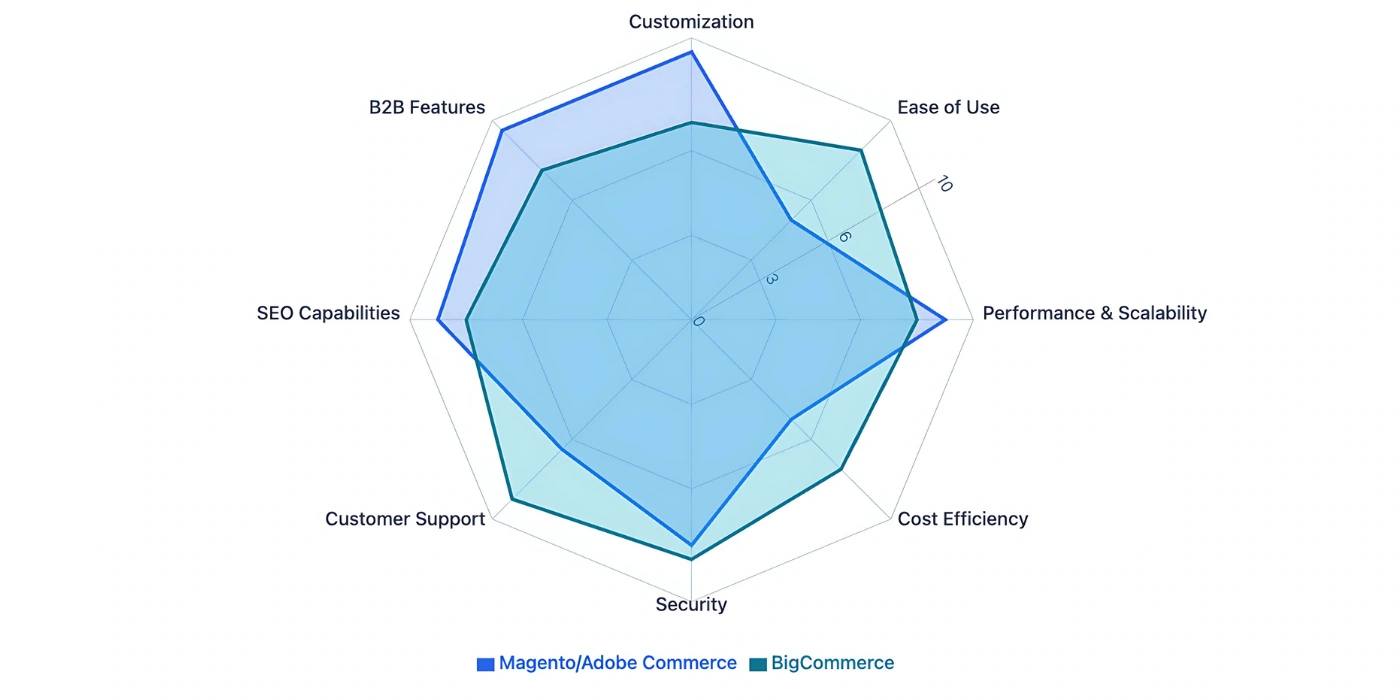
Both platforms have strengths, depending on business size, technical resources, and long-term goals. The table below summarizes the key differences as of September 2026.
| Feature | Magento / Adobe Commerce | BigCommerce |
|---|---|---|
| Core Functionality | Highly customizable, with multi-store management, complex catalogs, and a native B2B suite (company accounts, shared catalogs, quotes, requisition lists) | Out-of-the-box functionality with integrated CMS, payments, shipping; B2B Edition available, Price Lists only on Performance |
| Ease of Use | Steeper learning curve; needs technical expertise or a partner | Drag-and-drop interface and Makeswift visual editor, suitable for non-technical users |
| Performance & Scalability | Self-hosted (Open Source), Adobe-managed PaaS (on Cloud), or SaaS (Cloud Service); full control at the PaaS and self-hosted tiers | Hosted SaaS with automatic scaling and global CDN; managed Catalyst hosting for headless |
| Customization | Core-level customization through open-source architecture and custom modules (not on Cloud Service) | Themes, HTML/CSS, APIs, and Catalyst headless storefronts; no backend customization |
| Pricing | Open Source free; Adobe Commerce quote-based on GMV/AOV, partner estimates from ~$22K/yr on-premise and ~$40K/yr on Cloud | Published plans: Core $39/mo, Growth $105/mo, Scale $399/mo, Performance from $1,499/mo (annual); GMV caps and Open Payment Provider Fee apply |
| Security | Advanced, but you manage patches; Adobe enforces version upgrades on Cloud from June 1, 2027 | Managed security, automatic patches, PCI DSS Level 1 built in |
| SEO Capabilities | Advanced SEO tools with full customization and third-party integration | Built-in SEO tools sufficient for small to mid-sized businesses |
| Customer Support | Community support for Open Source; dedicated support for Adobe Commerce | 24/7 chat and email on all plans; phone from Growth; CSM on Performance |
Which platform should you choose?
Choose Magento / Adobe Commerce if…
- You sell B2B with account-specific pricing, negotiated quotes, approval workflows, or contract terms, and you need them to work with your ERP rather than around it. This is where most of our B2B eCommerce work lands.
- You run multiple brands, regions, or storefronts from one backend and one catalog.
- Your competitive advantage depends on custom checkout, pricing, or fulfillment logic that a SaaS platform will not let you touch.
- You have (or will hire) a development partner and a budget that covers license, hosting, and ongoing maintenance, not just the build.
Choose BigCommerce if…
- You want to launch in weeks, not months, and your catalog and pricing rules fit inside what the platform offers natively.
- You have no in-house developers and do not want to manage hosting, patching, or PCI scope.
- Your annual online sales sit comfortably inside a published plan tier, and you process payments through an embedded provider (Stripe, PayPal, Adyen, and the rest of the list), so the Open Payment Provider Fee does not apply.
- Your B2B needs are real but moderate: company accounts and quotes, without deep ERP-driven pricing logic. If that describes you, see our BigCommerce development services.
Summary
The right platform depends on your business’s size, complexity, and long-term goals.
- Magento / Adobe Commerce is the choice for large enterprises and complex B2B operations that need complete control over eCommerce operations. Its customization and scalability suit companies with complex needs, at the cost of a steeper learning curve and higher total cost of ownership.
- BigCommerce fits small to mid-sized businesses that want an easy-to-use, all-in-one solution. It provides strong functionality out of the box, with managed security and hosting, which makes it simpler and more affordable for businesses that do not need deep customization or technical management.
Atwix is an Adobe Gold Solution Partner and a BigCommerce Certified Partner, and has been the number one global code contributor to Magento from 2018 through 2025. We build and support both platforms, so we have no reason to steer you toward one. Whether you need a customized Adobe Commerce store or an efficient BigCommerce setup, our team can help you decide and then deliver.
Talk to us about your platform decision
If you are weighing Magento or Adobe Commerce against BigCommerce, the fastest way to a decision is a short call about your catalog, your pricing rules, and your integrations. We will tell you which platform fits, what it will cost to run, and what the migration path looks like.
Frequently Asked Questions
Got a question that is not covered here? Send it through our contact form.
Is Magento still worth using in 2026?
Yes, for the businesses it was built for. Adobe released Magento Open Source and Adobe Commerce 2.4.9 in May 2026 with support to May 2029, and continues to ship security patches on a regular cadence. The community-maintained Mage-OS distribution adds a second path for Open Source merchants. Magento is a poor fit for small stores without developer support, but for complex B2B and multi-store operations it remains one of the few platforms that offers full control.
How easy is it to migrate from BigCommerce to Magento?
Migrating from BigCommerce to Magento can be done with migration tools and services. The process requires technical expertise to transfer product catalogs, customer information, and order histories cleanly, and to rebuild integrations. Working with a development partner like Atwix simplifies the process and ensures every part of the store migrates successfully.
Is Magento or BigCommerce better for large enterprises?
Magento is better suited for large enterprises that need extensive customizability, scalability, and control over store operations. Its open architecture allows advanced features and complex setups. BigCommerce scales well and now publishes a Performance tier starting at $1,499 per month, but it suits mid-market businesses that want a managed solution without deep customization.
Which platform provides better SEO tools, Magento or BigCommerce?
Magento provides more advanced SEO capabilities: full control over URLs, meta tags, and third-party SEO extensions. It suits businesses with complex SEO strategies. BigCommerce offers solid built-in SEO tools that are easier to use but with less depth than Magento.
What are the long-term costs of running Magento compared to BigCommerce?
Magento Open Source has no license fee, but you pay for hosting, development, and security management. Adobe Commerce licenses are quote-based and tiered on GMV; 2026 partner estimates start around $22,000 per year on-premise and $40,000 per year on Cloud. BigCommerce publishes its plans, from $39 per month on Core to a Performance tier starting at $1,499 per month, with hosting and security included and GMV-based upgrade thresholds. For smaller businesses, BigCommerce has lower long-term costs.
Is BigCommerce a good option for B2B businesses, or is Magento better suited for that?
BigCommerce B2B Edition covers company accounts, quotes, price lists, and approval workflows, and is a reasonable fit for moderate B2B needs. Magento is better suited for B2B businesses that require multi-store management, custom workflows, account-specific catalogs, and deep integrations with ERP or CRM systems.
How secure is BigCommerce compared to Magento in terms of data protection?
BigCommerce manages all security patches and updates, so staying PCI compliant takes little effort. Magento gives users full control over security measures, which requires regular patching on Adobe’s published schedule and, for Cloud customers, meeting Adobe’s June 2027 version enforcement deadline. For businesses that need flexibility in security configuration, Magento is the better option, with more hands-on effort.

