


Your next customer may research you in ChatGPT, compare you with two other suppliers inside a procurement tool, and send a purchase order that software drafted. That shift explains why most lists of B2B eCommerce trends for 2026 lead with AI: agentic commerce, hyper-personalization, AI-led discovery and AI inside the ERP. They usually treat these as four separate projects. They depend on one thing most trend lists skip: whether AI can read your ERP data, and the product data built on it, accurately, safely and in real time. This guide covers what each trend changes for distributors and manufacturers, which numbers hold up, and what to fix in the next 90 days.
The short version
| Trend | What changes | Evidence | First move |
| Agentic commerce | Software agents research, compare and place orders for buyers | Gartner: 90% of B2B buying agent-intermediated by 2028 | Expose contract price and stock through authenticated APIs |
| Hyper-personalization | Each account and each role sees its own catalog, price and reorder prompts | Atwix TUG 2026 demo: contract-price quote plus order-history upsell in under 3 minutes | Pick one personalization use case that runs on ERP data |
| AI-led discovery | Shortlists form in AI answers before a buyer contacts you | Gartner 2026: 45% of B2B buyers used AI in a recent purchase | Check what AI engines say about you today |
| AI in ERP | Teams ask the ERP questions in plain language; agents act inside it | Gartner: 40% of enterprise apps with task-specific agents by end of 2026 | Give internal teams read-only AI access first |
Agentic commerce: your next buyer may be software
Agentic commerce is buying and selling in which AI agents search, compare, negotiate and complete purchases on behalf of a person or company, within rules that person sets. For a distributor, that means some orders will come from a customer’s software rather than from a person clicking through your portal.
The headline forecasts come from consumer retail. McKinsey’s research puts agentic commerce at $900 billion to $1 trillion of orchestrated US B2C retail revenue by 2030, and $3 trillion to $5 trillion globally. The same research states that those figures cover goods only, leaving out services and the B2B marketplace. The number most decks quote excludes B2B entirely.
The B2B forecast is larger and closer. In its 2026 strategic predictions, Gartner predicts that by 2028, 90% of B2B buying will be AI agent intermediated, pushing over $15 trillion of B2B spend through AI agent exchanges. We read “intermediated” as wider than “autonomous.” An agent that ranks your quote against two others counts, even when a human signs the PO.
Seller-side pressure starts sooner. Forrester predicts that in 2026, at least one in five B2B sellers will have to answer AI buyer agents with counteroffers from their own agents. In the same research, 61% of purchase influencers said their organization has or will use a private generative AI engine to support purchasing.
What a buyer’s agent needs from your store
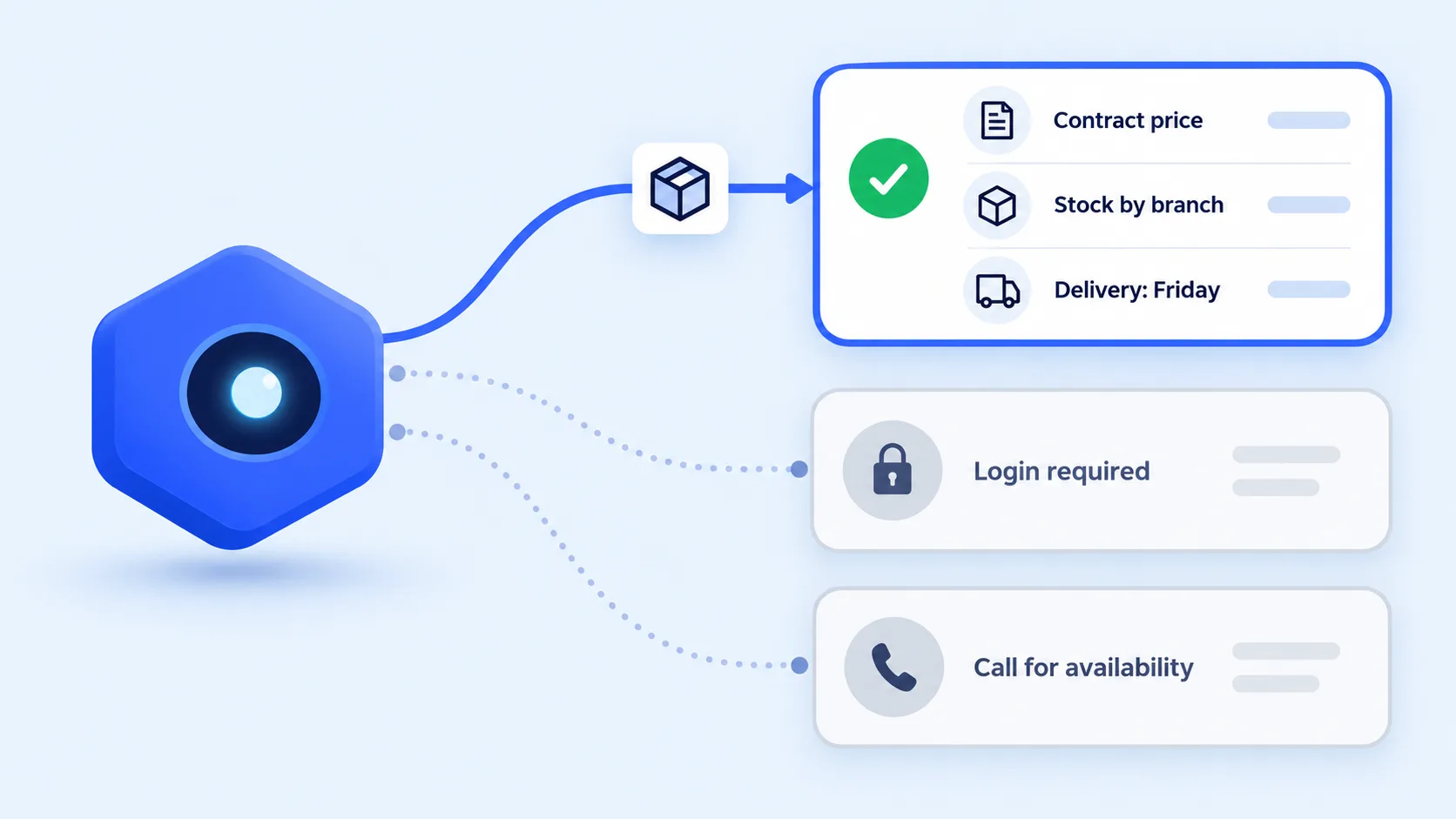
Picture a routine reorder. A facilities manager at a regional hospital network gives a purchasing agent a task: 40 cases of nitrile gloves, split across two sites, delivered by Friday, from approved suppliers only.
The agent checks three distributors. The first answers through an API with the hospital’s contract price, stock at the two nearest branches and a delivery date. The second shows list price until someone logs in. The third says “call for availability.” The agent orders from the first, and the other two never learn they were in the running.
That scenario describes what an agent needs:
- Identity. The agent has to prove whose account it represents, so it gets the contract price instead of list.
- Live price and availability. It needs stock by branch, lead time, and quantity breaks, all returned in a structured form.
- Order state. Once it orders, it needs confirmations, backorders and shipment events it can act on without an email thread.
Every item on that list lives in your ERP.
The protocols came from consumer checkout
The two best-known standards launched on consumer AI surfaces .OpenAI and Stripe built the Agentic Commerce Protocol to power Instant Checkout inside ChatGPT. In March 2026, OpenAI moved checkout out of the chat and into merchants’ own apps, and ACP continues under that model. Reporting on the change pointed to data: stock status, pricing and sales tax had to stay accurate across every merchant, and that proved hard to do from the outside. Google launched the Universal Commerce Protocol in January 2026 as an open standard that works with its Agent Payments Protocol (AP2) and lets businesses integrate through APIs, Agent2Agent (A2A) or the Model Context Protocol (MCP). Our guide to preparing your commerce stack for UCP, ACP and agentic checkout covers the platform-level work for Adobe Commerce, Shopware and Shopify.
For B2B, the protocol matters less than what sits behind it. Contract price, credit holds, approval chains and ship-to rules decide whether an order can happen. Whichever protocol wins, the agent ends up querying your ERP through something.
Some of that plumbing already exists. With Atwix’s Shared Quotes on Infor CloudSuite Distribution and Adobe Commerce, a rep builds the quote in the ERP, generates a link, and the buyer opens a ready checkout without logging in. The ERP calculates everything, and the order posts back under the same ID. The back half of that flow carries over to agents: the ERP prices the order and receives it as the record. The front half would change. A buyer’s agent starts the request itself, needs a machine-readable response instead of a checkout page, and has to authenticate as the account, the step this link deliberately skips for a human buyer.
Hyper-personalization: B2B had it first, AI makes it scale
Hyper-personalization means tailoring what each buyer sees, from catalog and price to search results, reorder prompts and content, to that account and that person in real time, using their transaction and behavior data.
B2B commerce ran on personalization long before the term existed. Every account already has its own contract prices, approved SKU list, ship-to addresses and payment terms. The ERP holds all of it. What AI changes is the reach of that data, in three places.
Search in the customer’s language. A mechanical contractor’s buyer types “HX-220” because that is what their own purchasing system calls the part. Your catalog calls it something else. The customer cross-reference table in your ERP already maps the two, and AI search can use it to return the right SKU on the first try.
Reorder timing from order history. An account orders a pallet of ice melt every five weeks from November through February. In week six there is no order. AI can flag the gap to the rep or prompt the buyer, based on a pattern the account created.
Views that match the role. Within one account, a field technician sees approved SKUs and the nearest branch’s stock. The purchasing manager sees spend against budget and pending approvals. Same account, same data, different jobs.
We showed a version of this at TUG Connects 2026. A customer called an inside-sales rep about two plumbing fitting SKUs. Working in one AI conversation connected to Infor CSD, the rep pulled the account’s credit status, checked stock across 31 branches, and confirmed the contract price: list on one SKU, 14% off the other. The AI also spotted a complementary SKU the account buys repeatedly and flagged it as an upsell. The customer had a confirmed quote in under three minutes.
Where personalization breaks
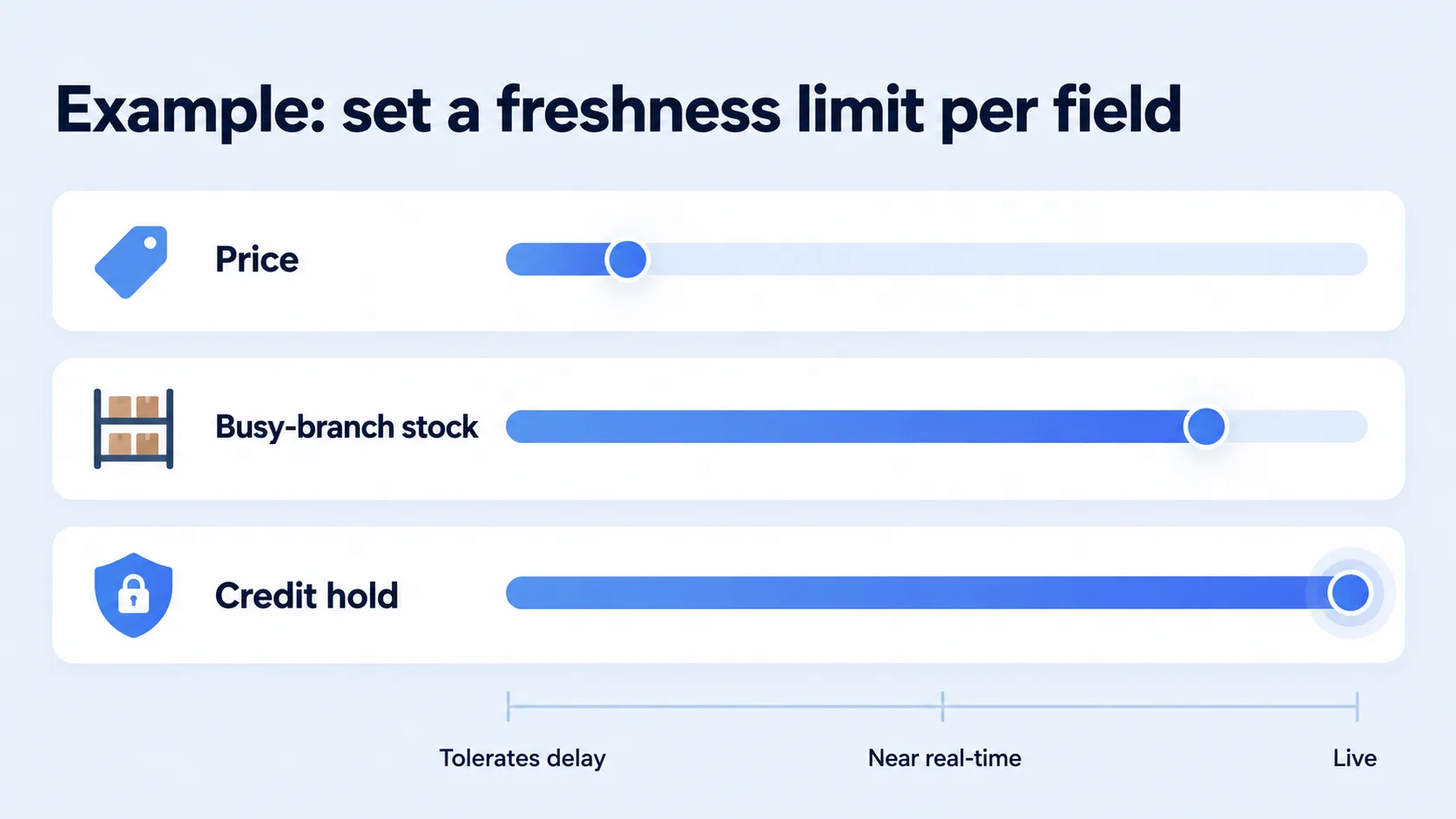
Personalization on stale data costs more trust than no personalization at all. Your storefront shows 60 units in stock at the Dayton branch. At 9 a.m. the ERP moved them to an allocation for another account. At 10 a.m. an AI assistant recommends that SKU to a buyer who orders it, and the rep calls that afternoon to explain a six-week backorder.
The fix is a design decision you make per field: how old can each piece of data be before the answer is wrong? Price might tolerate an hour. Stock at a busy branch might tolerate minutes. Credit hold status should come live on every request. An integration that caches everything on one timer will personalize confidently and wrongly.
AI in eCommerce moves upstream: the shortlist forms before your site
B2B buyers now finish most of their research before they talk to a supplier, and AI is doing more of that research. In a Gartner survey of 646 B2B buyers run in August and September 2025, 67% said they prefer a rep-free experience, and 45% reported using AI during a recent purchase.
Buyers also check what AI tells them. According to Forrester’s State of Business Buying 2026, generative AI search is where business buyers start, but they lean on colleagues and outside influencers to justify decisions. The typical purchase involves 13 internal stakeholders and nine external influencers. Forrester also found that answer engines often return incomplete or unreliable information, which pushes buyers to verify with trusted sources.
Consumer retail shows where traffic is heading. Adobe’s data shows AI traffic to US retail sites up 62% year over year in July 2026, converting 60% higher than non-AI traffic for the 11th month in a row. B2B traffic is smaller, but it moves in the same direction.
For distributors, this creates a real tension. Many B2B sites hide price and stock behind a login for good reasons. An AI engine can’t read what sits behind that login, so it recommends the supplier whose specs, lead times and policies it can read. Publish what you can: specifications, availability ranges, lead times, return and shipping policies. Authenticate the rest. Buyers who move between your portal, a rep and the phone during one purchase raise the stakes further; our guide to omnichannel B2B eCommerce covers keeping those channels consistent.
What AI engines check before they recommend you
Our audits run through five layers, in order, because each depends on the one before:
- Access. Can AI crawlers reach and read your pages, or does a bot rule or a JavaScript-only catalog block them?
- Commerce data. Can they read price, stock, delivery and returns information in a structured form?
- Citable content. Do you publish content an AI engine would quote, such as specs, guides and comparisons?
- Brand accuracy. What do AI engines say about you now, and what do they get wrong?
- Feeds. Are your products in the feeds that AI shopping surfaces pull from?
Our AI-readiness (GEO) audit runs these checks on public data only, with no access to your systems, and returns findings ranked by effort and impact.
AI in ERP: the system of record becomes the system of action
The ERP is where the other three trends land. An agent placing an order, a personalized reorder prompt and an accurate AI answer about your stock all read from the same records.
ERP vendors are moving fast. Gartner predicts that 40% of enterprise applications will include task-specific AI agents by the end of 2026, up from less than 5% in 2025. The same report warns against “agentwashing,” where vendors call a basic assistant an agent. For the wider market view, see our analysis of the AI in ERP market.
You don’t have to wait for your ERP vendor’s roadmap. The Model Context Protocol (MCP) is an open standard that lets an AI tool connect to a business system through one governed adapter, instead of a custom integration for every question. You choose the AI, and you decide what it can see and do.
At TUG Connects 2026, we ran three live demos on Infor CSD through Sirius, our ERP integration layer. No one opened an ERP screen in any of them:
| Role | Question | What happened |
| Customer success | “Where’s my order?” | Found a ball-valve backorder 16 months past its promise date, plus a November copper-fitting shipment that was never invoiced |
| Sales manager | “How is the month tracking?” | Pulled five live ERP datasets into one briefing with charts and priorities in about 15 minutes, a job that used to take 3–4 hours |
| Inside sales | “Are these in stock, and what’s my price?” | Account health, stock across 31 branches, contract pricing and an upsell, with a confirmed quote in under 3 minutes |
The customer success demo found a problem nobody was looking for. The CSR asked about one late order and surfaced an unbilled shipment, because the AI followed the order across releases, invoices and inventory in one pass.
Two design choices make this safe to run in production. Access is read-only by default. Permissions map to the ACL roles you already manage in the ERP, so the AI sees what the user is allowed to see and nothing more. The full walkthrough is in Your ERP already has the answers. If you run Infor CSD, Sirius connects the AI your team already uses to live pricing, inventory, orders and account data. The same layer drives live ERP data into Adobe Commerce, Shopware and Shopify storefronts.
The counterargument: most of this runs ahead of reality
Gartner, the source of the most aggressive B2B forecast, also predicts that over 40% of agentic AI projects will be canceled by the end of 2027 because of rising costs, unclear business value or weak risk controls. The firm estimates that only about 130 of the thousands of vendors selling agentic AI offer real agentic capabilities.
We think the timelines are too aggressive. Few B2B buyers will hand a $40,000 order to an agent without a human approving it in the next two years. Most agentic projects will fail for ordinary reasons: nobody decided what the project should skip, the data underneath was wrong, or the people meant to use the tool never learned how.
The preparation still pays off, even if agents never place an order on their own. Clean product data, authenticated APIs and safe ERP access make your portal faster and your reps better at their jobs today.
People matter as much as plumbing. Byrne Electrical Specialists ran a four-week AI program with Atwix for more than 90 people across six functions, from engineering and finance to compliance. By the end, a recurring internal review that took hours of manual work ran through AI in under a minute. As one participant put it, “It stopped feeling like a toy and started feeling like a tool.”
What to do in the next 90 days
Each step feeds the next, so the order matters.
| Step | Action | Why it comes here | Owner |
| 1. Assess | Run the five checks above and record what AI engines say about you | You can’t prioritize what you haven’t measured | Marketing + eCommerce |
| 2. Decide | Pick one or two AI use cases and write down what you will skip | Unclear value is the top reason agentic projects die | Leadership |
| 3. Train | Get the people who will use AI working hands-on with their real tasks | Tools without trained users stall | Operations + HR |
| 4. Build | Automate one repetitive workflow, such as quote handling or catalog enrichment, with a person approving the output | It proves value before you scale | eCommerce + IT |
| 5. Connect | Give internal teams read-only AI access to the ERP | Every trend above reads from this data | IT |
| 6. Set agent policy | Decide which protocols you’ll support, what data you’ll expose through authenticated APIs, and what an agent can do without approval | It prepares you for buyer agents before the first one arrives | Leadership + IT |
The future of B2B eCommerce
The storefront stays, but it stops being the only way in. Buyers will reach you through AI answers, procurement agents, reps working in an AI conversation and your portal, often in the same week. Each of those paths ends at the same place: your ERP data, and whether software can read it accurately and act on it safely.
The companies that do well won’t be the ones with the loudest AI messaging. They will be the ones whose price, stock and account data is correct, current and reachable.
If you’re not sure where your gaps are, start with the audit. It runs on public data, needs no access to your systems, and turns findings into backlog tickets your team can work on. Request your AI-readiness audit.
Frequently Asked Questions
Got some questions? We’re here to answer. If you don’t see your question here, drop us a line with out Contact form.
What is agentic commerce?
Agentic commerce is buying and selling in which AI agents research, compare, negotiate and complete purchases on behalf of a person or company, within rules they set. In B2B, that means a customer’s purchasing software can check your contract price and stock and place an order, often with a person approving the result.
What is the difference between agentic AI and agentic commerce?
Agentic AI describes AI systems that plan and take actions toward a goal instead of only answering questions. Agentic commerce applies agentic AI to buying and selling: finding products, comparing suppliers, negotiating and checking out.
How does AI personalization work in B2B eCommerce?
It combines account data from the ERP, such as contract prices, approved SKUs and order history, with on-site behavior to tailor search, catalogs and reorder prompts to each account and role. Its accuracy depends on data freshness: personalization built on stale stock or price data produces confident wrong answers.
How is AI used in ERP systems?
Teams use AI to query ERP data in plain language, build reports and briefings, investigate orders and handle quotes without learning ERP screens. Open standards such as the Model Context Protocol (MCP) let companies connect the AI tool of their choice to the ERP, with read-only access and existing role permissions as the safe starting point.
Will AI agents replace B2B sales reps?
Not for complex or high-value deals. Gartner found that 67% of B2B buyers prefer a rep-free experience, but Forrester’s research shows buyers still verify AI output with trusted people before committing. Reps who can answer with live ERP data in minutes become more valuable, not less.
What are the biggest B2B eCommerce trends in 2026?
The four with the most impact are agentic commerce, hyper-personalization, AI-led product discovery and AI inside ERP systems. All four depend on accurate, real-time ERP data that software can read safely.