
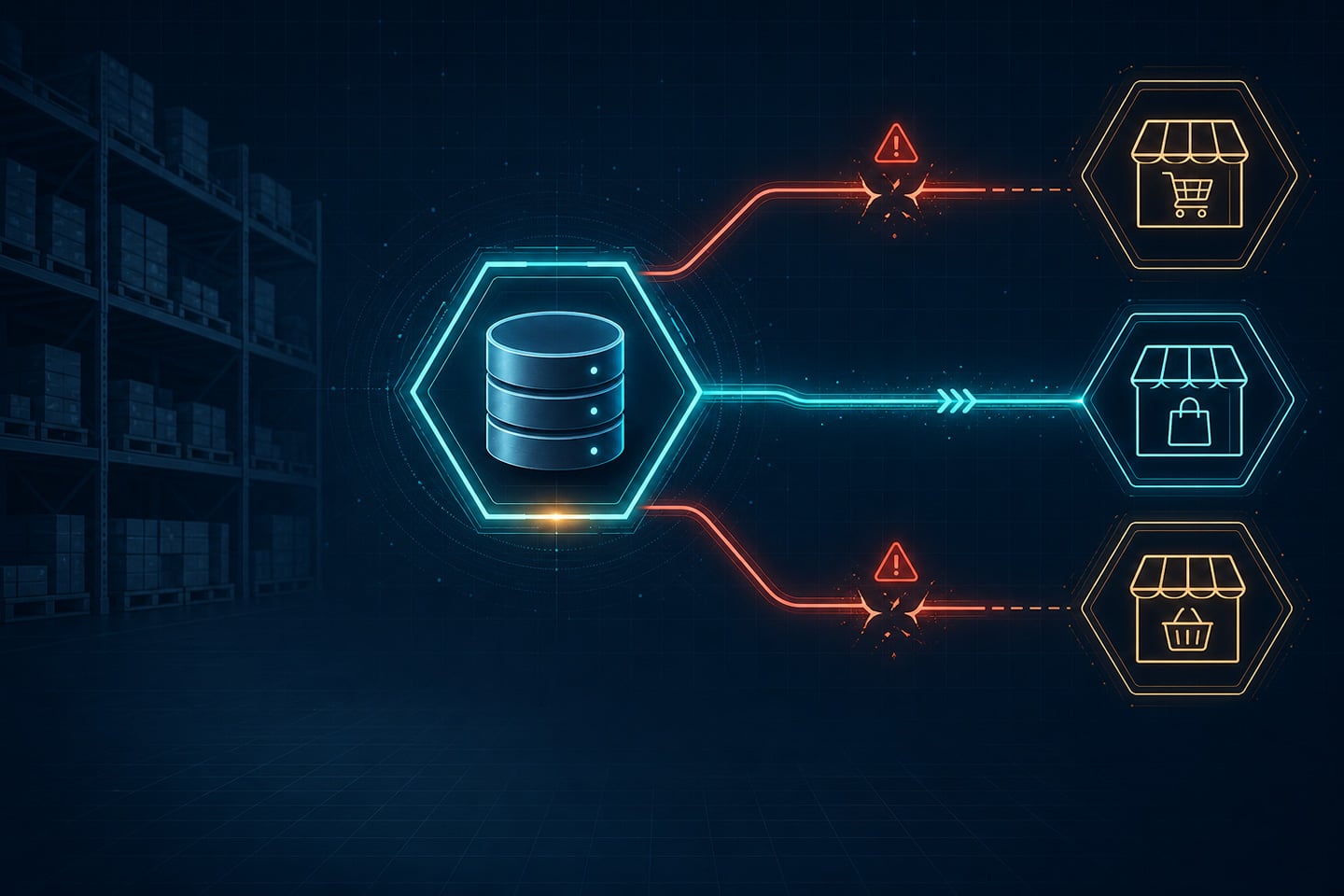

If you’re researching Prophet 21 integration to connect P21 to a Magento 2 / Adobe Commerce, Shopware 6, or Shopify storefront, the architecture you choose matters more than any other decision in the project. This article focuses specifically on the eCommerce use case. The question isn’t whether to connect it; it’s how to do it, or redo it, without breaking your pricing, inventory, or checkout experience. Most distributors find that generic integration tools treat P21 like any other ERP, and that assumption is what turns an eCommerce launch into a recurring support problem.
Custom Build vs. Pre-Built Connector: The Real Cost of Prophet 21 Integration
The approach you choose determines both your upfront cost and how often you’ll be paying a developer to fix it. The table below compares the two dominant paths using published timelines, verified Sirius specifications, and typical build costs for custom ERP integration projects.
| Factor | Custom Build | Pre-Built Connector (Sirius) |
|---|---|---|
| Initial development cost | $100K+ | Subscription / project based |
| Go-live timeline | 6–12 months | 6–12 weeks |
| P21 update compatibility | Manual re-coding required | Atwix-managed connector updates |
| Field mapping | Hardcoded; breaks on schema changes | Configurable; updated by Atwix when P21 schema changes |
| Inventory sync model | Batch sync by default | Real-time bidirectional |
| Contract pricing support | Must be custom-coded per rule set | Native P21 price matrix resolution |
| Account hierarchy support | Custom logic required | Built into connector |
| Centralized monitoring | None or separately built | Standard dashboard included |
Deployments of Sirius, Atwix’s pre-built ERP connector, are 60% faster than custom builds, and every P21 update that requires re-coding in a custom integration erodes that initial cost advantage.
Why P21’s Complexity Defeats Generic Integrations
P21’s distribution-first design creates data structures that most integration platforms were never built to handle.
Custom P21 modifications. Most distributors have modified their P21 instances over the years, adding custom tables, non-standard order-entry workflows, or proprietary pricing rules. Generic integrations assume a default P21 schema. When those assumptions meet a customized instance, data passes into the wrong fields without triggering visible errors.
High-SKU catalogs. Distributors commonly manage catalogs ranging from tens of thousands to over 500,000 active SKUs, with unit-of-measure variants, manufacturer substitutions, and multi-warehouse availability logic. Batch sync across that volume introduces latency that directly causes overselling. Each SKU also carries custom attributes that hardcoded field maps cannot accommodate as the catalog evolves.
Contract pricing and account hierarchies. P21 allows a single SKU to carry multiple simultaneous price records, tied to individual accounts, customer classes, and contracts with specific effective-date ranges. The correct price must resolve in real time from P21 at checkout, not from a cached field in the middleware. Generic tools either cache a single price at sync time or call the wrong API endpoint, serving list price to buyers with negotiated contract rates.
The 3 Points Where Prophet 21 Integrations Break
Most P21 eCommerce integrations don’t fail at launch. They fail months later, once real transaction volume exposes the integration’s structural limits.
Hardcoded field mapping. When developers map P21 data fields directly to eCommerce platform fields in code, any P21 schema change breaks the connection. A platform update, a new custom field, or a product attribute addition can orphan entire data flows. The integration looks functional until orders start missing critical data or writing to the wrong fields, with no error surfacing in the middleware logs.
Batch sync lag causing overselling. Scheduled batch sync, whether every 15 minutes or every hour, create windows where phone orders, warehouse activity, or EDI transactions consume P21 inventory. The eCommerce storefront still shows those units as available. B2B buyers place orders against inventory that no longer exists, triggering cancellations, manual corrections, and account trust erosion.
Pricing edge case logic breaking at checkout. P21 supports contract pricing, volume tiers, account-specific rates, and promotional overrides simultaneously. Generic integrations capture list price at sync time but fail when a logged-in buyer’s contract rate requires the integration to call P21’s pricing API in real time. The buyer sees the wrong price at checkout: either overpaying or opening a dispute that kills the order.
How Sirius Is Built for P21
In Atwix’s 20 years of ERP integration experience, pricing failures are the most expensive to fix post-launch because they reach buyers before operations teams catch them. Sirius addresses each issue at the data-flow level, not through workarounds added after deployment.
No outages or downtime for P21 updates. Sirius is built so that P21 schema changes do not break the integration. Atwix monitors platform changes and proactively updates connectors, removing the re-coding cycles that make custom builds expensive to maintain.
Real-time bidirectional sync eliminates the overselling window. When a P21 order is processed through any channel, including phone, EDI, or warehouse activity, inventory updates propagate to the eCommerce storefront immediately.
Native contract pricing resolution. Sirius calls P21’s pricing API in real time at checkout to determine the correct contract rate for each buyer account. Volume tiers, promotional overrides, and account-specific rates all pass correctly; buyers see their negotiated price before they submit the order.
Centralized monitoring dashboard. Operations teams track sync status, view error logs, and identify issues before buyers report them. Atwix resolves 98% of support issues within 4 hours, giving internal teams the visibility to proactively catch anomalies.
Frequently Asked Questions
Does Sirius sync order status and fulfillment updates back to the eCommerce storefront?
Yes. Sirius’s bidirectional sync sends order status, tracking information, and fulfillment updates from P21 back to the storefront in real time. B2B buyers see accurate order status without your team manually entering updates or managing a separate notification workflow.
What does the Sirius implementation process look like for a heavily customized P21 instance?
Every Sirius deployment begins with a discovery phase in which Atwix maps your specific P21 configuration, including custom tables, modified workflows, and non-standard pricing rules, before any connector configuration begins. We adapt Sirius’ configuration to match your existing schema. Most P21 deployments go live in 6–12 weeks; the timeline within that range reflects the number of systems connected and the complexity of your P21 configuration.
Can Sirius sync one P21 instance to multiple eCommerce platforms simultaneously?
Yes. Sirius connects P21 to Magento 2 / Adobe Commerce, Shopware 6, and Shopify via a single unified GraphQL endpoint. Multi-platform sync requires no duplicate configuration.
Are there data volume limitations for high-SKU distributors?
No. Sirius is built on Symfony, Redis, and RabbitMQ to support enterprise-scale operations with thousands of daily orders and real-time inventory updates across multiple warehouses.
What is the typical ROI timeline for replacing a custom build with Sirius?
Most Atwix clients achieve ROI within 6–12 months through reduced manual labor costs, eliminated integration developer time, and revenue gains from real-time inventory accuracy.
P21 Integration Failures Are Preventable: Start With the Right Architecture
Most Prophet 21 integration failures are not caused by P21 being difficult to connect. They result from integration architectures that underestimate P21’s pricing complexity, catalog scale, and ongoing update cadence. The distributors who avoid recurring failures choose tools designed specifically for P21’s data model: real-time sync, automatic P21 compatibility, and native contract pricing resolution. Sirius by Atwix delivers all three, without requiring custom development every time P21 releases an update. Schedule your Sirius integration assessment with Atwix.