
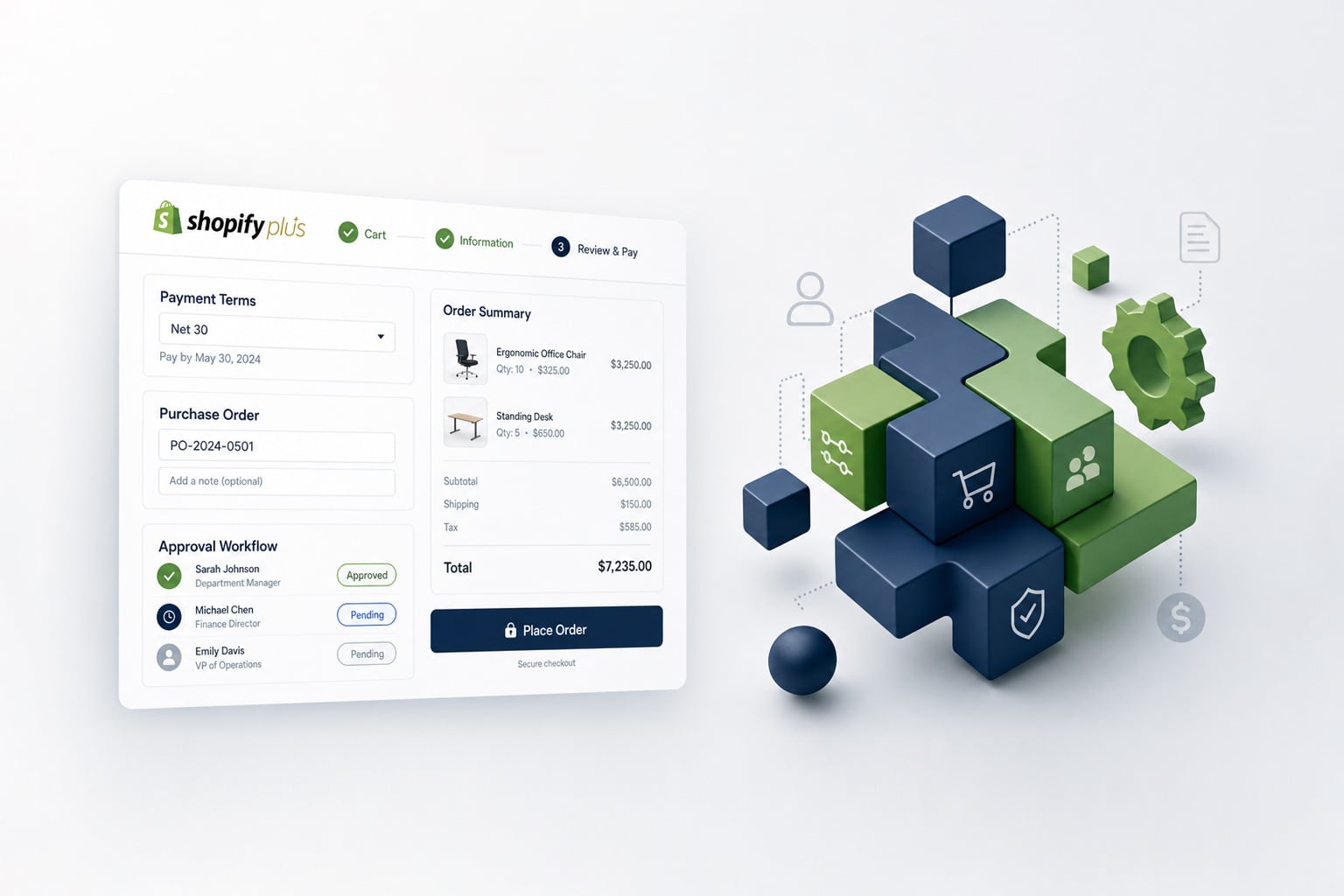

Shopify’s standard checkout converts D2C transactions beautifully. For B2B buyers navigating procurement workflows, net payment terms, and purchase order requirements, that same checkout becomes a deal-killing friction point. Research from Baymard Institute shows that 39% of online shoppers abandon purchases due to unexpected costs, 18% due to complicated checkout processes, and 10% due to insufficient payment methods.
While Shopify expanded native B2B features to all plans in April 2026, the checkout customization capabilities that power true B2B procurement automation remain exclusive to Shopify Plus. Shopify Plus checkout customization via Checkout Extensibility and the Shopify Functions API transforms the checkout process from a procurement obstacle into a B2B revenue engine.
Why Standard Shopify Checkout Limits B2B At Scale
Online shopping carts are abandoned at an average rate of 70.22%, and the reasons expose a fundamental mismatch between consumer checkout and enterprise procurement.
- Unexpected costs: 39% of shoppers cite extra costs such as shipping, taxes, and fees as abandonment triggers. For B2B buyers, unexpected costs go beyond shipping; they need visibility into payment terms, credit limits, and net payment schedules before committing to large orders.
- Insufficient payment methods: 10% abandon when checkout doesn’t offer their preferred payment options. B2B buyers require ACH transfers for large orders, wire payment confirmations, credit account applications, and most critically, Net 30/60/90 payment terms that align with their procurement cycles.
- Checkout complexity: 18% leave when the checkout process is too long or complicated. Paradoxically, B2B checkouts require more fields (PO numbers, department codes, delivery dates, project IDs), but those fields must integrate into procurement workflows rather than add friction.
While Shopify now offers native B2B features across all paid plans, including company accounts, Net 30/60/90 terms, PO number capture, and up to 3 customer-specific pricing catalogs, these foundational tools don’t address the complex checkout logic required by B2B procurement. Standard plans can’t conditionally display payment methods based on customer credit status, apply dynamic pricing rules at checkout, or customize checkout fields beyond basic options. For enterprises with 500+ wholesale customers requiring negotiated pricing, approval workflows, and procurement system integration, these limitations become operational blockers.
D2C Buyer Behavior vs. B2B Procurement Reality
| D2C Buyer Expectations | B2B Procurement Requirements |
|---|---|
| One-time purchase | Repeat orders with negotiated terms |
| Credit card payment | Net 30/60/90 payment terms |
| Immediate checkout | Budget approvals and PO tracking |
| Individual decision-maker | Multi-stakeholder approval workflows |
| Public pricing | Account-specific contract pricing |
| Simple checkout flow | Procurement data capture (PO#, dept codes, delivery dates) |
Shopify Plus Checkout Customization: What Actually Changes
Shopify Plus unlocks Checkout Extensibility and Shopify Functions API, infrastructure that transforms checkout from a fixed D2C flow into a customizable B2B procurement interface.
Checkout Extensibility enables:
- Custom fields at any step: Add PO numbers, department codes, or delivery dates where they belong in your workflow. Fields integrate with order metafields, flowing to ERPs without manual re-entry.
- Conditional display: Show approval indicators only for orders above $10,000. Display tax exemption uploads only for qualified accounts.
- Dynamic payment methods: Show net terms only to approved accounts. Hide credit card details for orders over $25,000.
- B2B validation: Prevent checkout without PO numbers for enterprise accounts. Enforce minimum quantities. Validate delivery dates against production schedules.
Shopify Functions API enables:
- Payment logic based on account attributes: Show Net 30 only to accounts with approved credit, Net 60 for enterprise customers with annual contracts, and credit cards for new accounts.
- Tiered pricing at checkout: Apply customer-specific pricing based on contracts or volume. Logic lives in Functions rather than hard-coded variants.
- Approval workflow triggers: Flag orders above $5,000 for internal approval. Route specific categories to specialized teams.
- Dynamic shipping: Show freight only above weight thresholds. Calculate from customer-specific carrier contracts.
Functions run in Shopify’s infrastructure using WebAssembly for near-instant execution without third-party app latency.
B2B Checkout Features Only Possible on Shopify Plus
- Net payment terms with dynamic logic: While standard plans offer Net 30/60/90 terms via native B2B features, Plus unlocks custom conditional term logic. Custom Shopify Functions API queries customer metafields, evaluates credit limits through external APIs, and dynamically renders specific terms based on real-time account status in milliseconds. Public apps using Functions work on all plans, but custom Functions tailored to your business logic require Plus.
- Advanced purchase order workflows: While standard plans support PO number capture through native B2B features, Plus unlocks advanced PO workflows through UI Extensions, including mandatory field enforcement at payment step, validation against format requirements (alphanumeric patterns, length, prefix rules), conditional display logic, storage in metafields accessible to all systems, and custom invoice formatting.
- Multi-level approval workflows: While Shopify Flow is available on all plans for basic B2B automation, Plus unlocks advanced approval workflows through Checkout Extensibility, enabling checkout completion with “Pending Approval” status for flagged orders, Flow automation to notify stakeholders, Customer Account Extensibility for approval dashboards, and automatic progression to fulfillment.
- Unlimited customer-specific pricing: Standard plans support up to 3 pricing catalogs assigned via Markets. Plus enables unlimited catalogs with direct company or location assignment, volume-based tier application, contract pricing overrides, and hidden pricing that is never publicly visible.
- Custom procurement fields with validation: Extensibility supports delivery dates, department codes, project IDs, handling instructions, and freight account numbers, with conditional display, business-rule validation, and data flow to fulfillment systems.
B2B Checkout Requirements: Standard vs. Plus
| Feature Required | Standard Shopify | Shopify Plus |
|---|---|---|
| Net payment terms display | ✅ | ✅ |
| PO number capture | ✅ (basic) | ✅ (advanced) |
| Approval workflows | ⚠ (Flow only) | ✅ (Flow + Extensibility) |
| Customer-specific pricing | ⚠ (3 catalogs max) | ✅ (unlimited) |
| Custom checkout fields with logic | ✖ | ✅ |
| Dynamic payment method display | ✖ | ✅ |
| Checkout Extensibility | ✖ | ✅ |
| Custom Shopify Functions | ✖ | ✅ |
Frequently Asked Questions
Can standard Shopify plans support B2B checkout requirements?
As of April 2026, standard Shopify plans (Basic, Grow, Advanced) include native B2B features like company accounts, Net 30/60/90 payment terms, PO number capture, and customer-specific pricing via up to 3 catalogs. However, Shopify checkout customization through Checkout Extensibility and custom Shopify Functions remains Plus-exclusive. You can’t conditionally display payment methods based on credit status, add custom checkout field logic beyond basic options, or assign unlimited customer-specific catalogs. Public apps using Shopify Functions work on all plans, but building custom Functions tailored to your business logic requires Plus. For merchants with complex procurement workflows that require dynamic payment-term logic, approval workflows, or 500+ wholesale customers with negotiated pricing, Shopify Plus becomes necessary.
How long does Shopify Plus checkout customization take?
Basic B2B checkout with PO capture, net terms, and customer pricing completes in 6-8 weeks. Complex implementations with approval workflows, ERP integration, and custom Functions can take 12-16 weeks.
What’s the difference between Checkout Extensibility and checkout.liquid?
Checkout.liquid was Shopify’s legacy customization method, deprecated in 2023. Checkout Extensibility replaced it with a component-based system using React and UI Extensions, offering better performance and security. As of August 2025, all Plus merchants must use Checkout Extensibility.
Can Shopify Functions replace third-party B2B apps?
Custom Shopify Functions can replace many apps for payment customization, discount logic, and shipping control. However, complex B2B operations may still need specialized apps for quote management or customer portals. The advantage: custom checkout logic runs natively through Shopify infrastructure rather than relying on third-party availability.
How does Plus checkout integrate with ERP systems?
Plus offers API rate limits up to 10x higher than those of standard plans. Custom fields from UI Extensions are stored in order metafields accessible through the Admin API. Integration middleware or custom APIs sync data to ERPs for order processing and accounts payable. Atwix specializes in ERP integration with NetSuite, SAP, and Infor systems.
Stop Losing B2B Deals to Checkout Friction
With 70% of online shopping carts abandoned and checkout friction costing eCommerce $260 billion in recoverable revenue annually, B2B merchants can’t afford procurement obstacles at checkout. While April 2026’s B2B expansion brought foundational wholesale features to all plans, the checkout customization capabilities that automate complex procurement workflows remain exclusive to Shopify Plus.
For merchants processing $1M+ in annual wholesale revenue with diverse customer pricing needs, Shopify checkout customization through Checkout Extensibility and custom Shopify Functions API typically pays back in under six months. Atwix builds Shopify Plus B2B checkout implementations that reduce abandonment, automate procurement workflows, and integrate with enterprise ERP systems.