
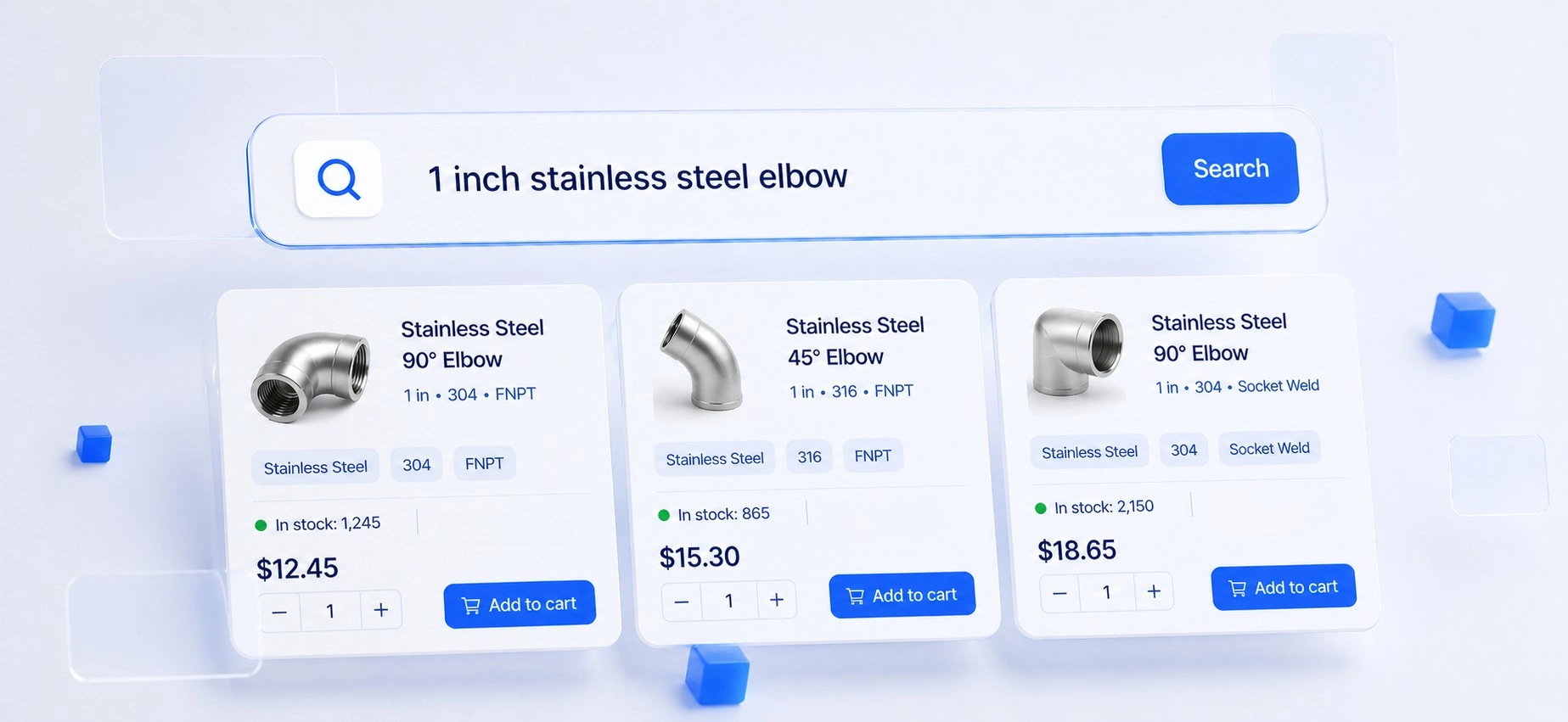

There’s a quiet moment that happens on almost every B2B website. A customer lands on your site already knowing exactly what they need. They go straight to the search bar, type something in, hit enter… and pause.
They scan the results. Scroll once. Maybe twice. Then one of three things happens: they leave, they open a new tab, and/or reach out to your sales team with, “Can you help me find…”
That moment is where revenue leaks. Not because your products are wrong. Not because your pricing is off. But because your site experience didn’t meet the way your customers actually buy. And in B2B, that gap matters more than most teams realize.
Recent UX research from Baymard Institute found that 56% of major eCommerce sites fail to adequately support search – and that’s looking primarily at B2C. In B2B, where buyers know exactly what they need before they hit the search bar, the cost of that friction is even higher.
- B2B Search Isn’t About Discovery. It’s About Getting Things Done.
- Where Things Start to Break: The Data Problem No One Talks About
- The Friction Builds in Small Moments
- The Missing Layer: Customer Context
- The Overlooked Opportunity: Reordering
- What Good Actually Looks Like
- What This Looks Like in Practice
- A Quick Reality Check
- See How Your Search Experience Stacks Up
B2B Search Isn’t About Discovery. It’s About Getting Things Done.
Most search experiences are designed with browsing in mind. That works in B2C. It doesn’t work here. Your customers aren’t exploring. They’re executing.
They already have context. They know the part, the spec, or at least what they think it’s called. They’ve likely ordered it before. They’re not asking your site to inspire them. They’re asking it to help them complete a task quickly and accurately.
When search slows that down, even slightly, people don’t push through. They switch channels. Usually back to email or phone. Now your digital investment is just… a slower version of your sales team.
Where Things Start to Break: The Data Problem No One Talks About
Most B2B product data was never designed for customers. It was designed for operations. That’s why it’s structured the way it is. That’s why naming conventions look the way they do, and why it often makes perfect sense internally but very little sense externally.
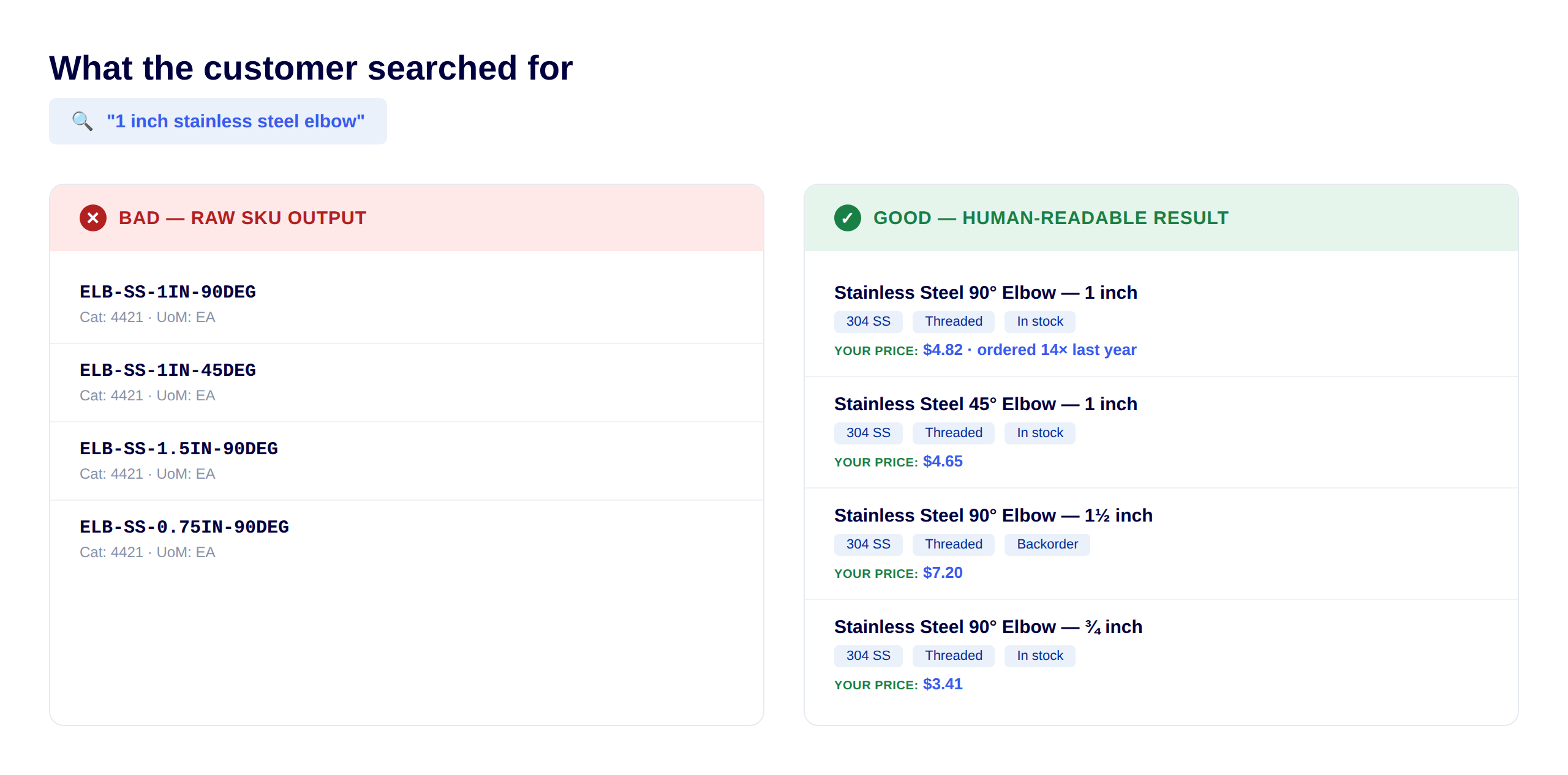
A customer might search for something like: “1 inch stainless steel elbow”
Your system might respond with: “ELB-SS-1IN-90DEG”
Technically? Correct. Practically? Useless.
Good search doesn’t require you to rebuild your ERP. But it does require you to translate it into something customers can actually use.
One of the ways we see this done effectively in the eCommerce ecosystem is with tools like ElasticSuite. Out of the box, it brings a much more flexible search layer that can handle synonyms, partial matches, and relevance tuning in a way default search simply can’t. But like most powerful tools, the real value isn’t in turning it on, it’s in how intentionally it’s configured. The difference between a basic implementation and a well-tuned one is the difference between “search technically works” and “customers actually find what they need in seconds.”
A simple place to start is mapping how your customers describe products versus how your system does. Even identifying the top 50 common search terms and aligning them with your data can dramatically improve results without a major rebuild.
The Friction Builds in Small Moments
Search rarely fails in one obvious way. It fails in small, compounding moments that add friction.
One of the biggest is intent. B2B users don’t type perfect queries. They type fragments, shorthand, old part numbers, and sometimes just guesses. If your search requires exact matches or doesn’t handle partial logic well, you’re asking your users to do extra work just to find something they already know exists. That’s not a great deal.
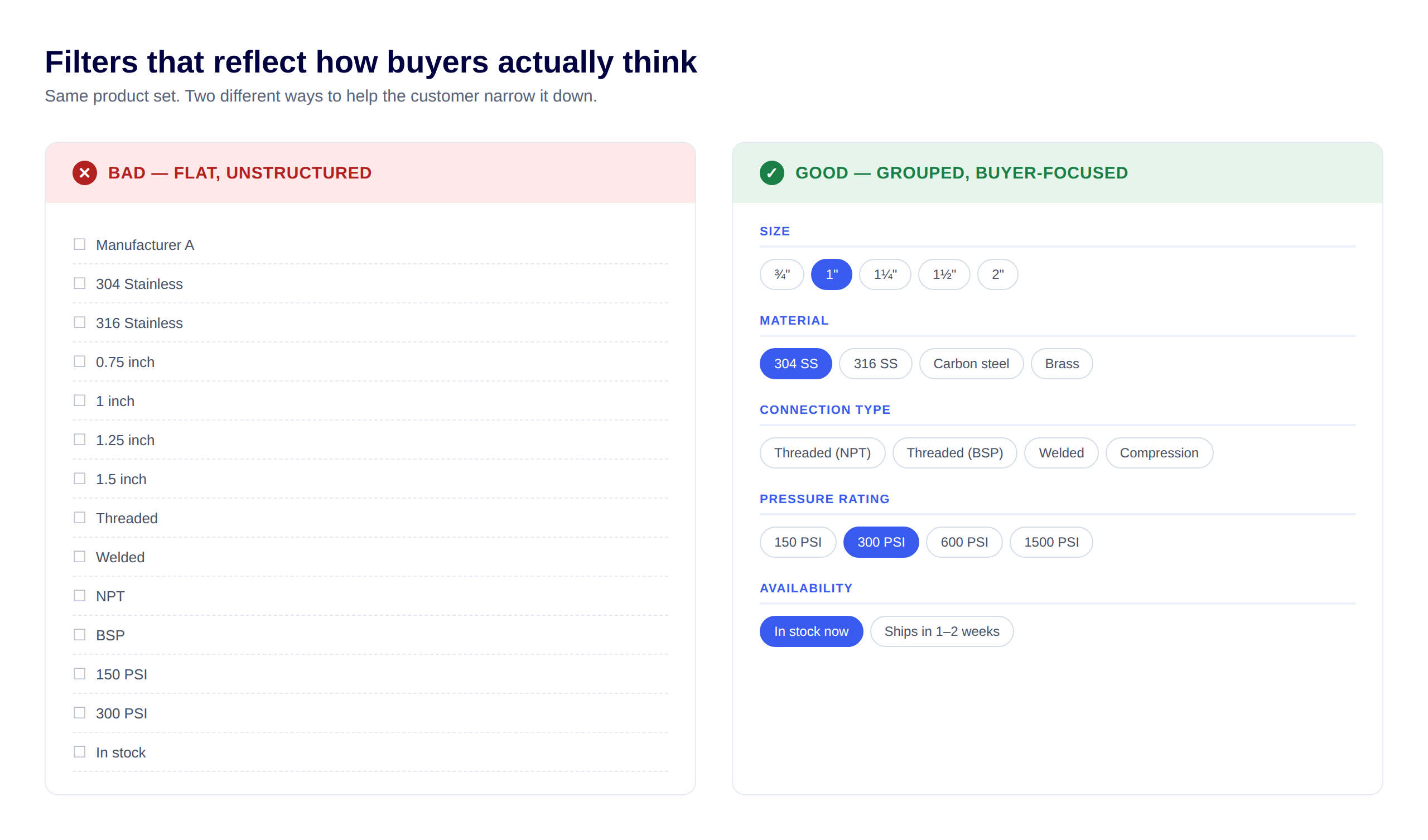
Another common issue is filtering. Filters are often treated as a secondary feature, but in B2B they’re essential. They’re how users make sense of complexity. When filters don’t reflect how customers actually think size, material, compatibility, use case, they stop being helpful and start being overwhelming.
A practical exercise here is to talk to your sales team. Ask them what questions they ask customers when helping them find a product. Those answers should directly inform your filter structure.
This is also where we often see the gap between standard and more advanced search setups. Again, with something like ElasticSuite, you can dynamically build filters based on product attributes and actual usage patterns, not just static data fields. That means your filters can evolve alongside your catalog and customer behavior, instead of becoming outdated the moment your product set changes.
The Missing Layer: Customer Context
This is where search quietly starts costing you real money. Your customers expect to see their pricing, their products, and their history. But many search experiences treat every user the same, showing generic results with no context. That creates hesitation and hesitation usually leads to a workaround.
If a customer has to double-check pricing, confirm availability, or validate that they’re choosing the right item, they’re far more likely to reach out instead of completing the order themselves.
Even small improvements here, like prioritizing previously ordered items or highlighting account-specific pricing, can significantly reduce friction.
The Overlooked Opportunity: Reordering
A large portion of B2B revenue comes from repeat purchases. But most search experiences don’t reflect that reality. Instead of helping users quickly reorder what they already buy, they make them start from scratch every time. If we’re being honest, it’s also a little frustrating when you know the system should be smarter than this.
You don’t need a full redesign to improve this. Start by:
- Surfacing previously ordered items higher in search results
- Adding quick reorder functionality
- Making it easy to recognize familiar products
These are small changes that make a big difference in how fast customers can move.
It’s also worth calling out that not all search setups are created equal. Standard implementations, even with good tools, tend to stop at ‘functional.’ Results appear, filters exist, and technically everything works. But the experience still asks too much from the user. More advanced or premium-level implementations go further. They prioritize relevance, adapt to user behavior, and actively reduce friction in the buying process. That’s where search starts to move from a utility to something that actually drives revenue.
What This Looks Like in Practice
It’s one thing to talk about search in the abstract. It’s another to watch it play out on a real B2B catalog.
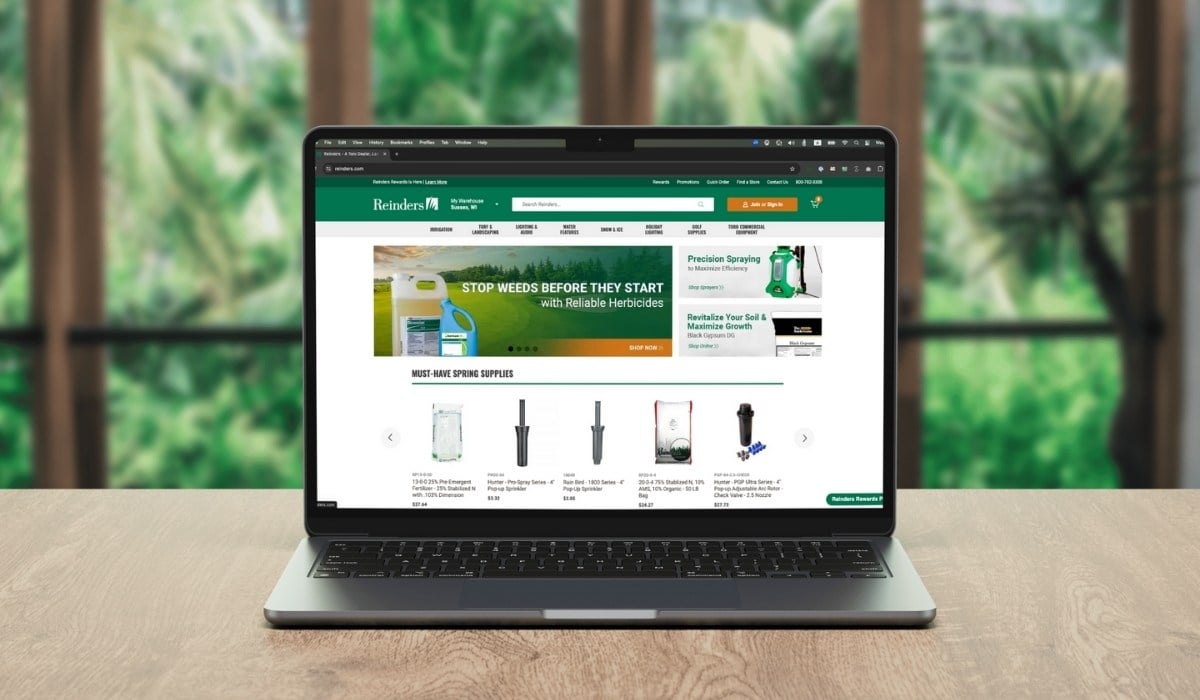
Reinders, a leader in the turf and irrigation industry, ran into exactly the pattern described above. Their customers knew what they needed, but the search experience couldn’t keep up. Results were slow, product listings were overwhelming, and large B2B orders strained the checkout. Customers were digging through pages of items to find a single product — and when that took too long, they did what B2B buyers always do: they picked up the phone, or abandoned the cart entirely. The support team absorbed the difference, fielding the same repetitive “can you help me find…” questions over and over.
The fix wasn’t a rebuild. It was making search actually understand the catalog. We integrated ElasticSuite to deliver more relevant results faster, whether a customer searched by SKU, keyword, or category, and tuned backend performance so the site kept pace even on large-cart checkouts.
The shift was immediate and measurable. Product discovery went from a bottleneck to an asset — customers find what they need in seconds, support stopped fielding the same lookups, and the faster, more reliable experience reinforced the trust those B2B relationships run on. As Jeremy Ott, Director of eCommerce and Digital Marketing at Reinders, put it: “We’re not just seeing better performance metrics — we’re seeing happier customers.”
What Good Actually Looks Like
A strong B2B search experience doesn’t feel impressive. It feels effortless. It understands both your system’s logic and your customer’s language. It allows users to refine results quickly based on real-world needs. It reflects the relationship you already have with your customers. Most importantly, it helps people go from intent to action without friction.
If you’re looking for a place to start, focus on three things:
- Language. Make sure your search can interpret how customers actually describe products, not just how they exist in your system.
- Structure. Align your filters and attributes with how people make decisions, not just how your data is organized.
- Context. Use the data you already have to make the experience feel relevant and personalized.
You don’t need to solve everything at once. Even improving one of these areas can noticeably impact usability and adoption.
A Quick Reality Check
If you’re not sure how your current experience holds up, ask yourself:
- Can a customer find what they need using their own language?
- Can they narrow results quickly without guessing which filters matter?
- Do returning customers see results that reflect their relationship with you?
- Can someone reorder a common product in under a minute?
If the answer is no to any of these, there’s opportunity sitting right in front of you.
See How Your Search Experience Stacks Up
If you want a clearer picture of where your search experience stands, we can take a look with you. We’ll review how your current setup handles product data, search logic, filtering, and whether your search tools are being fully leveraged, customer-specific behavior, and highlight where friction exists and what’s actually worth improving.
No overengineering. No unnecessary rebuilds. Just practical insight based on what we see working across B2B teams.