


In today’s competitive landscape, data-driven decision-making is critical for eCommerce success. If you’re running your online store on Magento or Adobe Commerce, you have access to a powerful analytics tool: Magento Business Intelligence (now officially Adobe Commerce Intelligence). This guide walks you through what changed with the rebrand, what the platform does in 2026, and how to leverage it to grow your eCommerce business.
As one of the top-rated Magento / Adobe Commerce development agencies worldwide, our team has been setting up and improving Magento performance for businesses across the globe since 2006. This extensive experience has given us deep insights into the platform formerly known as MBI — and the AI-driven evolution it has undergone since joining the Adobe Experience Cloud.
What’s New: The Magento BI → Adobe Commerce Intelligence Rebrand
Before diving in, the most important update: Magento Business Intelligence is now officially called Adobe Commerce Intelligence (ACI). Adobe’s own user guide confirms the change, noting that “Adobe Commerce Intelligence was previously known as Magento Business Intelligence.” The product still does what merchants relied on MBI for — but it now sits more deeply inside the Adobe Experience Cloud ecosystem, with expanded AI and predictive analytics capabilities.
Throughout this article, we’ll refer to the platform as Magento Business Intelligence (Adobe Commerce Intelligence) so both names are easy to find for teams transitioning between them.
Understanding Magento Business Intelligence
The eCommerce industry continues to expand at a rapid pace. The global B2B eCommerce market was valued at roughly $24 trillion in 2025 and is projected to reach $105.85 trillion by 2033, at a CAGR of around 20.9% (Grand View Research). The International Trade Administration projects the global B2B eCommerce market to hit $36 trillion in 2026, growing at a 14.5% CAGR through the end of the decade. Either way, the takeaway is the same: competition is intensifying, and store owners need smarter analytics to win.
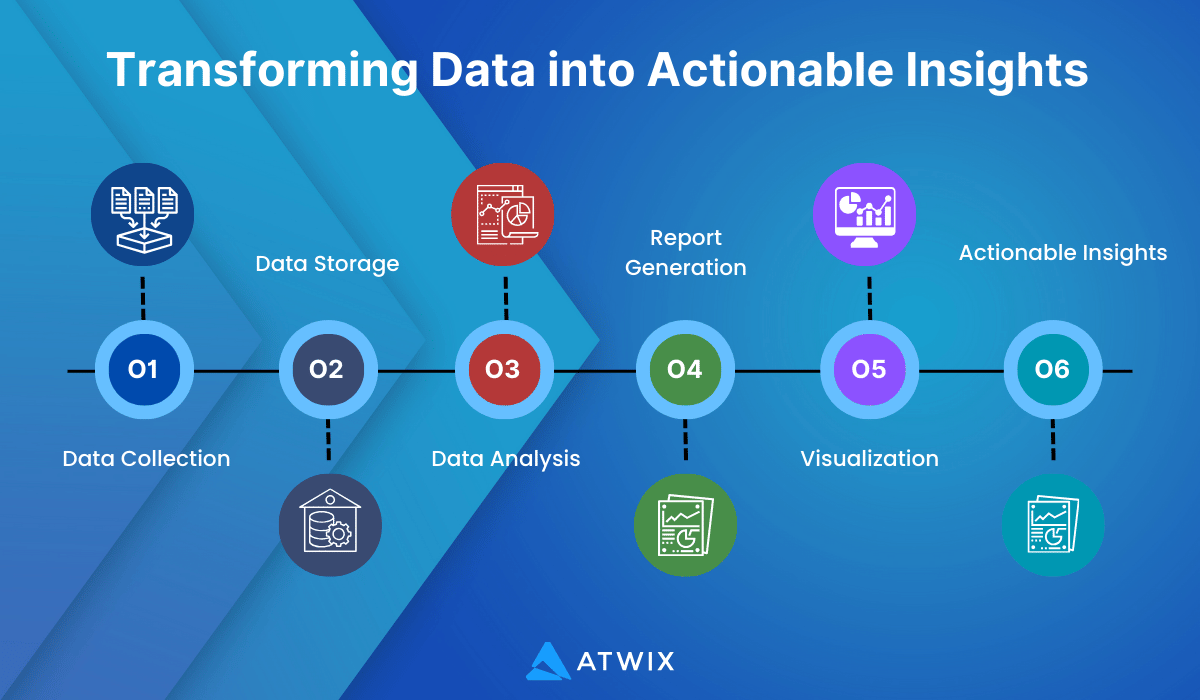
Magento Business Intelligence (Adobe Commerce Intelligence) is a cloud-based analytics platform designed specifically for eCommerce businesses. It collects, models, analyzes, and visualizes data from your Magento / Adobe Commerce store and other connected sources, surfacing the insights you need to make informed decisions.
Online stores generate an overwhelming amount of data — page views, conversion rates, repeat purchase rates, cohort retention, AOV, customer lifetime value, and much more. All of it needs to be organized, validated, and modeled before it can be effectively analyzed.
That’s exactly where MBI / Adobe Commerce Intelligence shines. It consolidates your data into a single source of truth and presents the insights through dashboards and pre-built reports, giving you a detailed view of your operations so you can refine your business strategies confidently.
Benefits of Using Magento BI For eCommerce Businesses
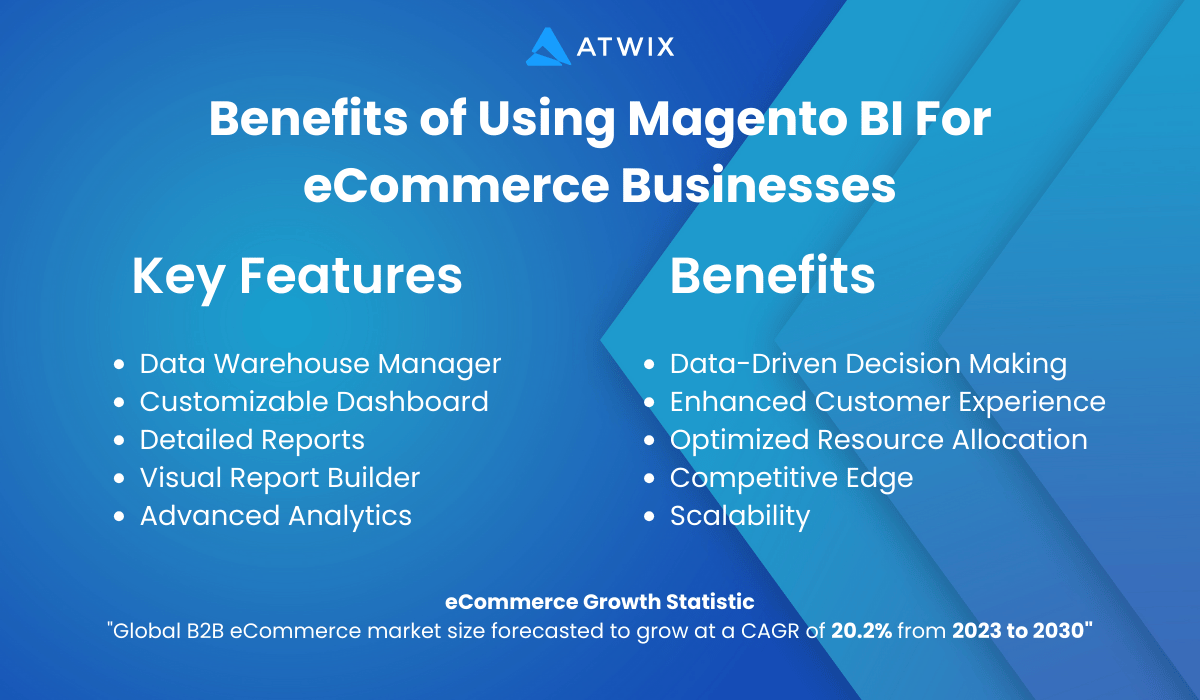
Implementing business intelligence with Magento can benefit your eCommerce business in several ways:
- Data-Driven Decision Making: Make informed choices based on actual data rather than assumptions. Gaining insights about your customers and their behavior can help you make your sales and marketing strategies more efficient.
- Enhanced Customer Experience: Design a better customer experience by creating different user segments and sending personalized offers. This, in turn, can help boost customer loyalty and satisfaction.
- Optimized Resource Allocation: Gain insights into your business performance and marketing spending, allowing you to allocate costs wisely and take timely actions when necessary.
- Competitive Edge: Stay ahead of your competitors by spotting various trends and useful opportunities earlier than other companies.
- Scalability: Magento BI supports increases in data complexity and volume, ensuring that you’ll always have access to valuable information as your business grows.
Implementing business intelligence with Magento / Adobe Commerce can benefit your eCommerce business in several ways:
- Data-driven decision-making. Make informed choices based on actual data rather than assumptions. Insights about your customers and their behavior can sharpen your sales and marketing strategies.
- Enhanced customer experience. Build a better customer experience by creating user segments and sending personalized offers — boosting loyalty and satisfaction.
- Optimized resource allocation. Gain visibility into business performance and marketing spend so you can allocate budget wisely and take timely action.
- Competitive edge. Stay ahead of competitors by spotting trends and opportunities earlier.
- Scalability. ACI scales with you as your data complexity and volume grow.
- AI-powered insights. The platform now delivers AI-assisted analytics, including predictive forecasting and anomaly detection, on top of standard reporting.
Features and Tools of Magento BI / Adobe Commerce Intelligence
To understand the power and potential of the platform, let’s explore its main features and tools.
1. Data Warehouse Manager
The Data Warehouse is a cloud-based storage layer that holds all your valuable eCommerce data. It’s accessible from any device when you log into your account. The Data Warehouse Manager lets you:
- Discover and connect data from multiple sources
- Add information to tables
- Build charts and reports
- Analyze information in near real-time
2. Customizable Dashboards
When you activate an Adobe Commerce Intelligence account, you get access to five dashboards with approximately 70 pre-built reports — designed to answer questions like “How are my orders growing month-over-month?”, “Who are my most loyal customers?”, and “Is my coupon strategy working?” You can:
- Display specific data sources or view all data at once
- Set up report frequency and email distribution
- Manage dashboard permissions and access for different team members
3. Detailed Reports
The platform offers a variety of report types out of the box:
- Purchase date history — Analyze when customers make the most purchases so you can predict sales and optimize timing for specific segments.
- Data history reports — Pull historical datasets for marketing tools and deeper analysis.
- ROI for marketing and ad campaigns — Track orders, inventory, and channels that drive your most valuable customers.
- Customer lifetime value predictions — Estimate how much each client is likely to spend at your store and use that data to target your most profitable customers.
4. Visual Report Builder
The Visual Report Builder turns raw data into clear visuals through an intuitive interface that lets you:
- Create custom reports and dashboards without advanced technical skills
- Visualize data through a variety of chart types
- Apply filters and segments to drill into specific subsets
- Schedule automated report updates and email distributions
5. Advanced and AI-Powered Analytics
Adobe Commerce Intelligence has expanded well beyond basic reporting in recent years:
- Predictive analytics to forecast future trends and customer behavior
- Cohort analysis to understand customer lifetime value and retention
- Segmentation tools to identify and target specific customer groups
- Attribution modeling to measure the effectiveness of your marketing channels
- AI-assisted insights, which complement the broader Adobe Sensei GenAI capabilities now available across Adobe Commerce (for example, in Product Recommendations and Content Generation)
What Sets Magento BI / Adobe Commerce Intelligence Apart
Here’s why ACI stands out from other BI solutions for eCommerce:
1. Seamless platform integration
Connecting analytics platforms to your eCommerce stack can be painful. Adobe Commerce Intelligence integrates directly with your Magento / Adobe Commerce store, pulling data from your customer database — purchase history, demographics, wishlists, entry sources, and shopping behavior — without manual ETL work.
2. Self-service reporting
The platform makes it easy to:
- Track lead statuses and performance indicators with B2B reports
- Export reports in CSV, Excel, PNG, SVG, and PDF for easy sharing
- Send reports manually or on automated schedules
3. Business performance tracking
The platform uses revenue distribution to help you identify the top-performing categories and the customer segments that spend the most. You can also model customer lifetime value based on store performance — tracking page views, churn rates, user sessions, and conversions.
4. No manual data entry
Adobe Commerce Intelligence eliminates the need for time-consuming and error-prone manual data entry. It connects to commonly used SaaS databases and tools, pulls data automatically, and refreshes on a schedule — freeing your team to focus on analysis rather than data wrangling.
5. Tighter ROI measurement
Using revenue data, ad costs, and AOV from your store, the platform calculates campaign ROI and helps you spot and forecast trends in client retention.
6. Data interpretation and visualization tools
ACI ships with a ready-made set of visualization tools so reports, dashboards, and charts can be built with just a few clicks.
7. Adobe-backed support
Setting up new analytical tools can be challenging. Adobe provides documentation, webinars, and a dedicated support team for Commerce Intelligence customers — useful for data integration, custom report design, and troubleshooting.
Integration with Magento / Adobe Commerce
Connecting Adobe Commerce Intelligence to your store generally involves:
- Creating your Commerce Intelligence account and verifying your email
- Adding store information
- Logging in and inviting users with the appropriate permissions
- Adding a permanent user to your Commerce project
- Generating and adding SSH keys
- Updating the relevant configuration files and accessing database connection info
- Completing the “Connect your database” form
- Entering your encryption settings
- Saving the integration to complete setup
Adobe regularly updates the connector flow — for the most current step-by-step instructions, check the official Commerce Intelligence User Guide on Adobe Experience League, or talk to a certified partner like Atwix.
Best Practices and Implementation Strategies
To get the most out of Magento BI / Adobe Commerce Intelligence:
- Define clear objectives. Spell out what you want to achieve before configuring dashboards.
- Pick relevant metrics and KPIs. Prioritize the metrics tied to your business goals and that drive action.
- Build custom dashboards. Tailor dashboards to specific roles and use cases so each team sees what matters most.
- Review and refine reports regularly. As your business evolves, retire stale reports and create new ones.
- Invest in user training. Make sure every user can navigate the platform, build reports, and act on the insights.
- Lean into AI features. Use predictive and AI-assisted insights to spot trends earlier and reduce manual analysis time.
For a detailed walkthrough of this process, consider consulting with our Magento experts or referring to official Magento documentation.
Adobe Commerce Intelligence Pricing in 2026
Pricing for Adobe Commerce Intelligence is quote-based — Adobe does not publicly disclose figures. In Adobe’s current product description, Commerce Intelligence is offered:
- As an upgrade to an Adobe Commerce Base Package (on Cloud or On-Premise)
- As part of an “Intelligence Bundle” sold together with Adobe Commerce on Cloud
- As a standalone package for customers who want the analytics layer separately
Final cost depends on factors like GMV, transaction volume, the features you need, and the size of your business. Adobe Commerce as a whole is now offered in two main deployment models: the traditional PaaS / on-premise editions and the newer Adobe Commerce as a Cloud Service (ACCS) introduced in mid-2025. To get exact numbers for your business, contact Adobe directly or work with an experienced partner like Atwix.
Is Magento BI / Adobe Commerce Intelligence Right for Your Business?
Every business is different, but ACI is a powerful platform that can benefit merchants of various sizes. It helps companies:
- Make data-driven decisions faster
- Determine customer value and build optimal growth strategies
- Analyze client behavior and introduce new products informed by data
- Analyze products and vendors to surface new sales opportunities
Consider Adobe Commerce Intelligence if you want to:
- Strengthen your data analysis capabilities
- Improve customer targeting and personalization
- Optimize marketing and sales strategies
- Scale your eCommerce operations efficiently
- Plug analytics into a broader Adobe Experience Cloud setup
Conclusion
Every eCommerce business benefits from smart, detailed analytics — and Magento Business Intelligence (now Adobe Commerce Intelligence) is built to deliver exactly that. The platform automatically collects data from connected sources, structures and processes it, and presents insights through dashboards and AI-assisted reports.
Gain actionable insights to drive your eCommerce success.
Reach out to Atwix today and find out how our solutions can help you

Setting up and optimizing analytics tools can be challenging if you’re not familiar with them — but you don’t have to do it alone. As a top-rated Magento / Adobe Commerce development agency, Atwix has been working with the platform since 2006. We can help with everything from initial consultations to ongoing support of your store and your analytics stack.
By leveraging Adobe Commerce Intelligence and partnering with experienced professionals, you can turn your data into actionable insights — and drive sustainable growth for your online store. Reach out to discuss how it can transform your business.